
During a damp concrete slab pour, a carpenter foreman sees a worker plugging a corded circular saw into a temporary 120-volt spider box receptacle whose GFCI test button is broken, with no assured equipment grounding program on site. What should the foreman require?
Select an answer to reveal the explanation.
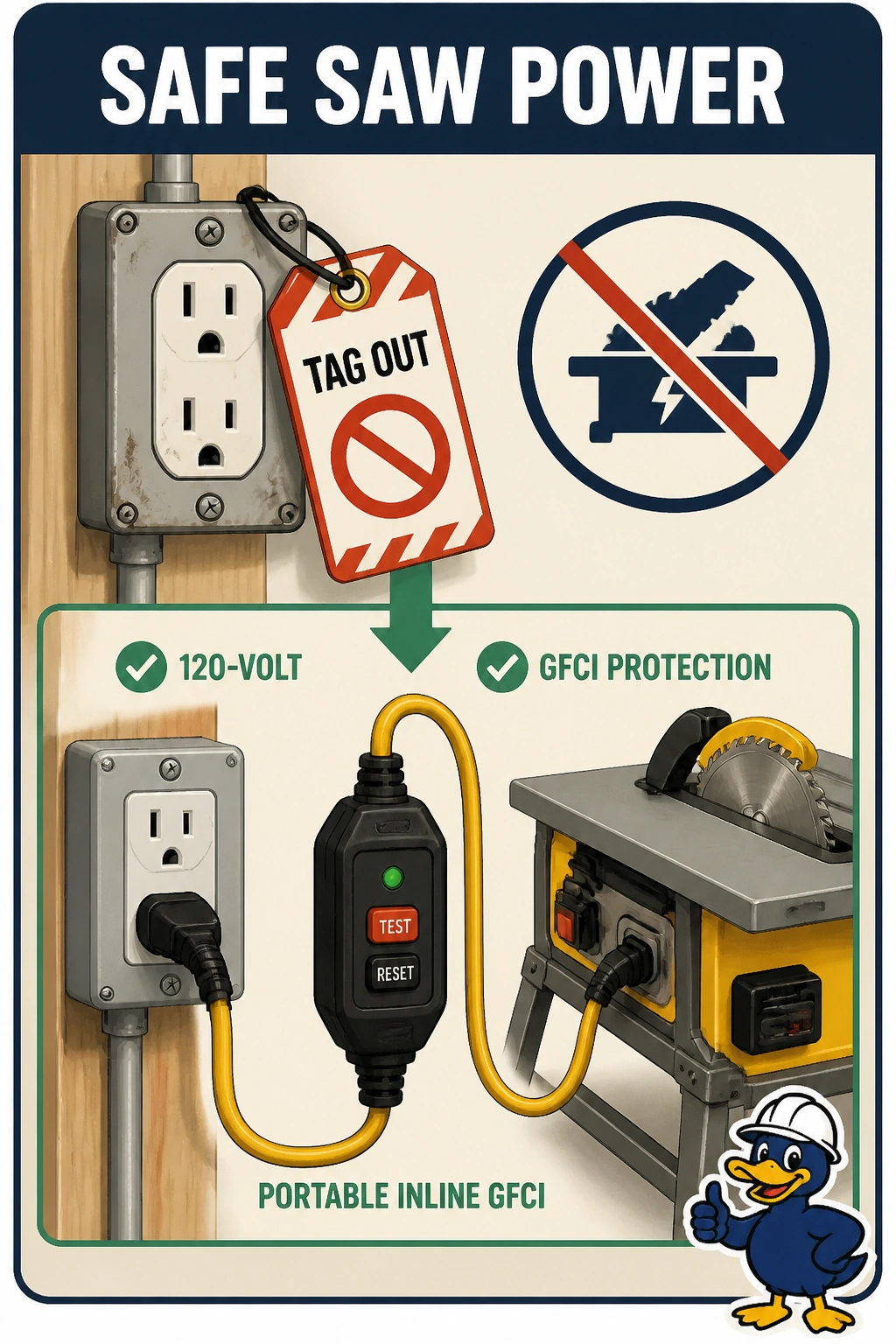
Short Explanation
Electricity and damp concrete are a deadly pair, and a broken test button means you cannot trust the safety net. Don't fall for the trap of relying on dry gloves or heavier cords—lock out the bad outlet and put real GFCI protection in line.
Full Explanation
Under 29 CFR 1926.404, all 120-volt, single-phase 15- and 20-ampere temporary receptacle outlets on construction sites must have approved ground-fault circuit-interrupter (GFCI) protection when no assured equipment grounding conductor program is in place, so the foreman must Tag out the defective receptacle and require a verified GFCI-protected circuit or portable inline GFCI before using the saw. A GFCI detects small current imbalances and trips rapidly to prevent fatal electrocution if moisture bridges the tool housing. Choosing to Allow the saw to run if the worker wears dry leather gloves and rubber-soled boots relies on non-insulating PPE that quickly saturates on a wet slab and is not an OSHA substitute for GFCI protection. Choosing to Tape the reset button down temporarily so the saw finishes the remaining deck cuts defeats the safety mechanism and is strictly prohibited. Choosing to Switch to a heavier-gauge extension cord to reduce voltage drop across the wet slab addresses power delivery, not ground-fault shock protection. Caveat: a GFCI protects against line-to-ground faults, not phase-to-phase contact, so inspect cords for nicked insulation too. As an operational check, press the GFCI test and reset buttons on temporary power boxes at the start of each shift.
Prefer to study offline? Printable PDF study book + test engine ($7.50, unofficial). These questions stay free here.