
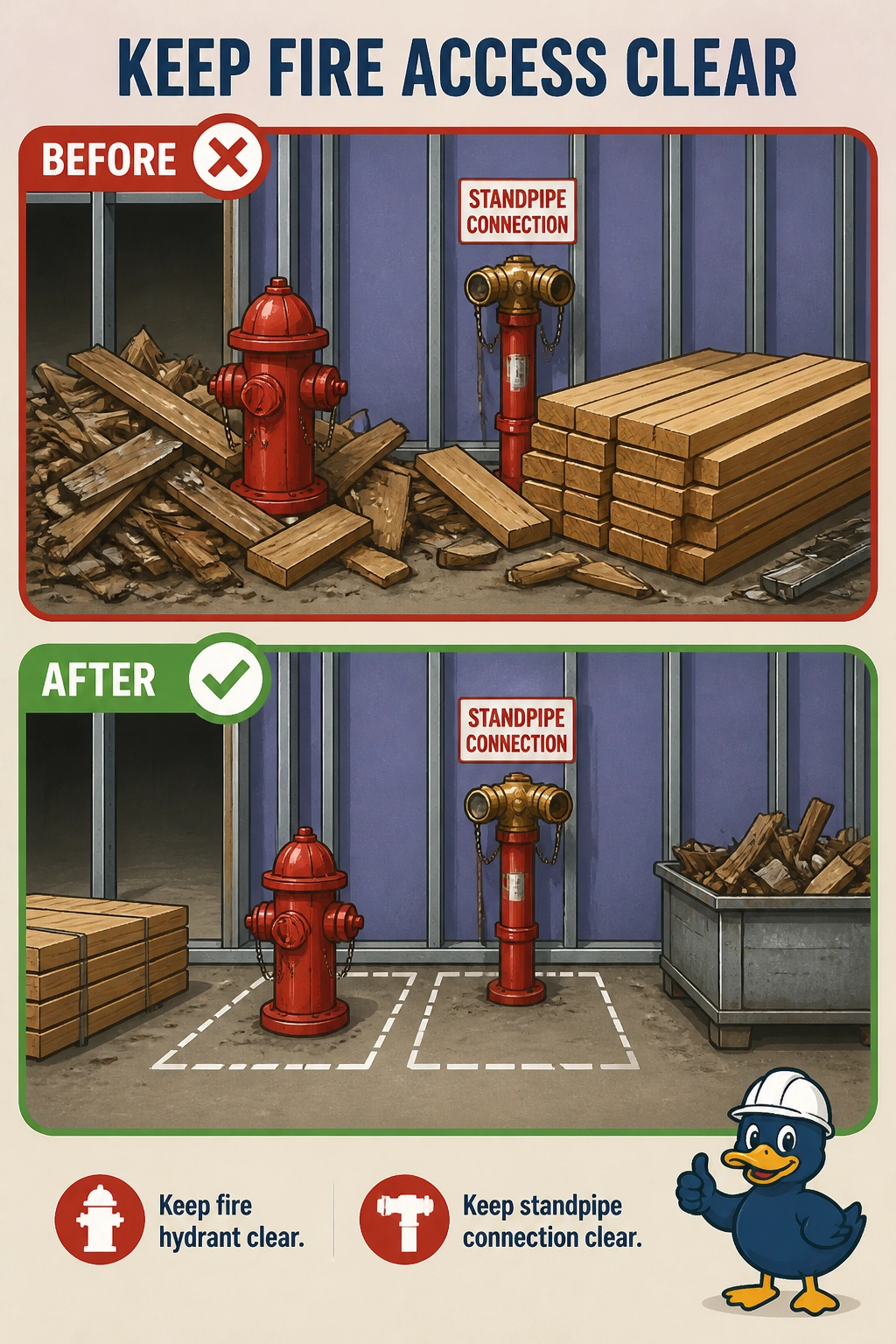
On a multi-story wood-frame apartment build, a framing crew stacks pallets of lumber and piles of scrap sheathing directly around the site's only temporary fire hydrant and standpipe connection. What must the site supervisor require immediately?
Select an answer to reveal the explanation.
Short Explanation
A fire hydrant buried behind lumber pallets might as well not exist when flames start climbing wood framing. You must relocate the lumber and scrap piles to keep the fire hydrant and standpipe clear at all times. The trap is thinking an orange flag or a portable extinguisher on the stack replaces unobstructed firefighter access.
Full Explanation
Under OSHA 29 CFR 1926.150, fire-fighting equipment and water-supply connections must be conspicuously located and kept unobstructed at all times so crews and responding fire departments can hook up hoses without delay. The supervisor must Relocate the lumber and scrap piles to keep the fire hydrant and standpipe clear so hose couplings and valve stems are immediately accessible from the fire lane. Choosing to Hang a bright orange flag above the lumber stack so firefighters can spot the hydrant still forces responders to waste critical minutes moving heavy pallets during a fast-moving wood-frame fire. Choosing to Leave the lumber stacked there until Friday's scheduled sitewide housekeeping cleanup leaves the site's primary fire-protection water connection blocked for days. Choosing to Place a single dry-chemical extinguisher on top of the lumber pile as a backup provides minimal capacity that cannot substitute for a pressurized hydrant and standpipe on a multi-story structure. Caveat: maintain clear vehicle access to the hydrant as well as physical clearance around the outlet threads. Operational check: mark a high-visibility no-storage perimeter around every hydrant and standpipe connection and verify it during daily site walks.
Prefer to study offline? Printable PDF study book + test engine ($7.50, unofficial). These questions stay free here.