
A commercial roofing crew is installing insulation and membrane on a flat warehouse roof 22 feet above the ground using a warning line system combined with a safety monitoring system. At what minimum distance from the roof edge must the warning line be erected on all sides where mechanical equipment is not being used?
Select an answer to reveal the explanation.
Short Explanation
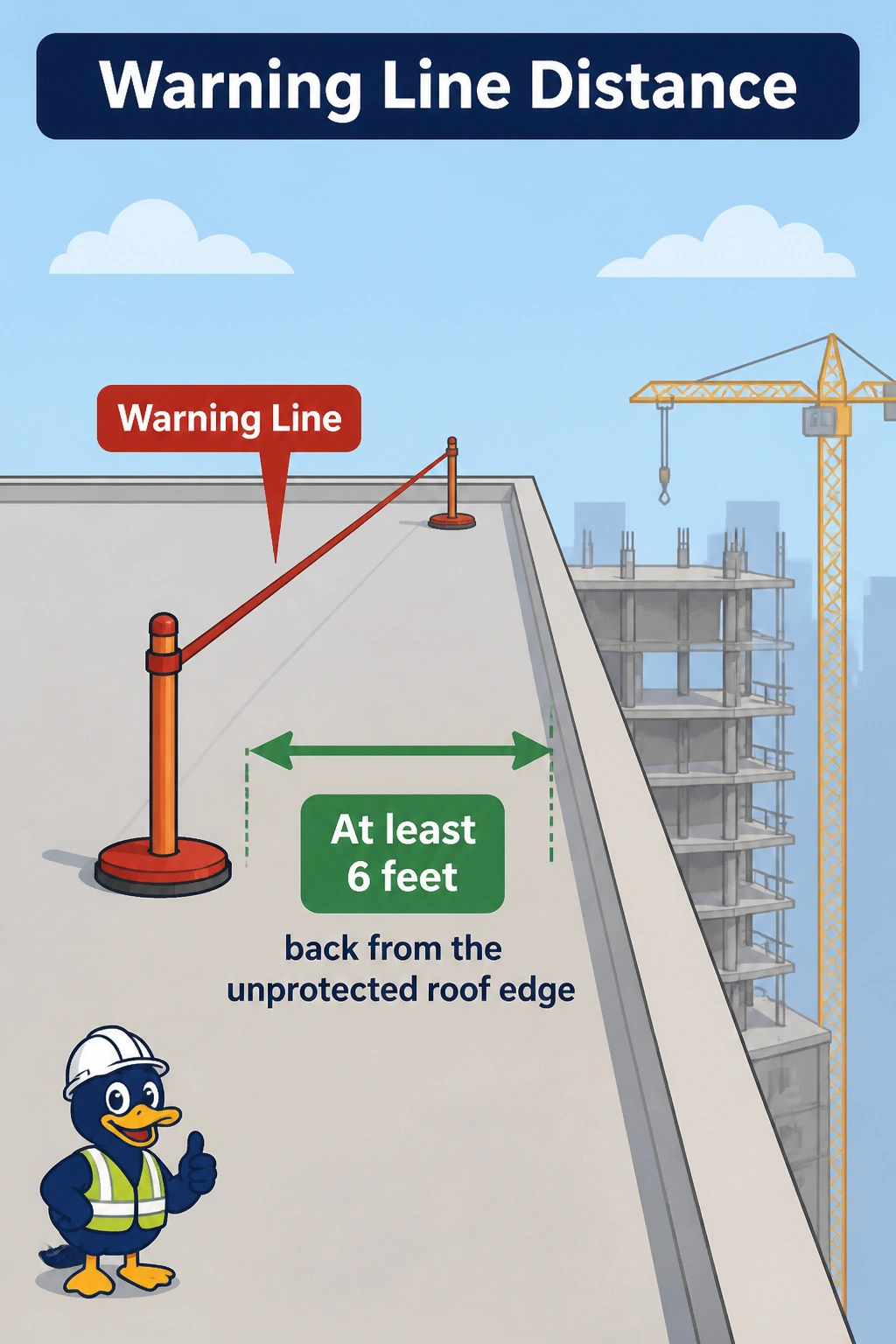
A warning line is your rooftop tripwire before anyone gets close to a fatal drop. Under OSHA 29 CFR 1926.502(f), you must set that flagged line at least 6 feet back from the unprotected roof edge when no mechanical equipment is operating. The trap is placing it too close at 3 feet or flush with a low curb, which leaves workers zero reaction space if they stumble.
Full Explanation
OSHA 29 CFR 1926.502(f)(1)(i) requires a warning line system on a low-slope roof to be erected around all sides of the roof work area at least 6 feet back from the unprotected roof edge when mechanical equipment is not being used. This buffer gives roofers clear visual and tactile notice before they enter the perimeter danger zone where a safety monitor or conventional fall protection is mandatory. Choosing Exactly 3 feet back from the unprotected roof edge with high-visibility flags violates the minimum 6-foot setback and leaves too little margin to arrest a misstep. Choosing At least 15 feet back from the unprotected roof edge regardless of equipment use confuses the standard 6-foot rule with an overly restrictive non-OSHA distance. Choosing Flush with the parapet wall so workers can step right up to the perimeter curb eliminates the warning buffer entirely and provides no fall protection unless the parapet itself meets guardrail height. When mechanical equipment is being used, the warning line shall be not less than 6 feet from the roof edge parallel to the direction of equipment operation, and not less than 10 feet from the roof edge perpendicular to that direction (1926.502(f)(1)(ii)). For an operational check, measure the setback from the roof edge with a tape and verify high-visibility flags are spaced at not more than 6-foot intervals.
Prefer to study offline? Printable PDF study book + test engine ($7.50, unofficial). These questions stay free here.