
During a morning walkthrough on a masonry project, a safety technician sees two laborers climbing the X-shaped diagonal cross-braces of a three-tier welded-frame scaffold instead of using the attached access ladder. What must the technician require under 29 CFR 1926.451?
Select an answer to reveal the explanation.
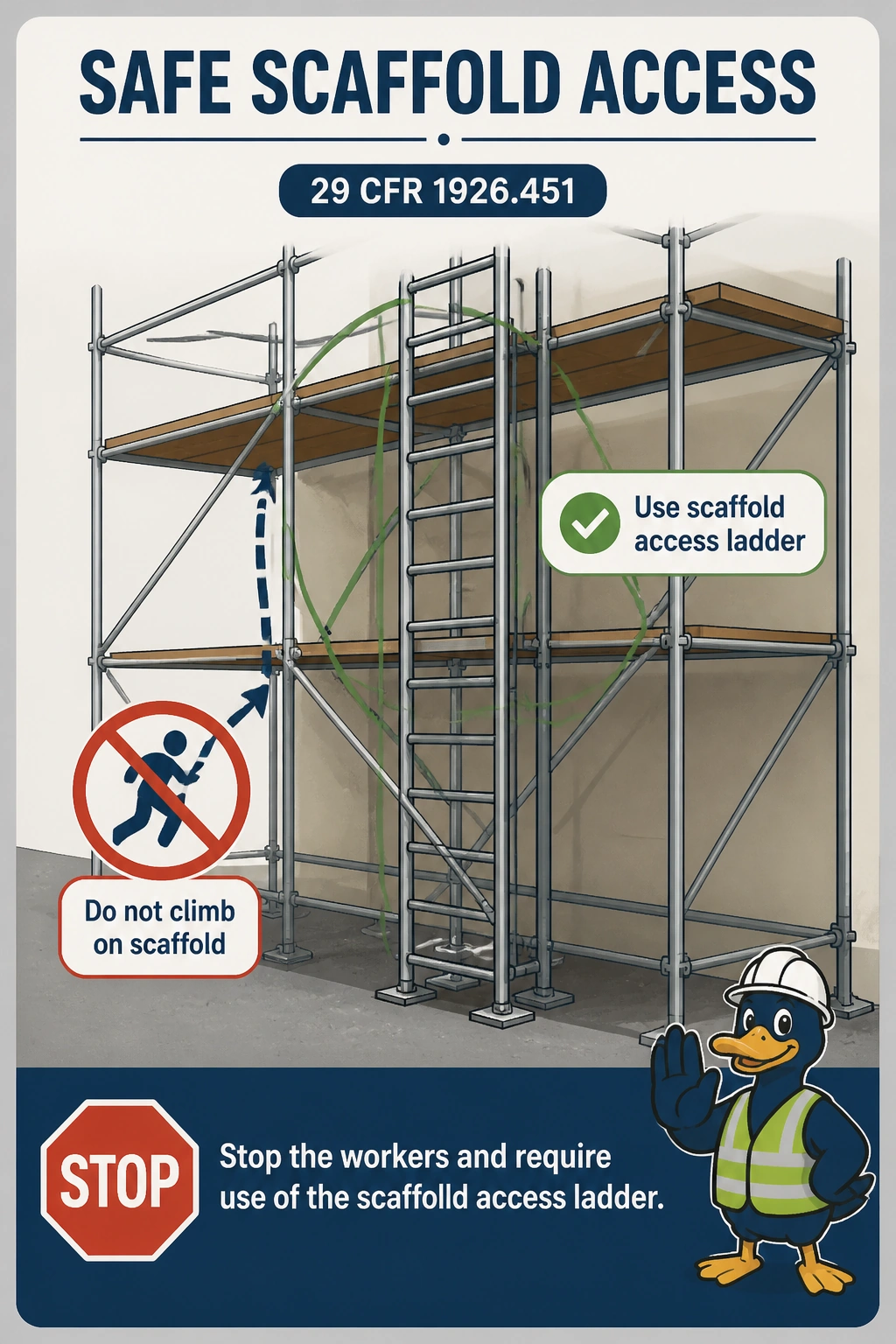
Short Explanation
You should stop the laborers and direct them to the scaffold access ladder: cross-braces keep the frame stable, but they are not a route up or down. Three-point contact, harnesses, and grip tape do not make climbing the braces acceptable under OSHA’s rule.
Full Explanation
Under 29 CFR 1926.451(e)(1) and (e)(9)(iv), cross-braces may not be used as a means of access or egress, so the technician must stop the laborers and require use of the scaffold access ladder. The braces are thin tubular members designed to provide lateral stability, not to carry vertical foot loads; their geometry also encourages awkward positioning that can lead to slips and falls. Requiring three points of contact does not make brace climbing lawful: the prohibition applies regardless of climbing technique. Allowing access only when workers wear full-body harnesses also fails, because personal fall-arrest equipment does not authorize an unapproved climbing path, and the braces are not rated fall-arrest anchors. Applying anti-slip grip tape does not turn structural bracing into a compliant ladder with uniform rung spacing and side rails. Exam caveat: 1926.451(f)(15) separately restricts using ladders on scaffolds to increase working height, except on large-area scaffolds meeting the specified conditions; that rule does not permit climbing cross-braces. Practical check: during daily competent-person scaffold inspections, verify that the scaffold access ladder is installed and unobstructed at each work tier.
Prefer to study offline? Printable PDF study book + test engine ($7.50, unofficial). These questions stay free here.