
During a pre-task check on a commercial steel erection job, a safety technician sees a connector wearing a waist-only leather body belt clipped to a shock-absorbing lanyard for fall arrest 25 feet above a slab. What must the technician require immediately?
Select an answer to reveal the explanation.
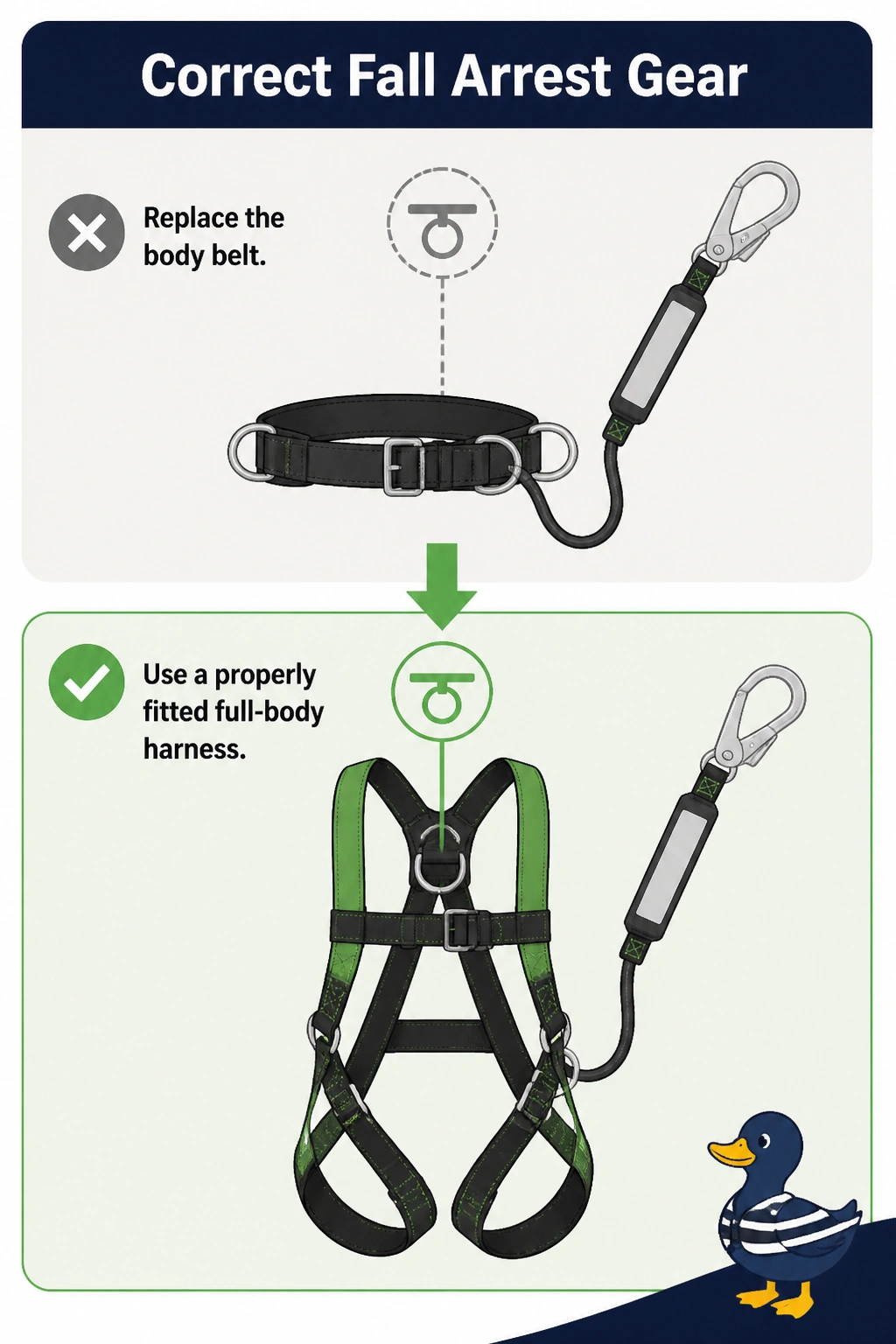
Short Explanation
A waist belt might hold up your tool pouch, but in a fall it concentrates brutal arrest force right onto your spine and internal organs. You must use a full-body harness for fall arrest; the trap is thinking an overhead anchor or shorter lanyard makes a body belt legal.
Full Explanation
Under OSHA 29 CFR 1926.502, body belts are prohibited for personal fall arrest systems, so the technician must Replace the body belt with a properly fitted full-body harness that distributes fall-arrest forces across the thighs, pelvis, chest, and shoulders. Choosing to Tighten the waist belt two notches and connect it to a shorter lanyard fails because any fall arrested by a waist belt still concentrates dangerous impact on the abdomen and lumbar spine. Choosing to Allow the body belt if the worker also wears a high-visibility safety vest fails because visibility PPE provides zero fall-arrest protection. Choosing to Keep the body belt for fall arrest as long as the anchor is overhead fails because even a minimal free-fall distance in a waist belt violates federal construction standards and risks severe internal injury or slipping out of the belt. One key caveat is that body belts remain permissible only in dedicated positioning device systems that limit free fall to two feet or less, never as fall arrest. As a concrete operational check, inspect every worker's fall protection gear before elevation work, confirm a dorsal D-ring on a full-body harness, and verify snug leg and chest strap fit.
Prefer to study offline? Printable PDF study book + test engine ($7.50, unofficial). These questions stay free here.