
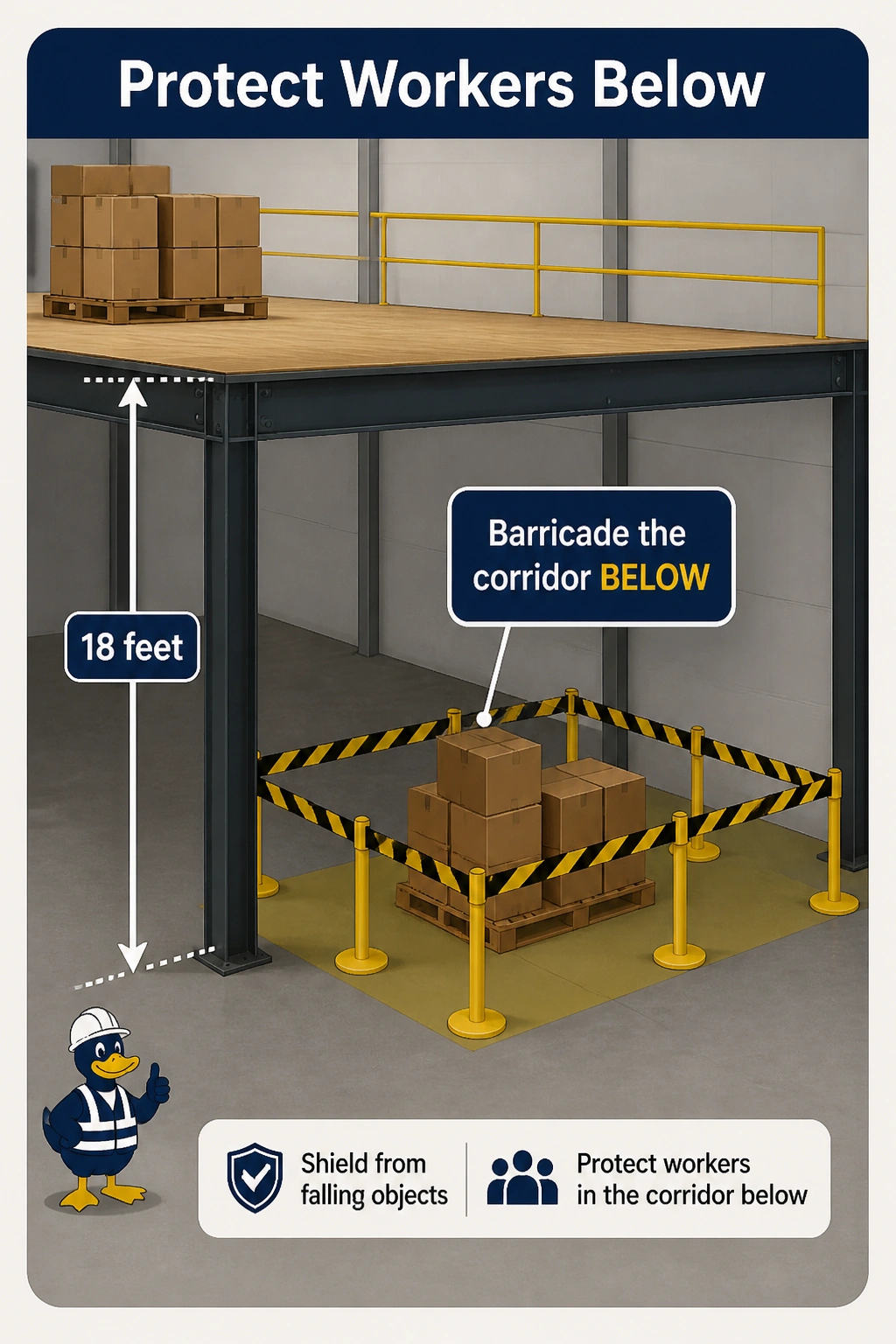
Electricians are installing conduit on an open mezzanine 18 feet above a busy main corridor where plumbers are staging copper pipe below, and loose couplings sit near the mezzanine edge. Beyond requiring hard hats, what control should the safety technician require to protect workers below from falling objects?
Select an answer to reveal the explanation.
Short Explanation
You’re right to treat a hard hat as your last line of defense, not a license to let couplings fall from 18 feet. Require physical protection by installing toeboards along the edge or barricading the corridor below, rather than relying on a painted stripe or a spotter’s shout.
Full Explanation
Under OSHA 29 CFR 1926.501 and 1926.502, when workers below are exposed to falling objects, the employer must pair hard hats with physical controls. Installing toeboards along the mezzanine edge physically blocks loose couplings from rolling off; barricading the corridor below keeps plumbers out of the drop zone. A yellow warning stripe six inches from the edge provides no physical barrier to stop kicked tools or rolling conduit fittings. A spotter assigned to shout when a fitting rolls toward the edge relies on reaction time and leaves workers below vulnerable in a noisy corridor. Safety glasses with side shields protect the plumbers against flying particles at eye level, not heavy objects falling 18 feet. As an exam caveat, toeboards used for falling-object protection under 29 CFR 1926.502 must be at least 3.5 inches high and have no more than 0.25-inch clearance above the walking surface. For a practical check, walk both the mezzanine edge and the corridor below before overhead work starts to confirm the toeboards are secured or the barricades are posted.
Prefer to study offline? Printable PDF study book + test engine ($7.50, unofficial). These questions stay free here.