
A concrete crew uses a handheld power saw outdoors for two hours per shift to cut masonry pavers, strictly following every engineering control, work practice, and respiratory requirement listed in OSHA's silica Table 1. What is the employer's obligation regarding personal air monitoring for respirable crystalline silica?
Select an answer to reveal the explanation.
Short Explanation
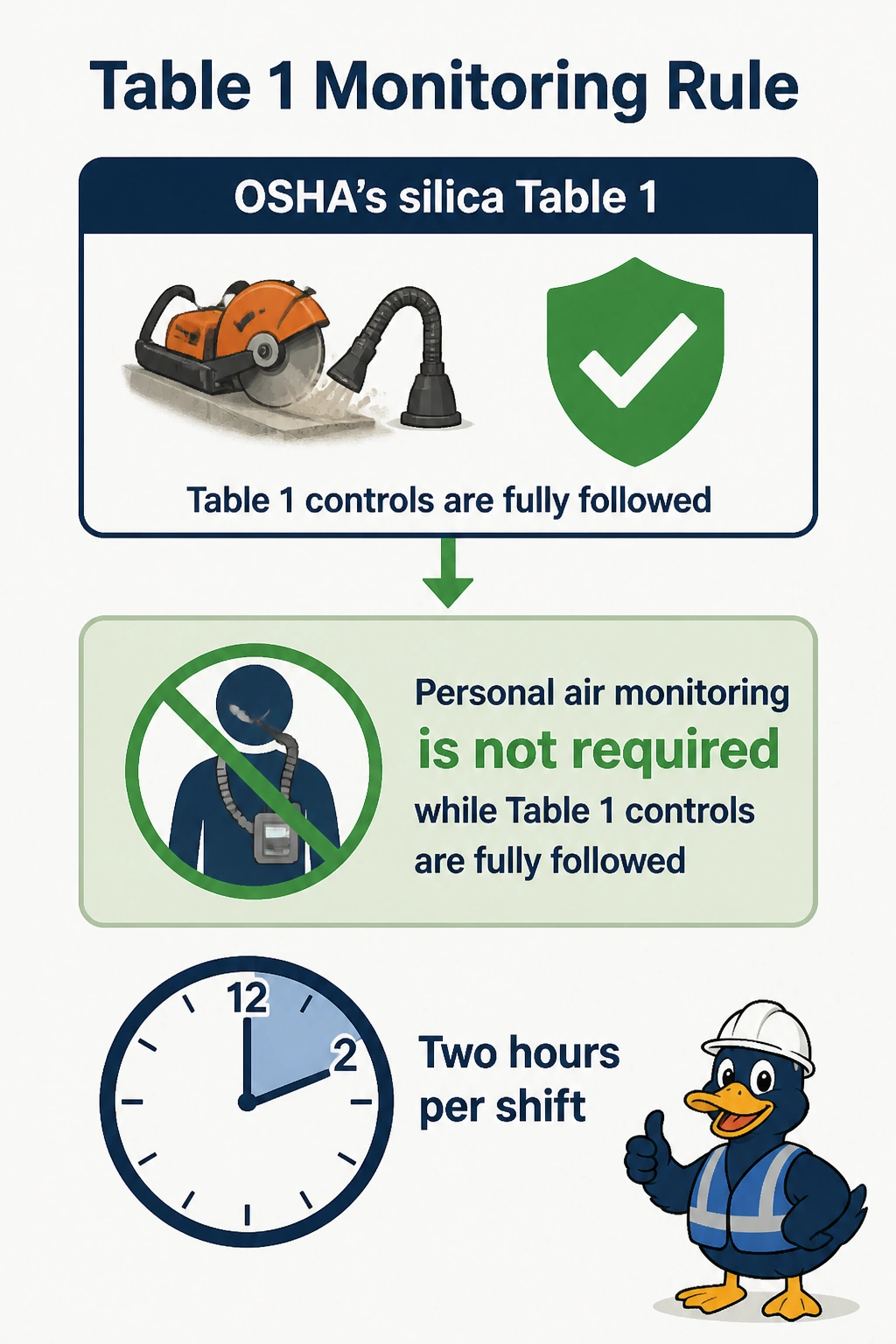
Think of OSHA’s silica Table 1 as a pre-approved recipe: when you follow every required control and work practice, you don’t have to send the air for testing. You get a safe harbor from personal air monitoring as long as your saw setup and work match the table. The key is not to assume monitoring is still required when you fully implement Table 1.
Full Explanation
Under OSHA 29 CFR 1926.1153, when you fully and properly implement the engineering controls, work practices, and respiratory protection specified for a task in Table 1, you are not required to conduct quantitative exposure assessments for respirable crystalline silica. Thus, personal air monitoring is not required while Table 1 controls are fully followed; this is the intended compliance pathway for construction tasks. Requiring personal air monitoring weekly to verify exposures remain below the action level confuses Table 1 with the alternative exposure assessment option, which applies when you do not follow Table 1. Requiring personal air monitoring only during the first shift of each new concrete pour invents a rule that does not exist in the construction silica standard. Requiring personal air monitoring whenever outdoor wind speeds exceed ten miles per hour is also incorrect because Table 1 does not trigger air sampling based on wind speed. If Table 1 is not fully and properly implemented, 1926.1153(d) requires an exposure assessment by the performance option (air monitoring data or objective data) or by scheduled monitoring, and exposures must be kept at or below the 50 µg/m³ 8-hour TWA PEL; personal air monitoring is not automatically required immediately, and results are also compared with the action level. Inspect the saw’s water-feed flow rate and nozzle condition before each shift to verify that Table 1 compliance remains intact.
Prefer to study offline? Printable PDF study book + test engine ($7.50, unofficial). These questions stay free here.