
Two ironworkers are tying off their personal fall arrest systems to independent structural steel beam clamps 35 feet above a concrete deck, without a qualified person designing a custom engineered system. What minimum static load must each independent anchorage support under 29 CFR 1926.502?
Select an answer to reveal the explanation.
Short Explanation
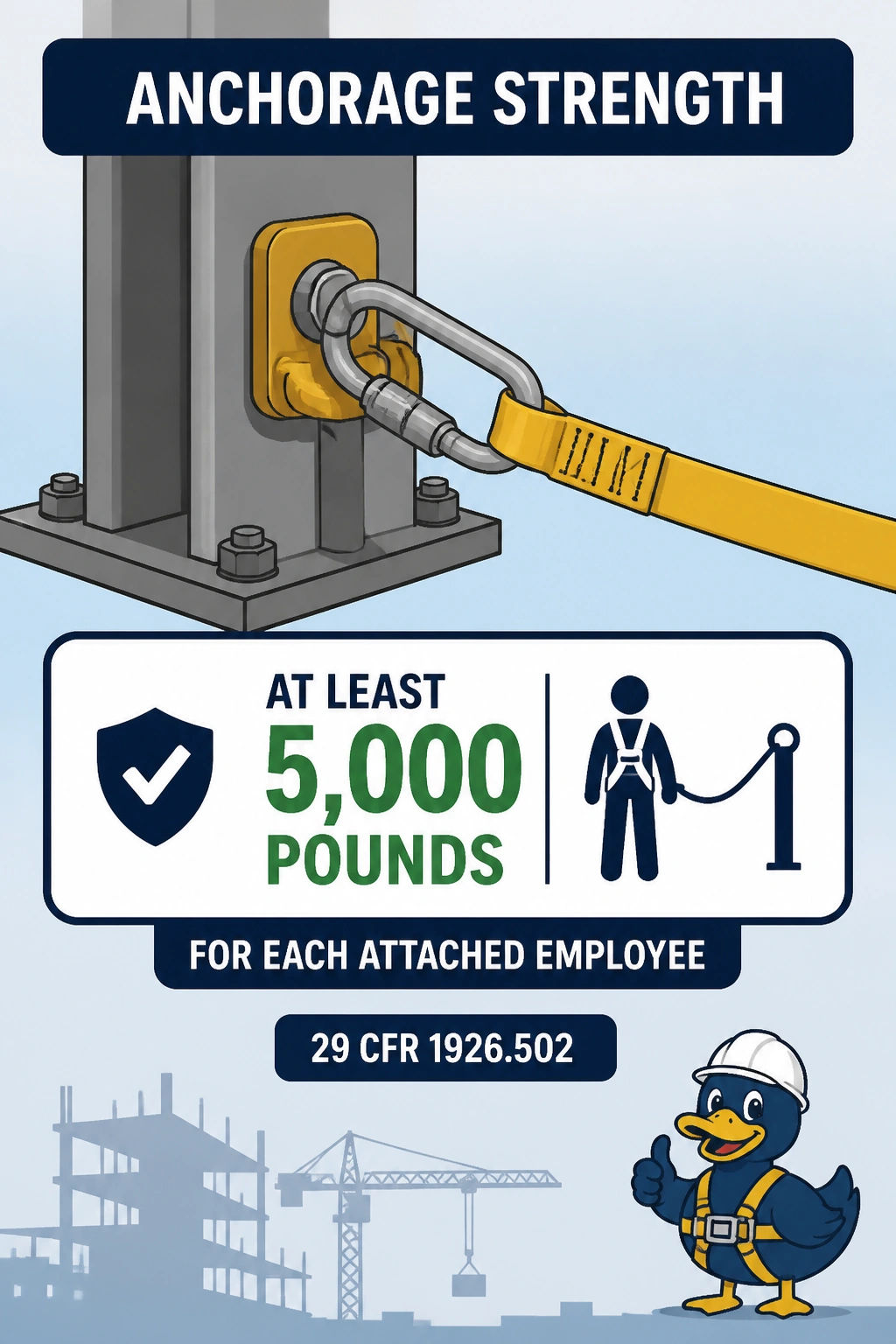
An anchor point is the foundation of a fall arrest system—if it pulls loose, the best harness and lanyard in the world cannot save you. When there is no engineered design, OSHA sets a massive 5,000-pound strength bar for every worker clipped in. The trap is confusing that anchor requirement with the 1,800-pound maximum arresting force limit.
Full Explanation
Under OSHA 29 CFR 1926.502, anchorages used for attachment of personal fall arrest equipment must be independent of any anchorage used to support or suspend platforms and must be capable of supporting At least 5,000 pounds for each attached employee, unless designed, installed, and used as part of a complete system with a safety factor of at least two under a qualified person's supervision. Choosing At least 1,800 pounds per attached worker confuses anchorage strength with the maximum arresting force permitted on a worker's body when using a body harness. Selecting At least 3,000 pounds per attached worker falls short of the 5,000-pound non-engineered threshold and instead echoes the lower requirement used for positioning device anchorages. Relying on At least 2,500 pounds shared by the crew is doubly wrong because the standard requires full capacity per attached person, not a shared total. As a caveat, two workers may share a single structural member only if it supports 5,000 pounds per worker, meaning 10,000 pounds total for two workers, or is engineered by a qualified person with a two-to-one safety factor. For an operational check, inspect beam clamp markings, torque, and structural steel connections before each shift to verify rated capacity.
Prefer to study offline? Printable PDF study book + test engine ($7.50, unofficial). These questions stay free here.