
An electrical crew erects a freestanding mobile welded-frame scaffold with a 5-foot base width to reach conduit 24 feet above a warehouse slab. What stability requirement applies under OSHA 29 CFR 1926.451(c)(1) before workers climb onto the platform?
Select an answer to reveal the explanation.
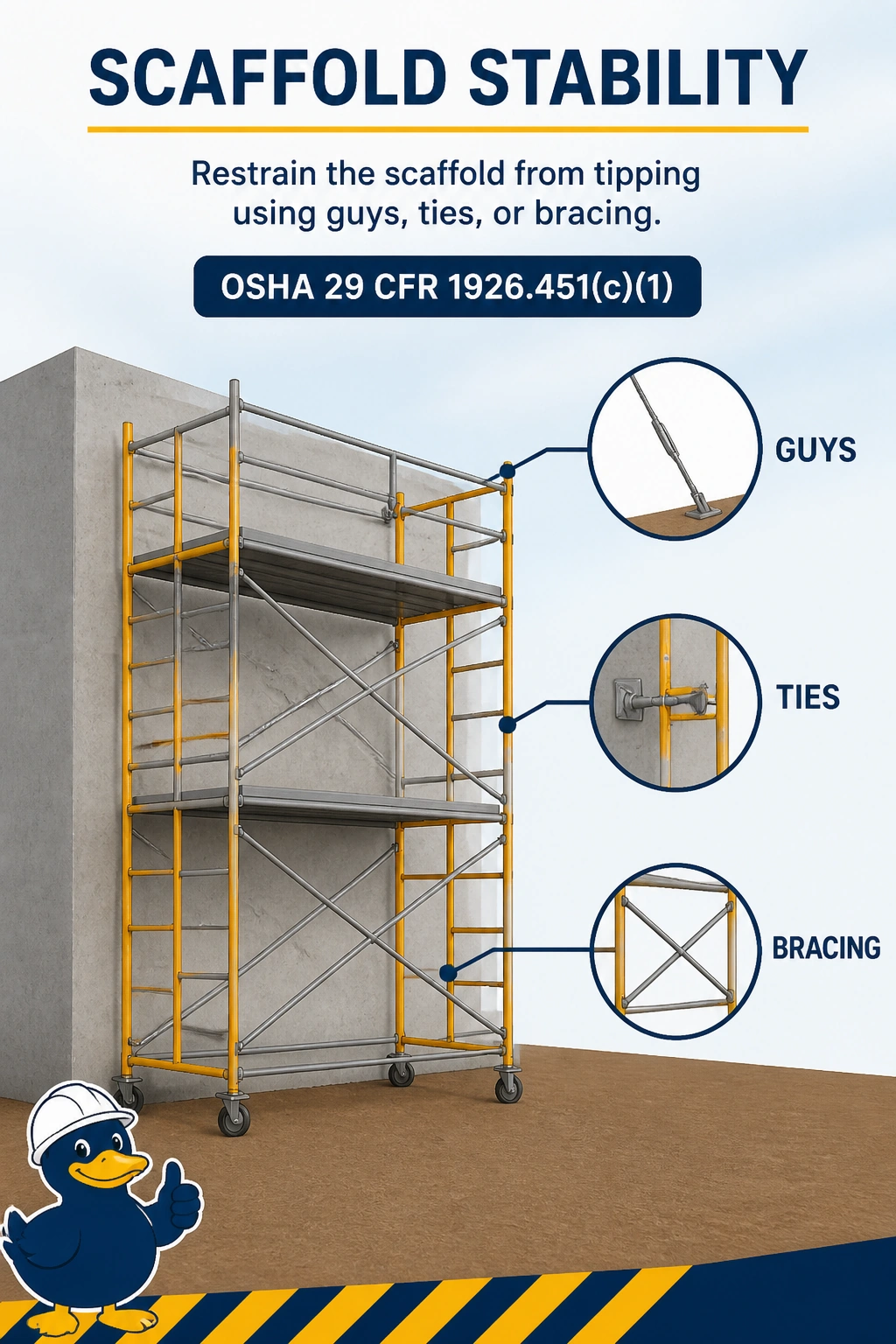
Short Explanation
A tall, narrow scaffold can tip when a sideways force acts on it. Since your 24-foot scaffold is more than four times its 5-foot base width, you need restraint with guys, ties, or bracing before you climb; toeboards, unlocked casters, and a two-worker limit do not meet that stability requirement.
Full Explanation
Under 29 CFR 1926.451(c)(1), a supported scaffold with a height-to-base-width ratio greater than four to one must be restrained from tipping by guying, tying, bracing, or an equivalent means. Here, 24 feet divided by a 5-foot base width gives a 4.8-to-1 ratio, exceeding the four-to-one limit, so the crew must restrain the scaffold from tipping with guys, ties, or bracing before workers climb onto the platform. Toeboards along all four sides of the top working deck help prevent tools and materials from falling; they do not stop the scaffold from overturning. Casters must be locked whenever a mobile scaffold is stationary and occupied, so leaving them unlocked for quick repositioning is unsafe and does not provide the required stability. Limiting the platform to two workers does not satisfy the rule, because horizontal forces from pulling wire or leaning can still overturn an unbraced narrow tower. A caveat is that outrigger frames that widen the effective base can sometimes bring the ratio within limits if approved by a qualified person. Before climbing, measure the narrowest base dimension against the top platform height and confirm that structural ties or outriggers are secured.
Prefer to study offline? Printable PDF study book + test engine ($7.50, unofficial). These questions stay free here.