
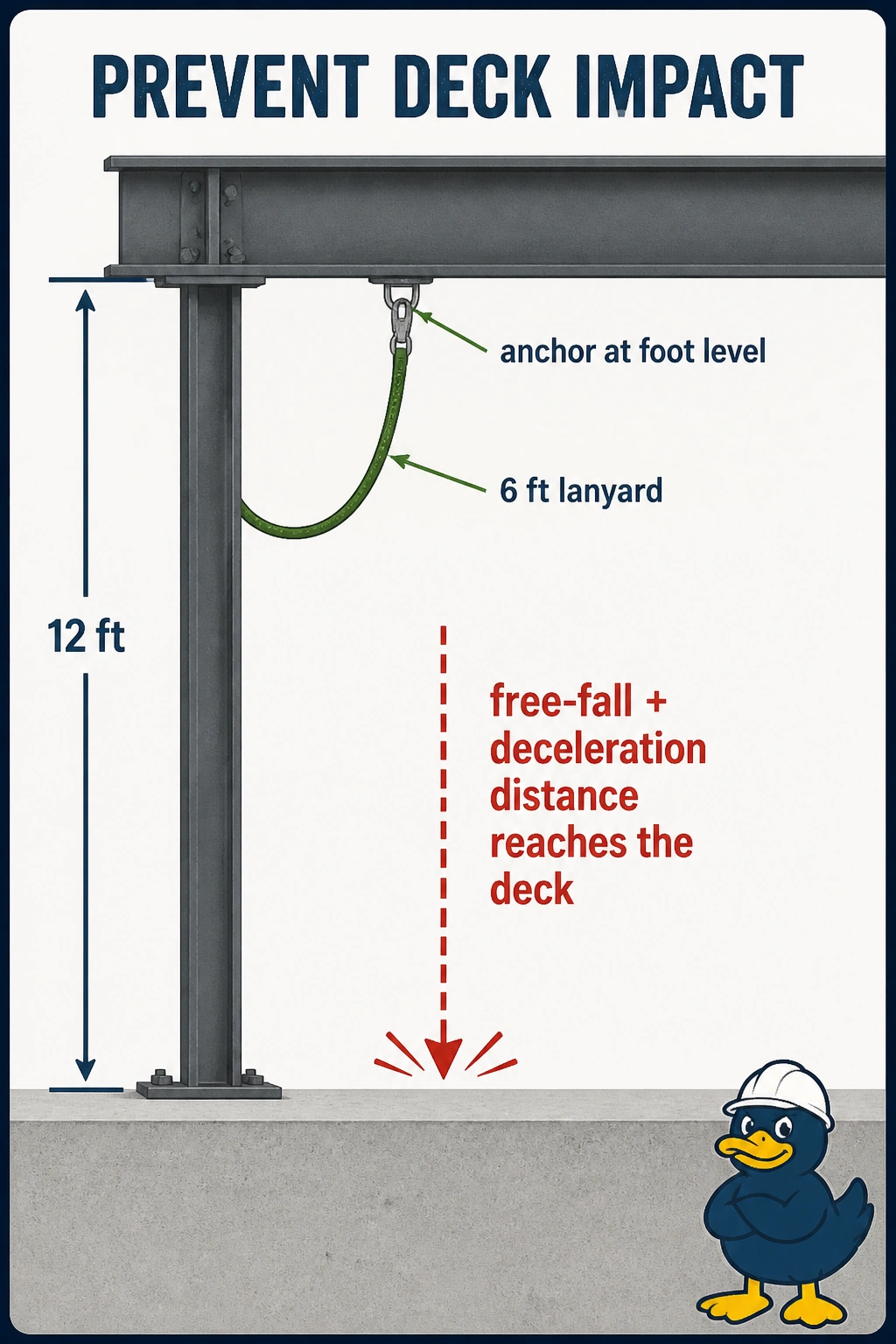
An ironworker wearing a 6-foot shock-absorbing lanyard anchors at foot level on a steel beam only 12 feet above a lower concrete deck. Why must the safety technician stop the worker and require a higher anchor or self-retracting lifeline?
Select an answer to reveal the explanation.
Short Explanation
Your 6-foot shock-absorbing lanyard does not stop you in 6 feet: free fall, deceleration tear-out, harness stretch, and your height can use up the 12 feet of clearance. Check the total fall distance before tying off so you do not hit the deck below.
Full Explanation
Under 29 CFR 1926.502, a personal fall arrest system must prevent a free fall over 6 feet or contact with a lower level. With a 6-foot shock-absorbing lanyard anchored at foot level, free fall is about 10 feet: roughly 4 to 4.5 feet from the D-ring to your feet, plus the lanyard. Lanyard length, absorber extension, harness D-ring shift, your height, and a safety margin add to the clearance needed; deceleration can therefore let you hit a deck only 12 feet below. Shock-absorbing lanyards are not prohibited on all structural steel; they are permitted when the anchorage is rated and clearance is adequate. Connecting two lanyards does not reduce total fall distance and can worsen arrest forces if they are misrigged. A 12-foot elevation is not below the general construction fall-protection threshold: it is 6 feet, though steel erection has specific rules. OSHA allows free fall over 6 feet only when a better anchorage is infeasible; free fall must still be limited as far as possible, arresting force must not exceed 1,800 pounds, and you must not contact a lower level. An extended-free-fall lanyard does not make this setup compliant. Move the anchor overhead or use a self-retracting lifeline with enough clearance. Before work begins, calculate total fall clearance and confirm the anchor location or lifeline provides it.
Prefer to study offline? Printable PDF study book + test engine ($7.50, unofficial). These questions stay free here.