
An electrician operating an articulating boom lift near steel roof trusses wants to clip a personal fall arrest lanyard to an adjacent structural beam instead of the basket because the beam looks sturdier. What must the safety technician require?
Select an answer to reveal the explanation.
Short Explanation
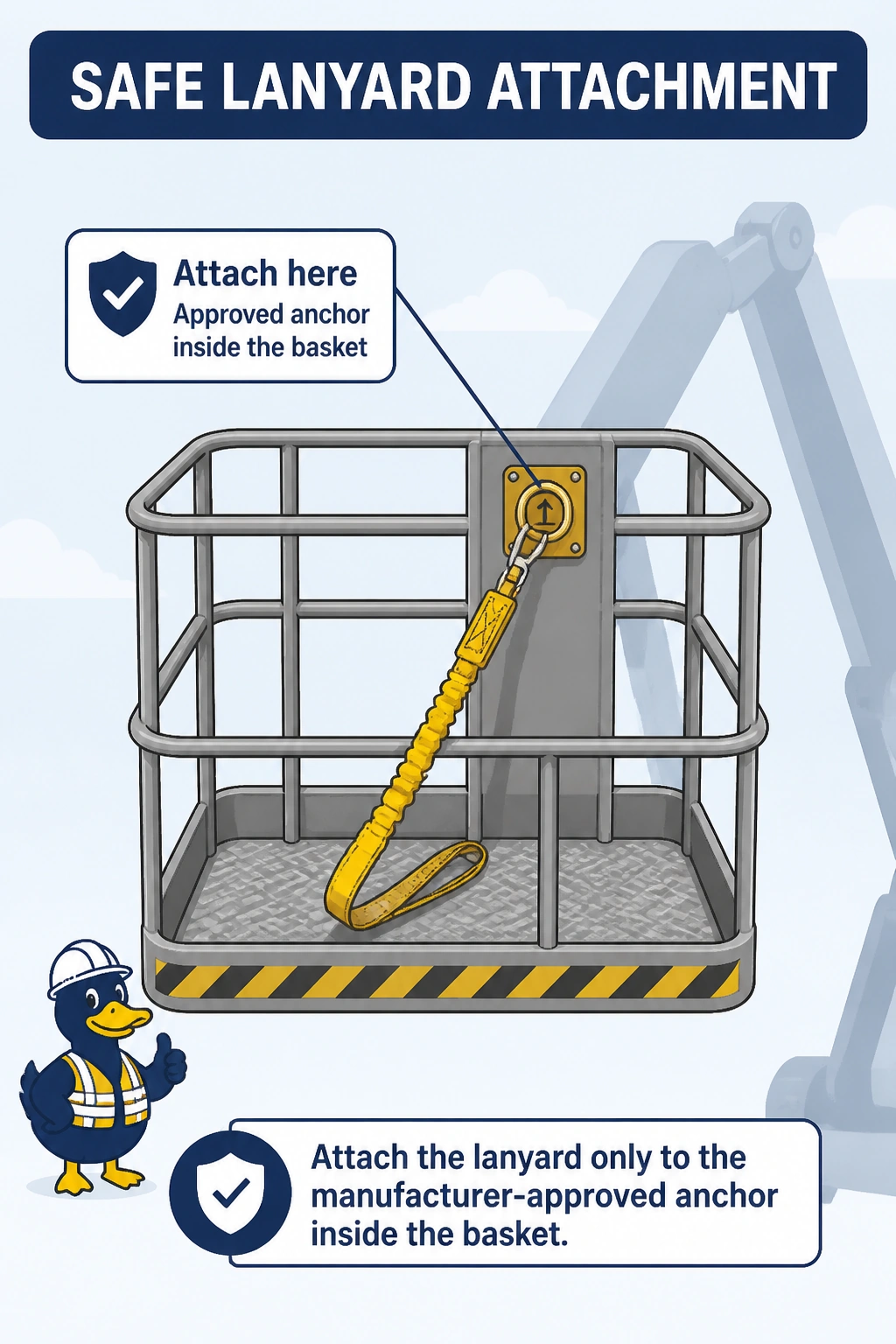
Think of a boom lift like a moving boat: if you tie yourself to the dock while the boat drifts away, you get yanked straight into the water. Workers often assume a heavy steel beam is safer than the basket, but tying off outside the lift turns any boom movement into a severe pull-out hazard. You must keep the lanyard anchored inside the basket.
Full Explanation
29 CFR 1926.453(b)(2)(iii) prohibits belting off to an adjacent pole, structure, or equipment while working from an aerial lift. 1926.453(b)(2)(v) requires a lanyard attached to the boom or basket, not only to an anchor inside the basket. The note to (b)(2)(v) says that as of January 1, 1998, a body belt is not acceptable as part of a personal fall arrest system; a body belt may still be used in a restraint or tethering system under 1926.502(e), and a harness is used when the system can arrest a fall. Attaching the lanyard to the manufacturer-approved anchor inside the basket satisfies this rule because you travel with the platform and avoid creating a tether to a fixed object. Choosing to Attach the lanyard to the adjacent structural steel beam if it supports 5,000 pounds still violates the prohibition even if the beam is strong, because any boom drift or bump can drag you over the rail. Choosing to Attach two lanyards so one connects to the basket and one connects to the steel beam keeps that same hazardous link between moving lift and fixed steel. Choosing to Remove the lanyard while working inside the basket as long as the midrail is latched leaves you exposed to ejection and bounce, which guardrails alone do not control in a boom lift.
Prefer to study offline? Printable PDF study book + test engine ($7.50, unofficial). These questions stay free here.