
While auditing incoming receiving at an aerospace electronics plant, an auditor notices several moisture-sensitive component reels stored outside dry-cabinet humidity controls, even though humidity storage is not on the receiving checklist. How should the auditor proceed?
Select an answer to reveal the explanation.
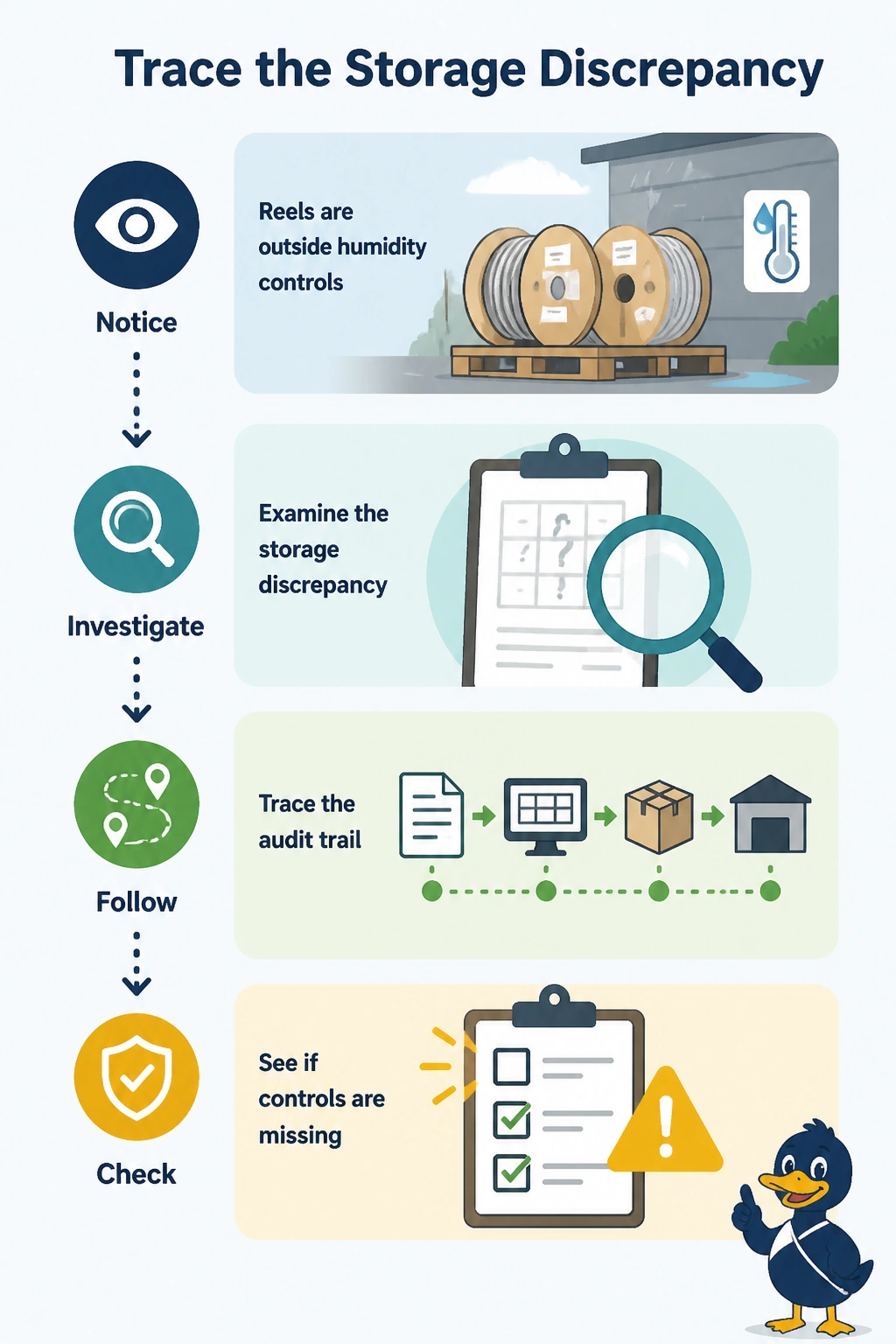
Short Explanation
A checklist is a compass, not a pair of blinders—if you spot a live risk right in front of you, you cannot just walk past it. Follow that audit trail to see whether humidity controls are actually failing, while avoiding the trap of either ignoring it or shutting down the dock yourself.
Full Explanation
Checklists are memory aids rather than rigid boundaries, so when fieldwork uncovers an unexpected risk within the audit scope, the auditor should Investigate the storage discrepancy and follow the audit trail to see if controls are missing. Exploring the anomaly determines whether an isolated placement error occurred or a systemic handling gap threatens component reliability. Choosing to Ignore the observation because moisture control is outside the pre-approved receiving checklist items misses a tangible product-quality risk simply because it was not pre-scripted. Choosing to Immediately halt all receiving dock operations until engineering inspects every reel in stock oversteps the auditor's advisory role by issuing operational stop-work orders. Choosing to Wait until the next annual audit cycle so the program manager can add humidity control to the plan leaves potentially compromised components in production for months. As a caveat, following a new trail must remain balanced against the overall audit schedule and defined scope boundaries. Operational check: inspect the component manufacturer's handling specification, check dry-cabinet logs, and ask the receiving lead how moisture-sensitive parts are tracked.
Prefer to study offline? Printable PDF study book + test engine ($7.50, unofficial). These questions stay free here.