
A tool library packs a loaner drill only if a member is predicted to pick it up. A wasted packed box and a missed true no-show both hurt. Leadership wants one blended score for this yes-or-no call, not a regression error number. Which metric should they use?
Select an answer to reveal the explanation.
Short Explanation
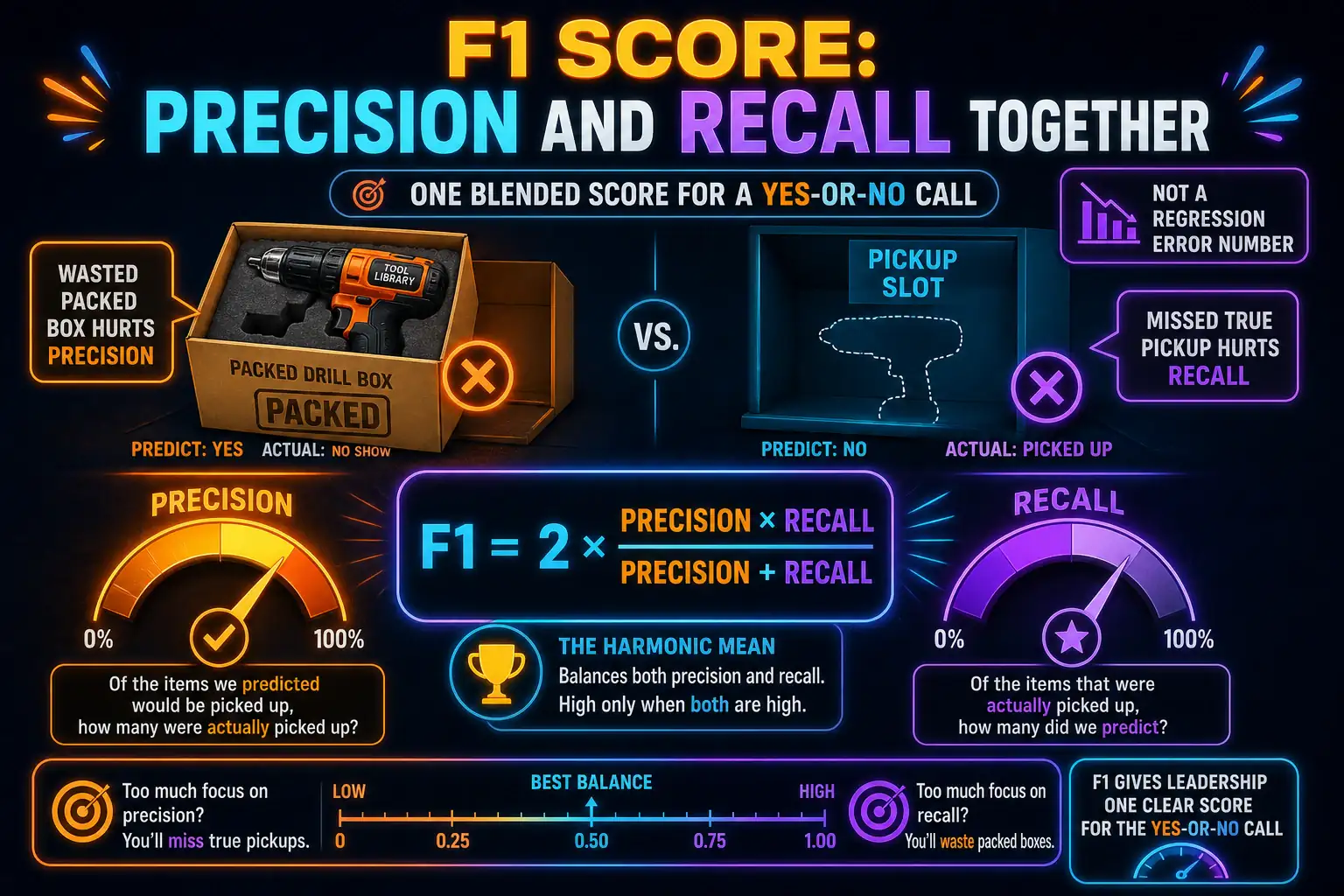
Think of packing a drill that nobody picks up versus missing a true no-show. F1 is the blended score that only looks good when both of those hurts are under control. RMSE is a measuring tape for numbers, accuracy can hide a lopsided tradeoff, and GPU loss is not the business number.
Full Explanation
The tool library packs a loaner drill only when a member is predicted to pick it up, and both a wasted packed box and a missed true no-show hurt the operation. Leadership wants one blended score for that yes-or-no call—not a regression error number—which is the F1 score, the harmonic balance of precision and recall. F1 fits because it rises only when both error types are controlled, matching the business pain on wasted packs (hurting precision) and missed no-shows (hurting recall). RMSE is a numeric regression error measure and does not correctly score a binary pickup call even if someone encodes yes and no as one and zero. Accuracy alone can look acceptable while hiding a lopsided tradeoff that favors one error type over the other and leaves either the packing bench or the no-show process broken. GPU training loss reflects optimization progress on the fitting machine and is not the business metric for packing decisions. Exam caveat: when both false positives and false negatives matter and the output is binary, F1 is the usual blended exam answer—not RMSE, accuracy-only, or hardware loss. Operational check: compute precision from wasted packs and recall from caught no-shows, report F1, and set a threshold that keeps both warehouse waste and missed no-shows within agreed limits.