
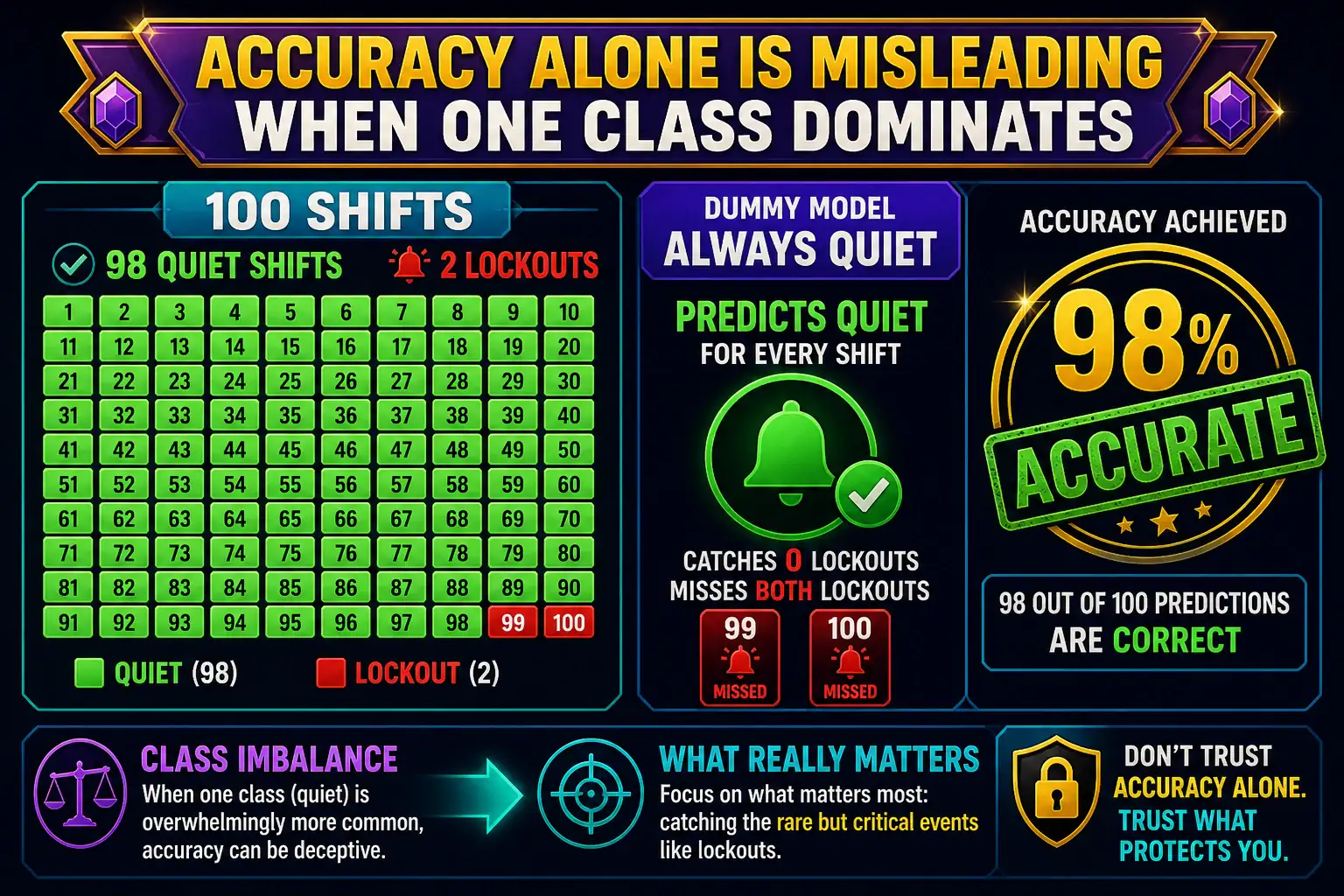
A boiler-lockout alarm is quiet on 98 shifts out of 100. A dummy model that always predicts quiet is 98 percent accurate and never catches a lockout. Which statement should the plant trust?
Select an answer to reveal the explanation.
Short Explanation
Think of a smoke alarm that is right every quiet night and never rings on a fire. 98 percent quiet shifts make an always-quiet dummy look like a genius. Accuracy alone lies when one class owns the room.
Full Explanation
When boiler-lockout alarms are quiet on 98 of 100 shifts, a dummy model that always predicts quiet can post 98 percent accuracy while never catching a lockout. Trusting that accuracy alone is misleading when one class dominates is correct because accuracy credits every easy quiet shift and hides total failure on the rare class that matters for plant safety. Claiming 98 percent accuracy proves readiness for live alarms ignores that the dummy never predicts lockout and therefore never protects the asset when a real lockout occurs. Saying accuracy is the only metric that works on rare events is backwards; rare events usually need recall, precision, F1, or cost-weighted metrics that focus on the minority class. Calling the dummy "overfitting" because accuracy is high confuses concepts: overfitting is memorizing training quirks with a train–test gap, whereas this score is a majority-class artifact of label imbalance. Always compare against a naive majority baseline before celebrating accuracy. Exam caveat: on imbalanced labels, treat high accuracy as suspicious until minority-class metrics are reviewed. Operational check: report lockout recall and false-alarm rate alongside accuracy, compare against an always-quiet baseline, and refuse promotion if the model matches the dummy on the rare class.