
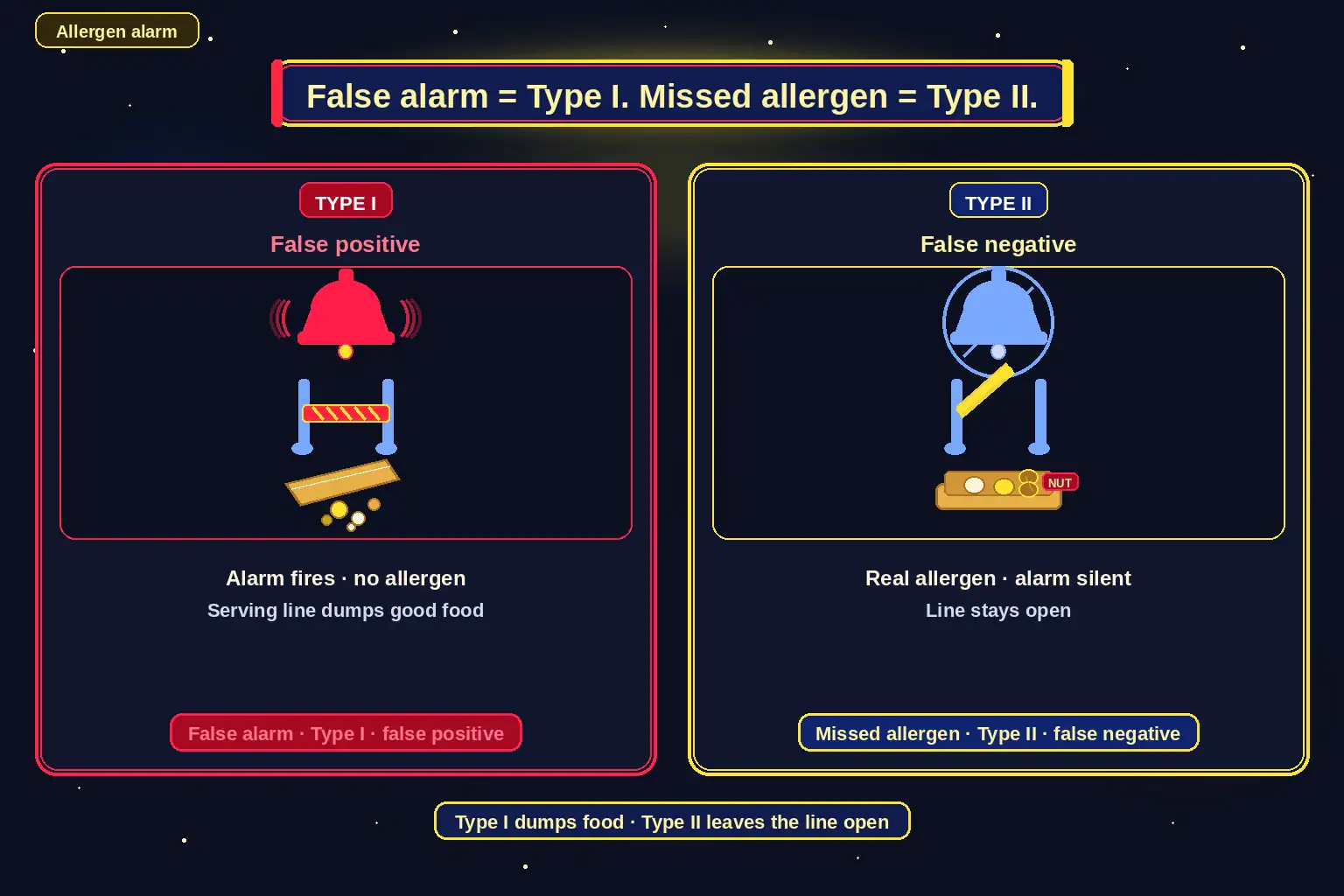
A school cafeteria can close the serving line when a nut-allergen alarm fires. A false alarm dumps good food. A missed real allergen leaves the line open. Which pairing names those errors in plain language?
Select an answer to reveal the explanation.
Short Explanation
Think of a fire alarm in the cafeteria. A false alarm dumps good food (Type I, false positive). A quiet alarm when the allergen is real is the miss (Type II, false negative). The room does not swap those names, and they are not RMSE and MAE.
Full Explanation
In the school cafeteria nut-allergen alarm, a false alarm that dumps good food is a Type I error (false positive), and a missed real allergen that leaves the serving line open is a Type II error (false negative). That pairing is correct because Type I means raising the alarm when the allergen condition is absent, while Type II means failing to raise the alarm when the condition is present. Swapping the names—calling the false alarm Type II and the miss Type I—reverses the standard definitions and would mis-teach the food-safety tradeoff between waste and exposure. Saying both errors are Type I because they happen in a cafeteria confuses location with statistical error type; the room does not redefine the labels. Equating Type I and Type II with RMSE and MAE is wrong because those are regression error magnitudes, not hypothesis-testing or classification error names used for alarm decisions. Keep the mapping tied to the concrete harms: dumped food versus an open line during a real allergen event. Exam caveat: memorize Type I = false positive and Type II = false negative, then map them to the business harms in the story. Operational check: log each alarm outcome as false positive, false negative, true positive, or true negative, and review food-waste versus exposure incidents with the same Type I / Type II vocabulary used in the model card.