
A locksmith shop has about two hundred PDF manuals. Techs need answers such as what torque a cylinder needs, taken from those existing documents. They do not have a labeled set of past torque numbers to train a numeric predictor. Which approach fits?
Select an answer to reveal the explanation.
Short Explanation
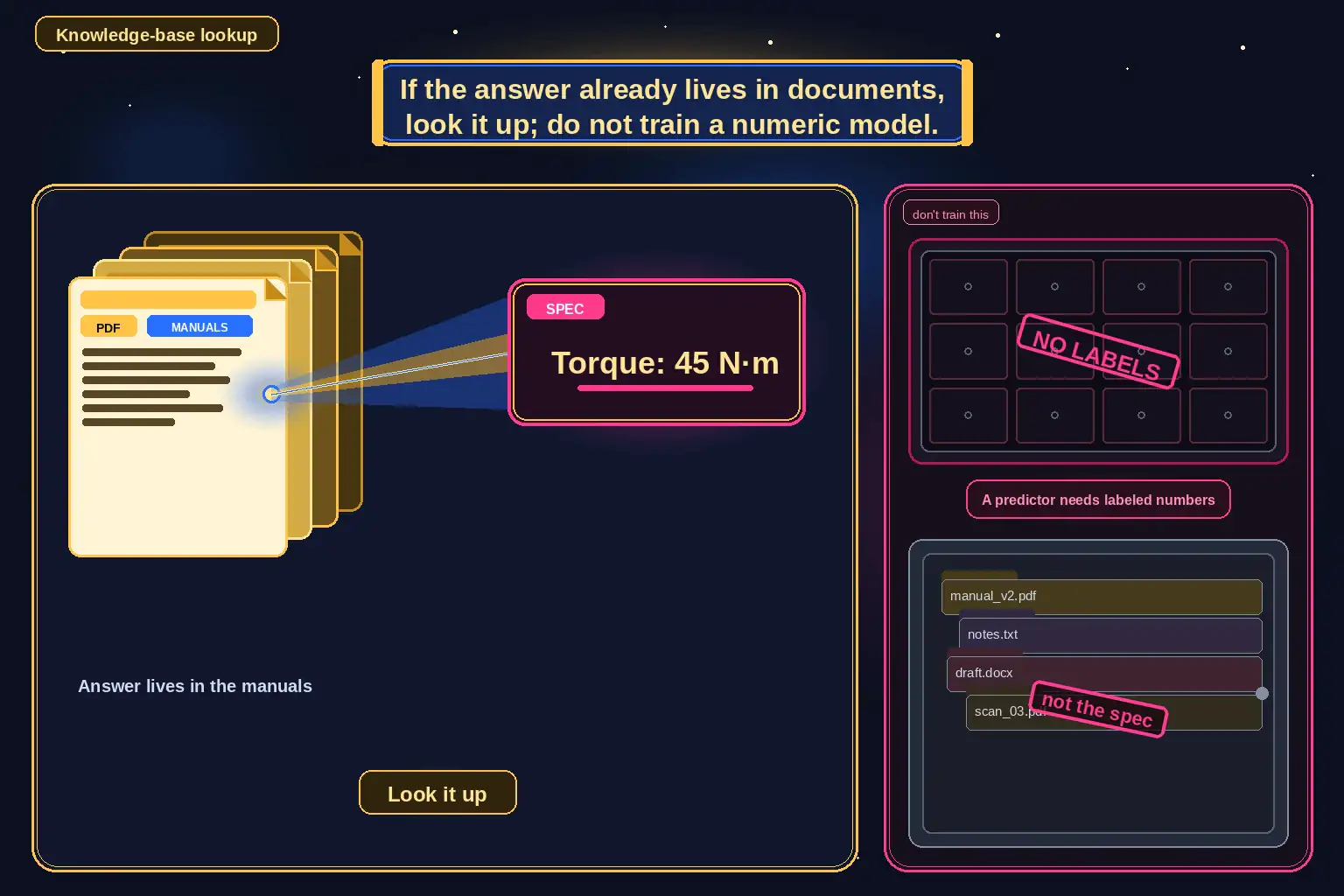
Think of flipping to the right page in the manual instead of inventing a torque from thin air. The answer already lives in those PDFs, and there is no labeled set of past numbers to train on. A filename cluster or a door camera will not spit out inch-pounds.
Full Explanation
When torque answers already live in about two hundred PDF manuals and there is no labeled numeric torque dataset, the right move is knowledge-base lookup against those existing documents. Looking up the answer works because the authoritative figure is already written in the manuals; retrieval or document search returns the published torque without inventing a predictor from thin air. Training a regression model fails because the shop explicitly lacks labeled past torque numbers, so there is nothing proper to fit and no ground truth against which to evaluate predictions. Clustering PDF filenames and treating a cluster ID as torque confuses an unsupervised grouping index with an engineering specification; filenames and cluster numbers are not inch-pound values. Computer vision on the shop's front door inspects an unrelated image stream and cannot extract cylinder torque from PDF manuals sitting in the knowledge base. Document-grounded lookup is the efficient path when the answer is already published and labels for supervised learning do not exist. Exam caveat: if the answer already exists in documents and labeled training data does not, choose retrieval or knowledge-base search over supervised learning. Operational check: index the PDFs, query a sample of torque questions a tech would ask, and confirm answers cite the manual passage before considering any numeric model.