
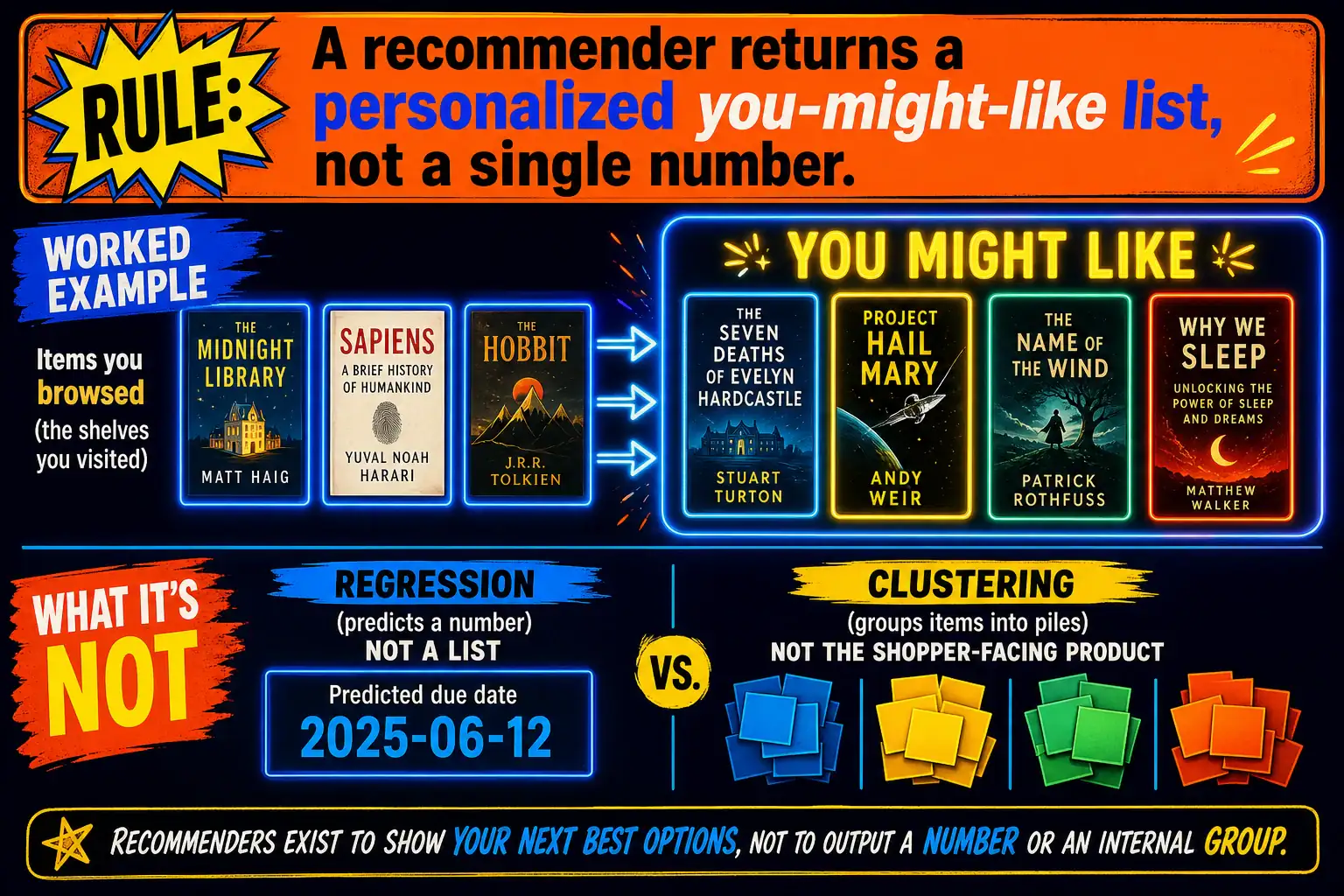
A used-bookstore site wants each shopper to see a short list of titles they might like after browsing three shelves. The team is not predicting a due date and is not treating unlabeled clusters as the finished product. Which application is this?
Select an answer to reveal the explanation.
Short Explanation
Think of a clerk who watches you browse three shelves and then hands you a short you-might-like stack. That is a recommendation list, not a due-date number and not a pile of unnamed clusters. Reading a library card aloud is a different job.
Full Explanation
After a shopper browses a few shelves, producing a short personalized you-might-like list of titles is a recommendation system. That application fits because the delivered product is a ranked set of items tailored to recent behavior or history, not a single numeric forecast and not unlabeled groups presented as the finished experience. A regression model whose only output is a book's due date answers a different question—when something is due—and never surfaces a list of titles the shopper might enjoy next. Treating clustering as the finished product leaves the shopper with unnamed groups rather than actionable title suggestions; clustering may support recommendations behind the scenes as a feature or candidate generator, but unlabeled clusters are not what the site shows. Computer vision that reads a library card number aloud is a perception and speech task about identity, not collaborative or content-based recommendation of books. The stem already rules out due-date prediction and unlabeled clusters as the end product, which narrows the answer to recommendations. Exam caveat: distinguish the business output shape—list of items, single number, or cluster labels—before picking the application name. Operational check: define the recommendation trigger (browse history), the output (top-N titles), and the success metric (clicks or borrows), and confirm no due-date or vision requirement is sneaking into the same story.