
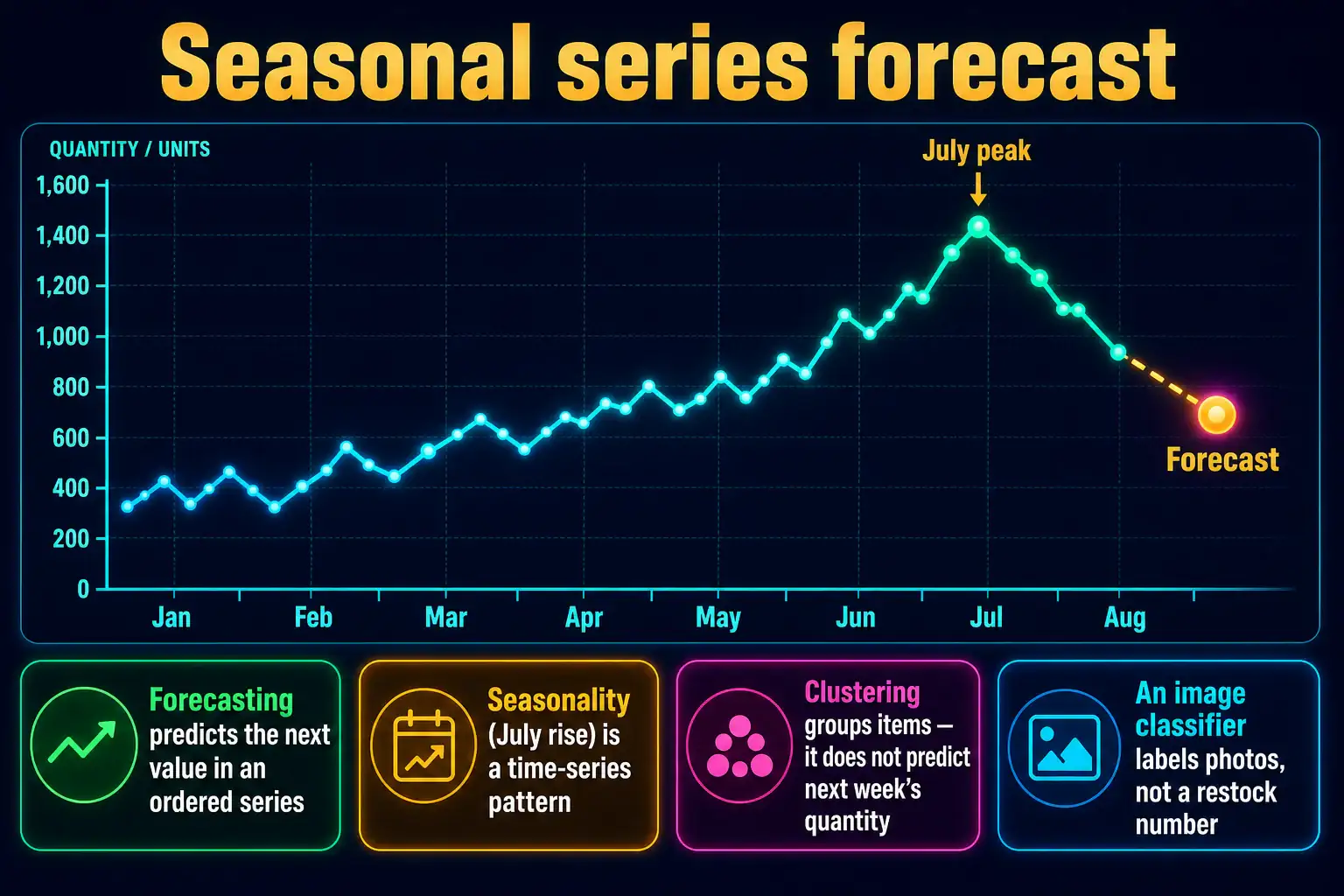
An ice-cream plant wants next week's freezer restock quantity from three summers of weekly sales, which rise every July. The team is not grouping stores and is not classifying carton photos. Which technique should they use?
Select an answer to reveal the explanation.
Short Explanation
Think of last July's freezer run, then asking what next July will need. That is forecasting a seasonal series, not grouping stores or labeling carton photos. A reward-seeking flavor inventor is a different machine.
Full Explanation
Forecasting predicts future values in an ordered series, often capturing trend and seasonality from history. The ice-cream plant needs next week's freezer restock quantity from three summers of weekly sales that rise every July—a seasonal weekly series. Forecasting the next value in that series is the technique that matches the operational ask.
Clustering stores by unlabeled floor plans would group locations, which the team said it is not doing and which does not yield next week's restock quantity. An image classifier on carton photos would assign visual labels, which they also ruled out and which does not produce a numeric restock plan from sales history. Reinforcement learning to invent new flavors optimizes exploratory actions for a reward signal; it is unrelated to forecasting a weekly freezer quantity from seasonal sales.
Exam caveat: when the stem emphasizes history over time plus clear seasonality and asks for a future quantity, prefer forecasting over clustering, classification, or reinforcement-learning distractors. Operational check: plot weekly sales to confirm the July peak, backtest next-week forecasts on held-out summers with appropriate error metrics, and translate the forecast into freezer restock using a documented safety-stock rule before peak season.