
A community radio station wants to discover groups of listening sessions that sound similar. Staff have not defined personas such as morning-news or late-jazz, and they will name the groups after the model runs. Which technique should they use?
Select an answer to reveal the explanation.
Short Explanation
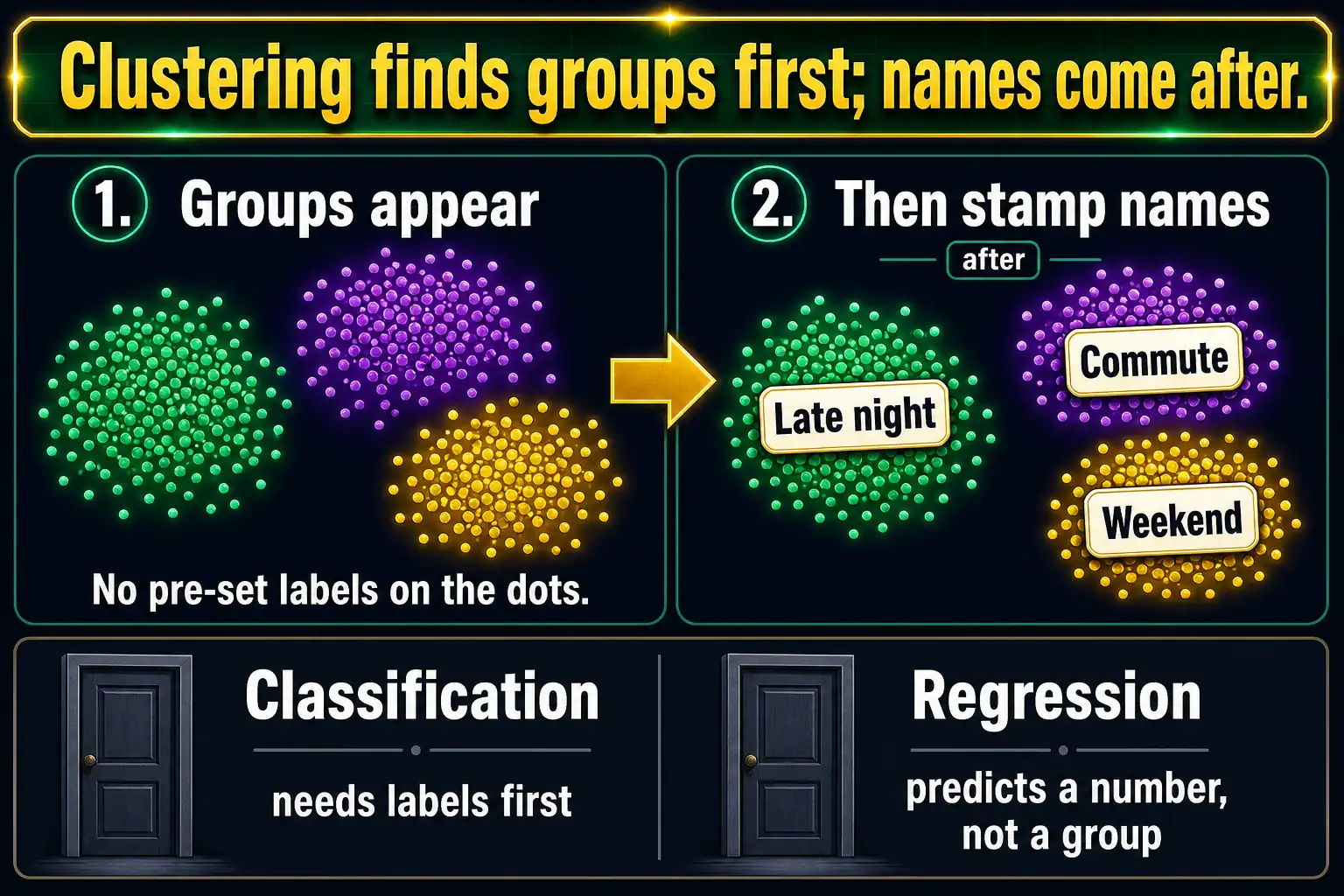
Think of making piles of similar listening sessions first and naming them after you see what landed. That is clustering: no pre-set personas. Classification would need the names first, and a file on disk does not make this a computer-vision job.
Full Explanation
Clustering is an unsupervised technique that partitions examples into groups without requiring pre-defined class names; naming can happen after humans inspect what landed in each group. The community radio station wants groups of listening sessions that sound similar, has not defined personas such as morning-news or late-jazz, and will name the groups after the model runs. Clustering matches that discovery-first request.
Classification requires a pre-set label inventory that staff already apply to examples; they said those persona names are not published yet, so classification would invent supervision they do not have. Regression predicts a continuous number such as minutes listened; that is not the same as discovering and later naming session groups, and minutes are not a class name. Computer vision interprets images; storing sessions as files on disk does not make an audio or session-similarity job into a vision problem.
Exam caveat: "we will name groups after the run" points to clustering; "assign each session to known personas" would point to classification. Operational check: choose a similarity feature space (listening histograms, embeddings, or related session features), select a cluster count or density method with staff review of exemplars, check that clusters are stable enough for programming use, and only promote cluster IDs to named personas after editorial sign-off.