
A field-guide app must assign each mushroom photo to one of five edibility classes: edible, choice, inedible, toxic, or unknown. It must not output a weight in grams. Which technique should the team use?
Select an answer to reveal the explanation.
Short Explanation
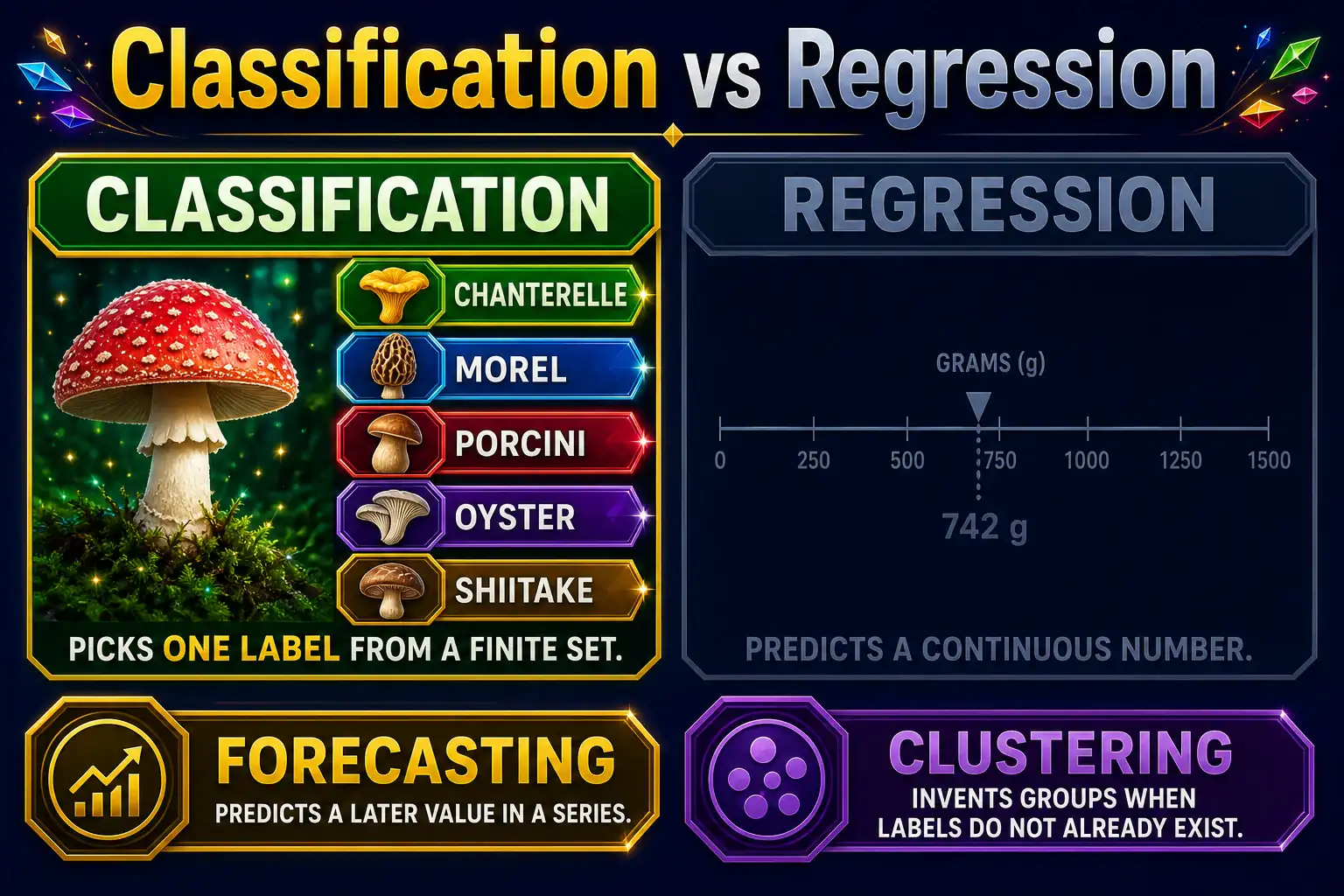
Think of sorting mushrooms into five labeled bins, not putting them on a scale. Classification picks from a finite set of names. Grams would be regression, invented piles would be clustering, and "it is July" does not turn a single photo into a forecast.
Full Explanation
Classification predicts one value from a finite set of predefined labels. The field-guide app must assign each mushroom photo to one of five edibility classes—edible, choice, inedible, toxic, or unknown—and must not output a weight in grams. The target is a closed set of names, so multi-class classification is the correct technique.
Regression predicts continuous numeric quantities such as grams; the fact that "five" is a number does not make the task regression when the required outputs are class names rather than masses. Forecasting predicts future values in a temporal series; seasonal foraging habits do not turn a single photo-to-class mapping into a time-series forecast. Clustering invents groups without pre-set names; here the five class names already exist, so the problem is labeled classification, not unsupervised grouping.
Exam caveat: the count of classes being numeric is a common distractor—regression is about continuous targets, not about how many category names appear in the taxonomy. Operational check: build a labeled photo set with the five edibility tags, evaluate with per-class precision and recall (especially for toxic), calibrate decision thresholds for safety, and refuse any model head that emits grams or free-form text instead of the closed label set.