
A thrift warehouse has thousands of donation photos and no category tags. The team wants the system to discover groups of visually similar items so staff can invent aisle names later. They are not training a reward-seeking robot. Which learning approach fits?
Select an answer to reveal the explanation.
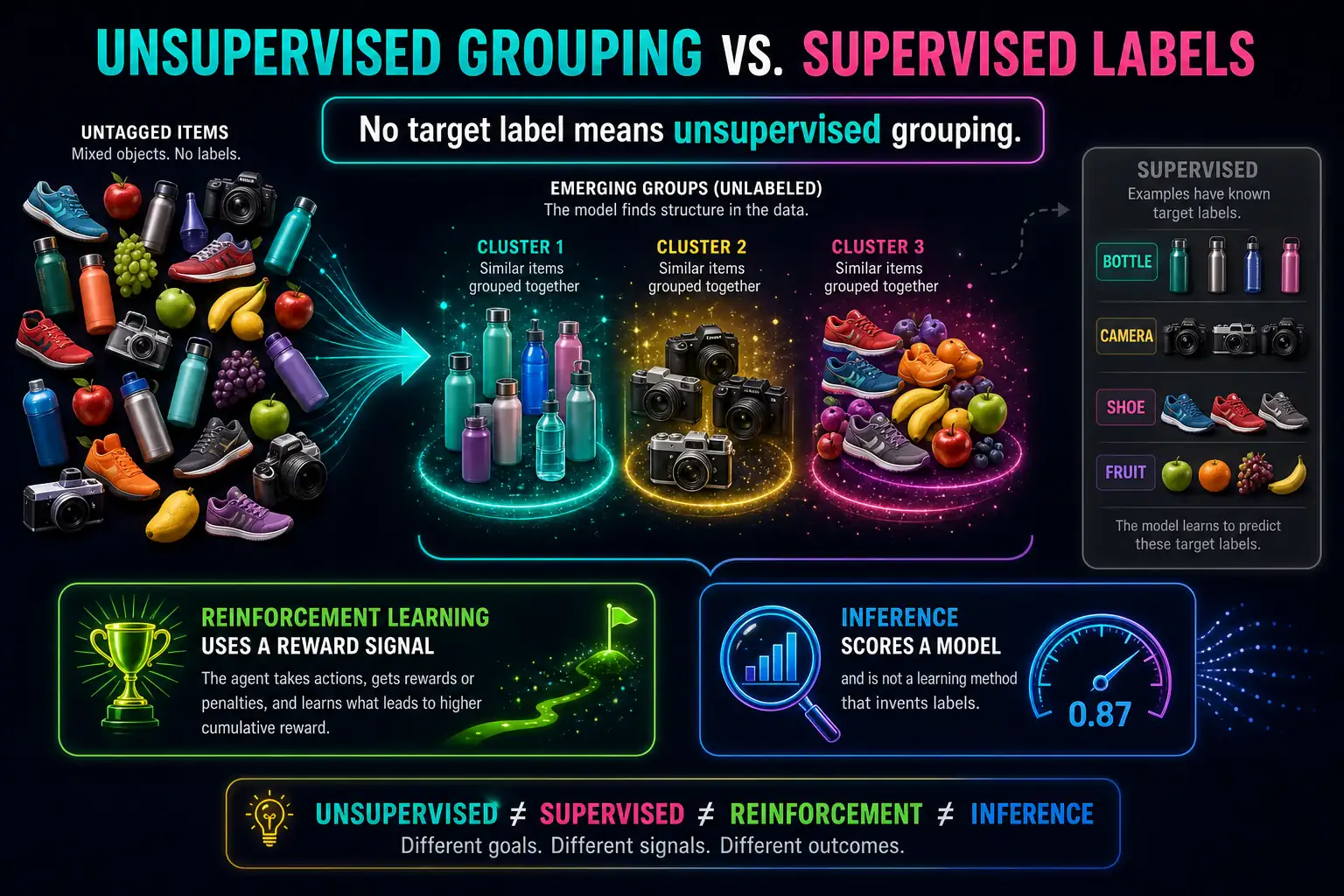
Short Explanation
Think of dumping a pile of photos on a table and asking someone to make stacks of things that look alike, with no name tags yet. That is unsupervised learning: no target label on each donation. A filename is not a category, and nobody is handing out treats to a robot.
Full Explanation
Unsupervised learning finds structure—clusters, embeddings, associations—in examples that have no target label attached. The thrift warehouse has thousands of donation photos without category tags and wants the system to discover groups of visually similar items so staff can invent aisle names later. That requirement is unsupervised grouping (typically clustering or representation learning on image embeddings), not supervised classification into known categories.
Supervised learning needs known targets on each example; a photo file does not secretly contain a category label merely by existing on disk. Reinforcement learning optimizes an agent through rewards for actions in an environment; the presence of warehouse aisles does not turn photo grouping into a reward-seeking control problem, and the team said they are not training such a robot. Real-time inference is a serving pattern for an already trained model; it is not a learning method that creates labels.
Exam caveat: phrasing like "discover groups" and "name them later" is a clustering or unsupervised cue; "assign to known classes" would be supervised classification. Operational check: embed the photos, run clustering, review sample clusters with floor staff before naming aisles, measure stability across re-runs, and only switch to supervised tagging after a stable taxonomy exists and photos are human-labeled.