
A marina keeps a slip spreadsheet with berth ID, length, monthly fee, and occupancy. It also keeps dock-camera video and VHF radio recordings. Which statement correctly names the data types?
Select an answer to reveal the explanation.
Short Explanation
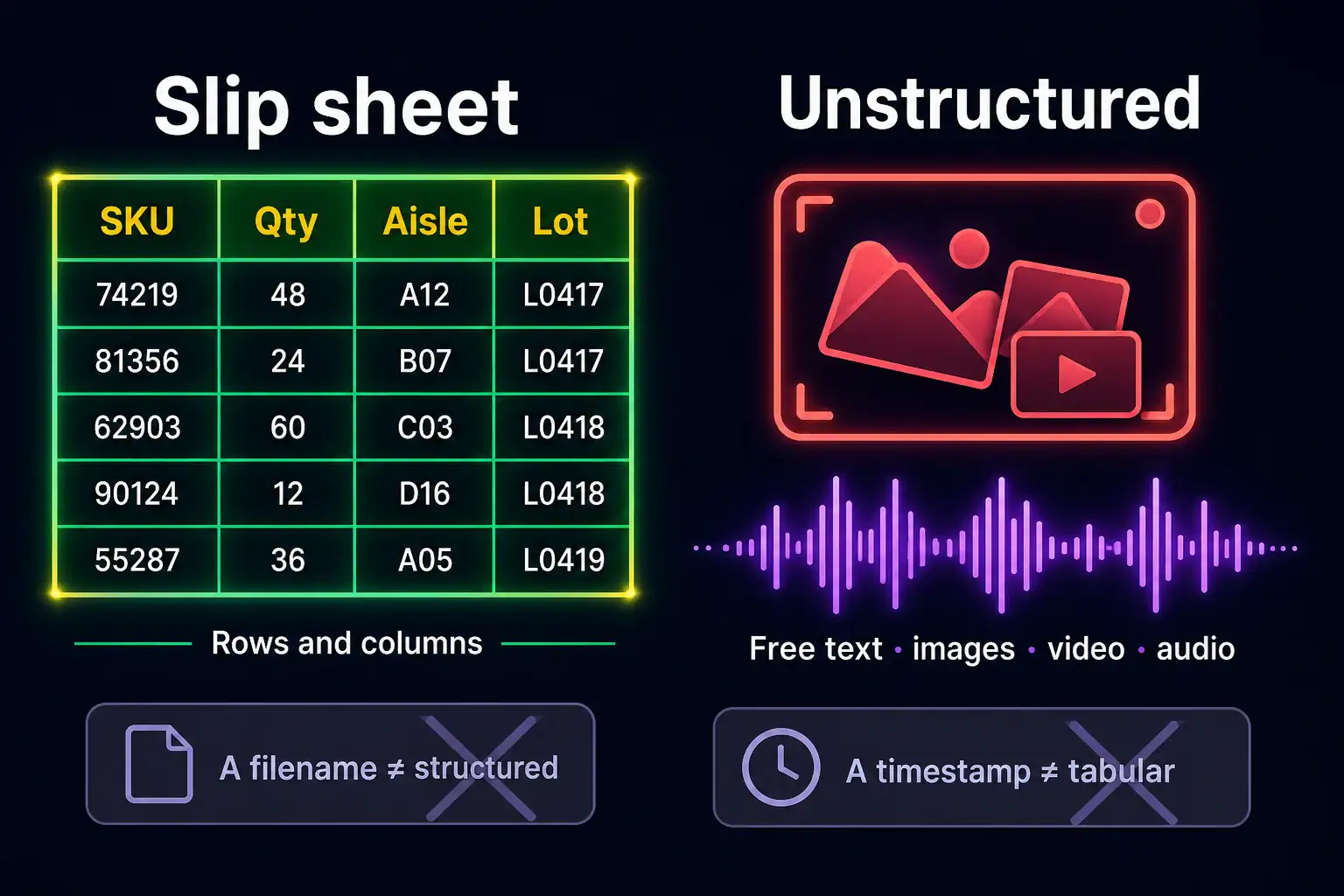
Think of the slip sheet like a grid of cubbies and the dock video like a messy pile of tapes. Rows and columns are structured. Camera footage and radio chatter are unstructured. A filename or a start time does not magically turn media into a table.
Full Explanation
Structured data is organized into predefined fields, typically rows and columns with consistent types—exactly the marina slip spreadsheet with berth ID, length, monthly fee, and occupancy. Unstructured data is free-form content without that rigid tabular schema, such as dock-camera video and VHF radio recordings. Naming the spreadsheet structured and the video and radio unstructured correctly separates schema-shaped records from media streams.
Giving each video file a name does not make the video structured; filenames are thin metadata wrapped around still-unstructured pixel streams. Living inside a file on disk does not make a spreadsheet unstructured; storage medium is not the same as data shape. A start timestamp on an audio clip does not convert a waveform into tabular data; one time field is not a relational table of berth attributes.
Exam caveat: "has some metadata" is not enough to call media structured—look for consistent fields that form records you could load as a table without heavy feature extraction. Operational check: keep slip operations on the spreadsheet or a database table, store video and audio in object storage with separate feature-extraction pipelines if models need them, and do not force media blobs into the berth-fee table schema.