
A beekeeper records hive audio. For some clips an apiarist has already marked swarm or calm. A new intern says those marks are just the file type, such as MP3 versus WAV. What is the label on each example?
Select an answer to reveal the explanation.
Short Explanation
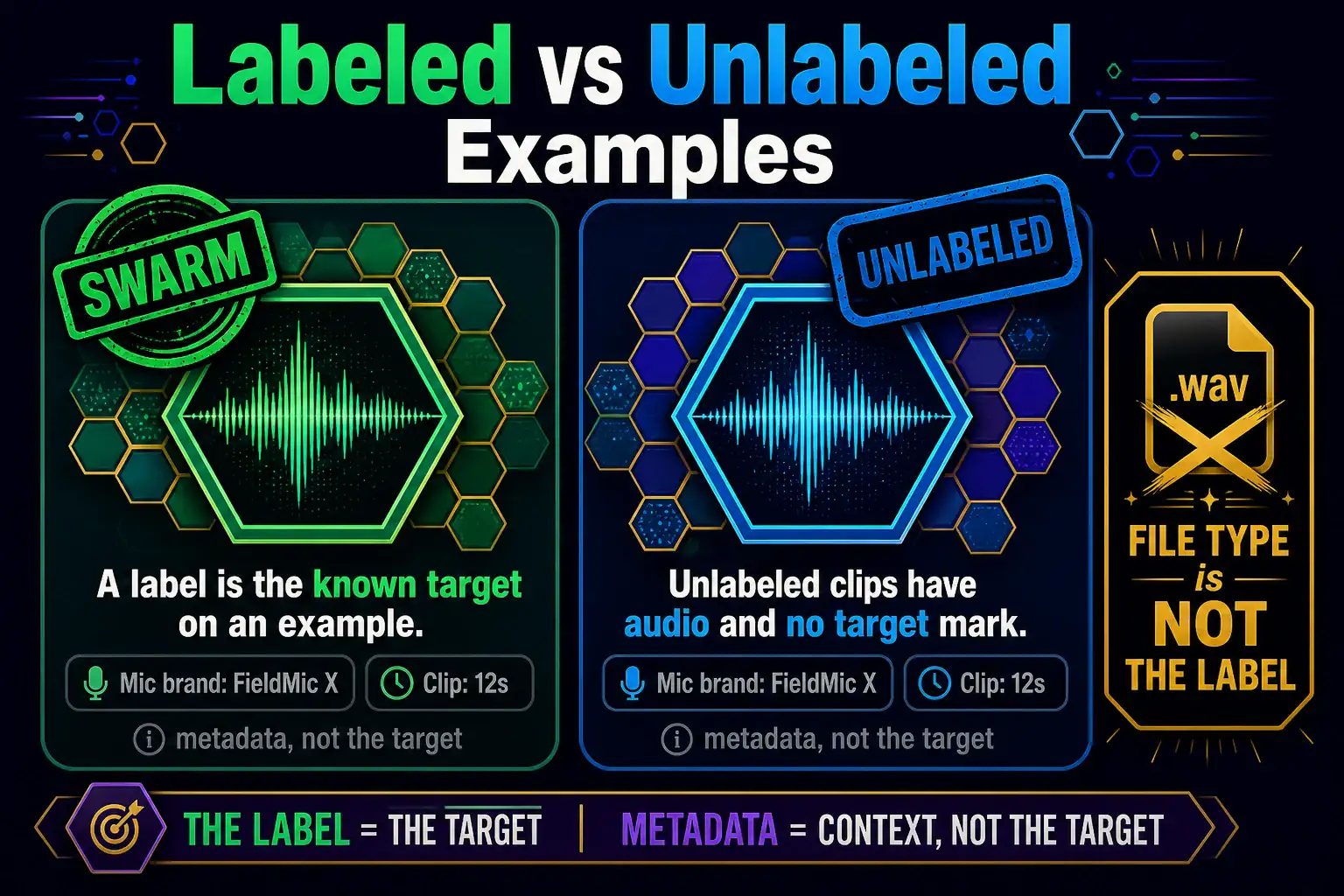
Think of a label like the sticky note on the jar, not the jar itself. Swarm or calm is the known answer on that clip. MP3 versus WAV, the microphone brand, and the clip length are just how the file was stored, not what the model is supposed to learn.
Full Explanation
A label is the known target value attached to a supervised learning example—the answer the model should learn to predict from the input features. For hive audio clips an apiarist has already marked as swarm or calm, those behavioral tags are the labels. They are the supervision signal that turns raw recordings into supervised training rows, not metadata about how the file was stored on disk.
File format such as MP3 versus WAV describes encoding and container choice, not the learning target. Microphone brand is capture-hardware metadata and does not tell the model whether the colony was swarming. Clip length in seconds is a duration attribute; unless the task is explicitly to predict duration, length is not the label. Treating storage details as labels sends the intern to the wrong field and breaks supervised setup.
Exam caveat: anything that is not the prediction target—device IDs, formats, durations—may be a feature, ancillary metadata, or noise, but it is not "the label" unless the task explicitly predicts that field. Operational check: open the annotation store and verify each training row has an explicit swarm/calm (or equivalent) target column separate from path, format, mic brand, and duration; reject or quarantine rows missing that target before any training job runs.