
A county fair runs a photo-scoring booth only three weekends a year. Traffic spikes for those days and is otherwise zero. The team does not want to pay for an always-on dedicated host in January. Which inference hosting style fits?
Select an answer to reveal the explanation.
Short Explanation
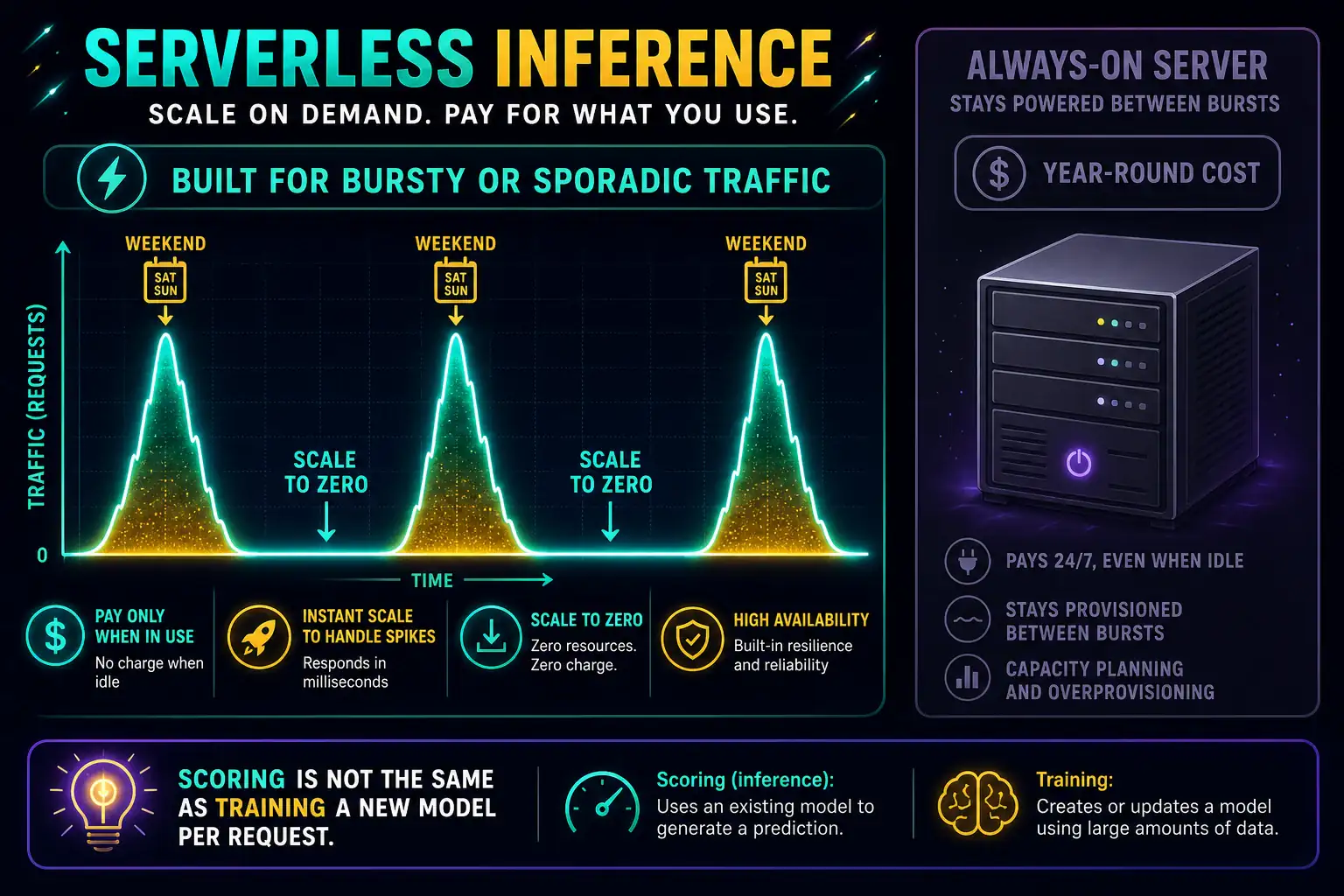
Think of a carnival booth that only opens three weekends. Serverless inference is the host that can go dark in January and wake up when the line appears. An always-on box burns money all year, and scoring a guest photo is not a reason to train a new model at the door.
Full Explanation
Serverless inference hosting can scale out for traffic spikes and scale to zero when idle, so you pay for actual invocations rather than idle dedicated capacity year-round. A county fair photo-scoring booth that runs only three weekends a year, spikes those days, and otherwise sees zero traffic is a textbook serverless fit: wake for the burst, sleep in January.
A dedicated host that stays powered all year burns cost through long idle months the team explicitly wants to avoid. Nightly batch scoring of every county tax record is a different workload and a different inference pattern; it does not address weekend guest-photo bursts at the fair booth. On-device training of a new model each time a guest arrives confuses inference hosting with continual training and is unnecessary, expensive, and unstable for a seasonal scoring booth.
Exam caveat: scale-to-zero plus bursty or seasonal traffic are the serverless cues; always-on dedicated hosts fit steady, latency-sensitive load that justifies paying for idle capacity. Operational check: configure concurrency limits and cold-start budgets for opening weekend, pre-warm if the first-guest latency SLA is strict, run a load test that mimics fair arrival waves, and confirm billing shows near-zero cost in the off season.