
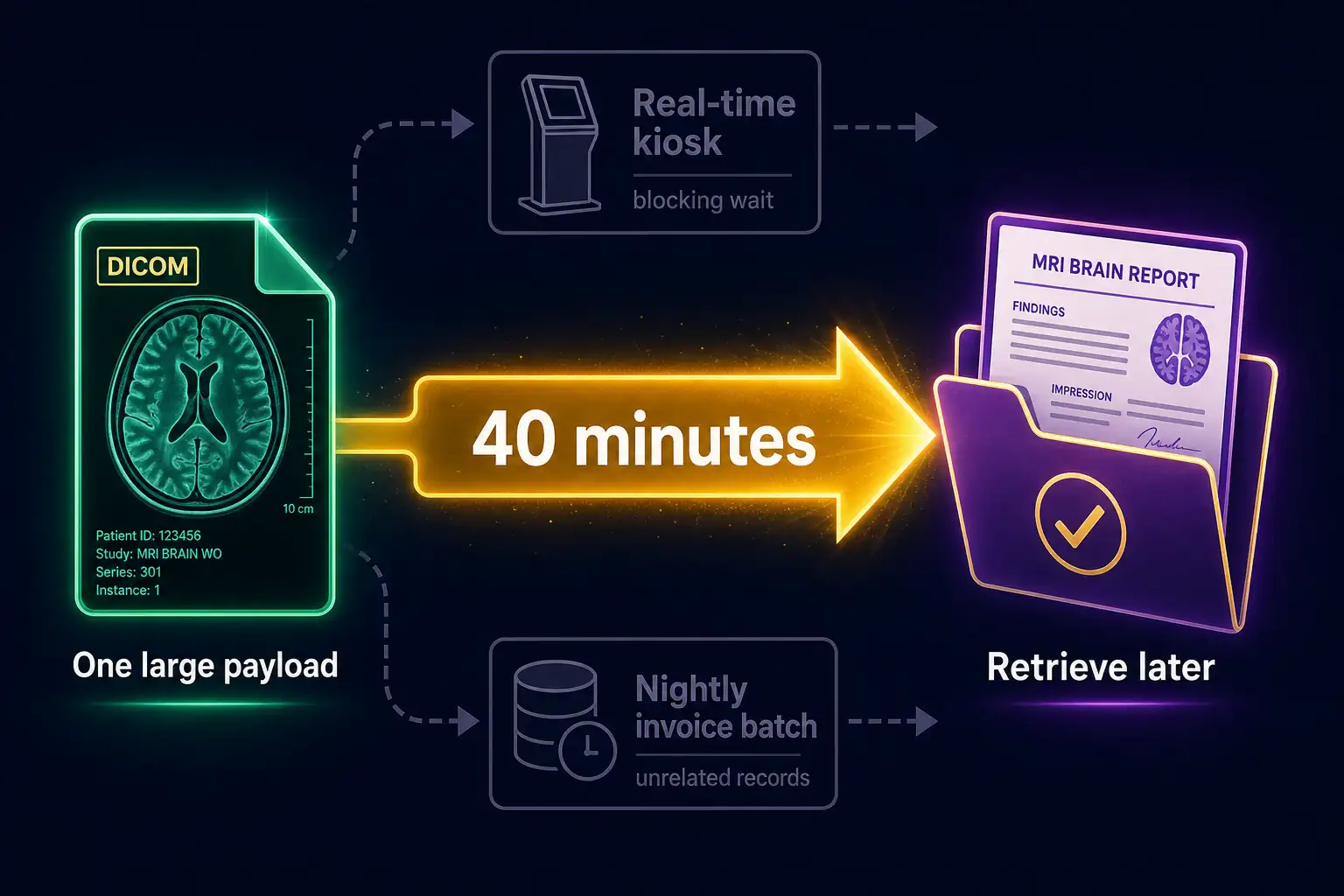
A veterinary hospital submits one 4-gigabyte MRI study for a specialist model. The study takes about 40 minutes to score, and the radiologist picks up the result later in the patient chart. The hospital is not waiting at a kiosk, and it is not mixing this study into a nightly pile of unrelated invoices. Which inference style fits?
Select an answer to reveal the explanation.
Short Explanation
Think of it like dropping a film off at the lab and picking up the prints later. One huge MRI study that takes 40 minutes is a single long job with a deferred result, which is asynchronous inference. It is not a kiosk wait, and it is not a nightly pile of unrelated invoices.
Full Explanation
Asynchronous inference handles a single long-running or large payload where the client submits work and retrieves the result later rather than blocking in a short interactive wait. One 4 GB MRI study that takes about 40 minutes, with the radiologist picking up the result later in the chart, matches asynchronous inference: large individual payload, long runtime, deferred result.
Real-time inference implies a short, blocking wait suitable for kiosks or gates; a 40-minute score is not real-time even if the patient remains in the building. Batch inference aggregates many unrelated records on a schedule (for example a nightly invoice pile); this is one study, not a mixed nightly stack. File size alone does not turn scoring into training—training fits parameters from labeled examples; here a specialist model is applied to a new study.
Exam caveat: "patient still on site" does not force real-time; choose the style by latency tolerance and payload shape, not by whether someone is physically present. Operational check: submit the study to an async queue with job ID, notify when the chart result is ready, and alert if runtime exceeds an agreed clinical SLA—without forcing a radiologist to hold an HTTP connection for 40 minutes.