
A ferry terminal has two scoring jobs. Job A must accept or reject a boarding pass at the gate in under 200 milliseconds. Job B scores every cargo manifest from the previous day in one overnight run and nobody waits at a counter for those scores. Which pairing matches inference style to the job?
Select an answer to reveal the explanation.
Short Explanation
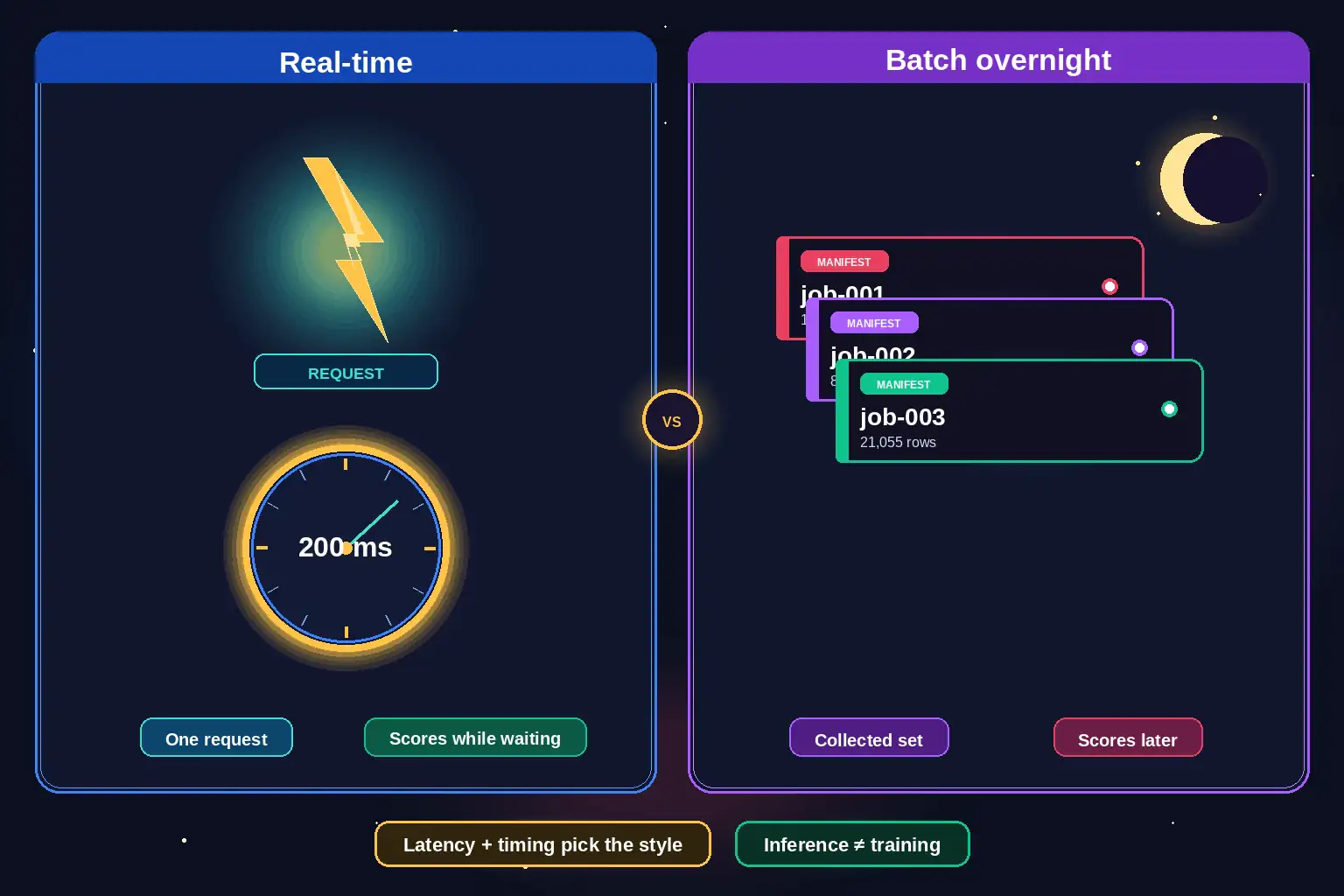
Think of Job A like a turnstile and Job B like the night accountant. The gate has to say yes or no while someone is standing there (real-time). Last night's cargo pile can wait until morning (batch), and a crowded boat does not turn a per-pass check into a batch job.
Full Explanation
Real-time inference scores an individual request against a tight latency budget while a user or gate process waits for the answer. Batch inference scores a collection of records on a schedule when no interactive waiter needs an immediate response. At the ferry terminal, Job A must accept or reject a boarding pass in under 200 milliseconds at the gate—that is real-time inference. Job B scores every cargo manifest from the previous day in one overnight run with nobody waiting at a counter—that is batch inference.
Calling Job A batch because many passengers board the same vessel confuses concurrency of people with the inference pattern; each pass is still an interactive, low-latency decision. Calling Job B real-time because cargo is valuable confuses business importance with latency class; valuable cargo can still be scored asynchronously overnight. Calling both training jobs is wrong: both apply an already trained model to new inputs, which is inference, not parameter fitting.
Exam caveat: passenger volume or cargo value does not redefine real-time versus batch—the presence of a waiting human or process and the latency SLA do. Operational check: put Job A on a warm, low-latency endpoint with a hard 200 ms budget and a documented fallback lane process; schedule Job B as a nightly batch with completion alarms before the morning cargo desk opens.