
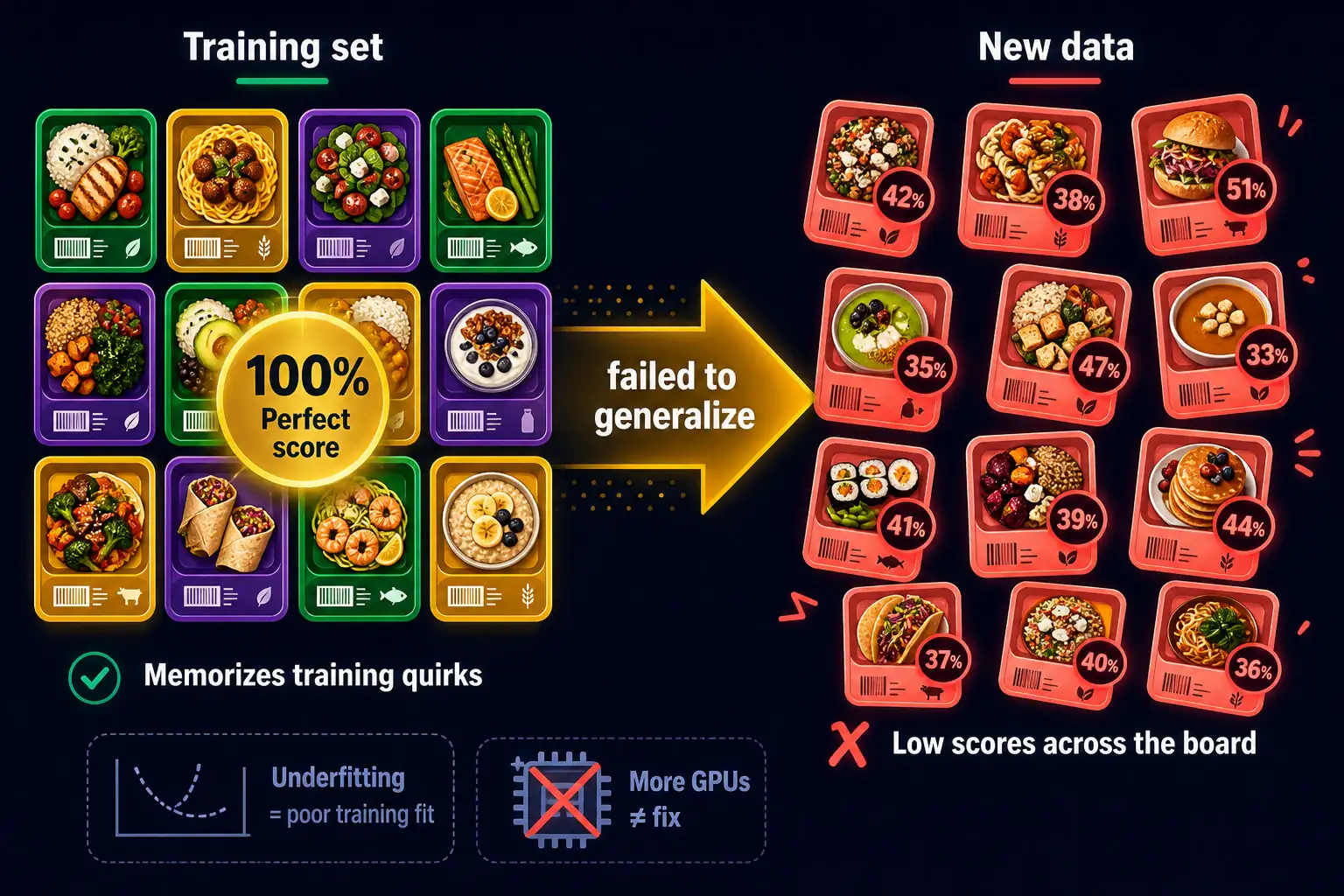
A greenhouse trial has twelve trays. A model memorizes which tray IDs had a cracked moisture probe and scores 100 percent on those twelve. The next season, new trays with intact probes are scored poorly. What happened?
Select an answer to reveal the explanation.
Short Explanation
Think of a student who memorizes the twelve tray ID numbers instead of learning what a dry plant looks like. Perfect on the old trays, lost on the new season. That is overfitting, the opposite of underfitting, and extra GPUs will not un-memorize a cracked probe.
Full Explanation
Overfitting occurs when a model memorizes idiosyncrasies of the training set instead of learning generalizable patterns, so training performance looks excellent while new data fails. Memorizing which of twelve tray IDs had a cracked moisture probe and scoring 100 percent on those trays, then failing on new trays with intact probes, is textbook overfitting to a training quirk.
Needing more GPUs at inference addresses compute capacity, not the generalization failure shown by the next season's poor scores. Underfitting is the opposite pattern: weak performance even on training data because the model is too simple or under-trained; high training accuracy with poor new-tray performance is not underfitting. Batch inferencing is a scoring style for many records offline; it does not diagnose why the model latched onto probe quirks.
Exam caveat: 100 percent training accuracy on a tiny labeled set is a warning light for memorization, especially if identifiers or sensor fault flags leaked into features. Operational check: drop tray IDs and probe-fault indicators from features if they are not legitimate predictors, evaluate on a held-out season or cross-greenhouse split, and track the train–test gap before expanding the trial.