
A campus facilities desk has two requests. Request 1: given "the chiller on roof 2 is down," look up the asset, open a lockout permit, schedule a vendor, and confirm parts. Request 2: "What is the setpoint for chiller 2?" answered in one reply with no follow-on actions. Which pairing is accurate?
Select an answer to reveal the explanation.
Short Explanation
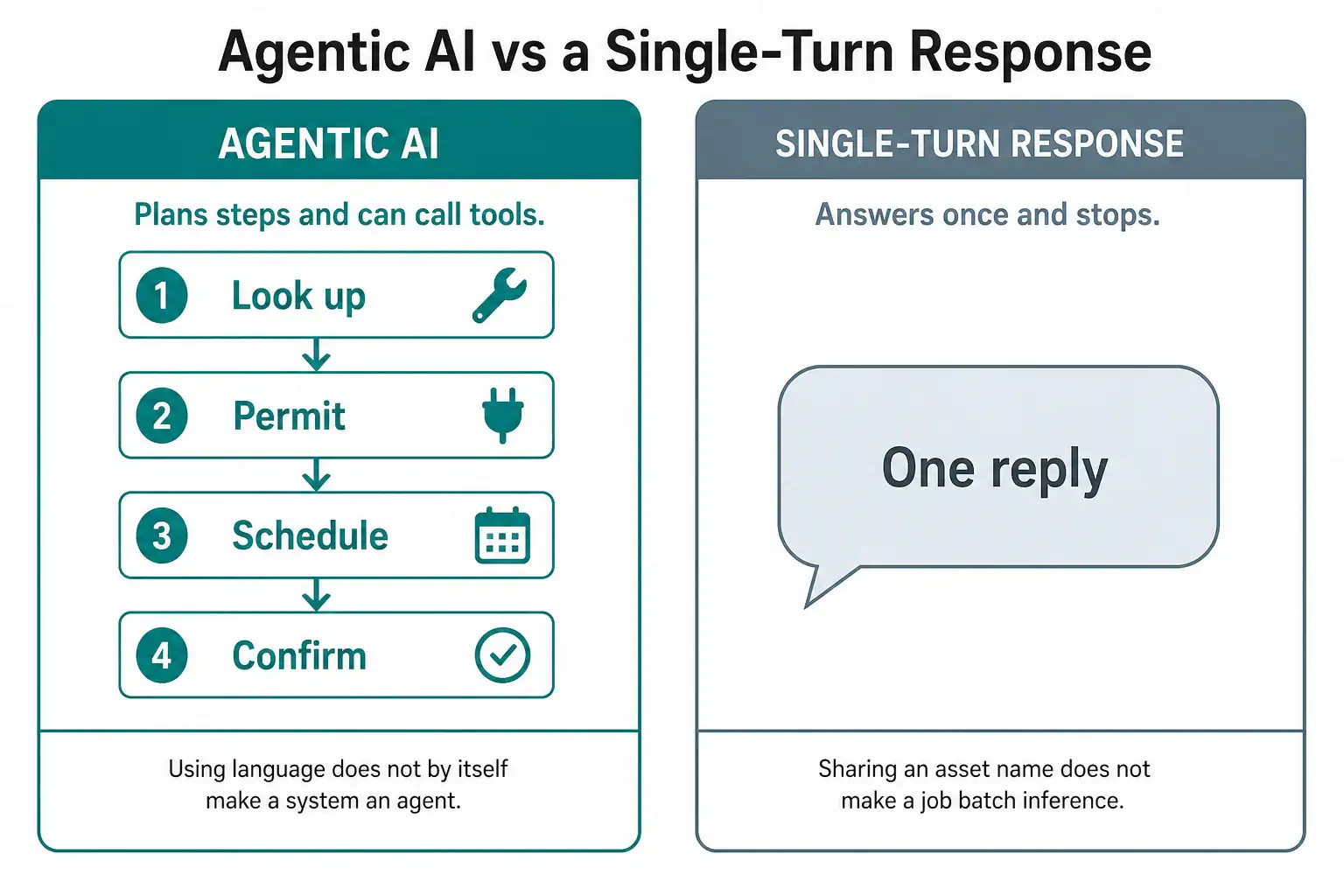
Think of Request 1 like a dispatcher who looks up the asset, cuts a permit, books the vendor, and checks parts. Request 2 is one question, one answer, done. An agent plans steps and uses tools; a single-turn reply just talks and stops.
Full Explanation
Agentic AI plans multi-step work, calls tools, and pursues a goal across actions. A single-turn generative response answers one prompt without tool orchestration. Request 1 requires looking up the asset, opening a lockout permit, scheduling a vendor, and confirming parts—plan, tools, and multiple steps—so it is agentic. Request 2 is a one-shot setpoint question with no follow-on actions, so it is a single-turn generative response.
Calling both batch inferencing because they mention the same chiller confuses a shared entity with an inference hosting pattern; batch means scoring many records offline, not "two tickets about one asset." Calling Request 1 unsupervised clustering misreads a workflow automation need as unlabeled grouping of work orders. Calling Request 2 agentic merely because it uses language empties the word "agent"; language alone does not imply tool use or multi-step planning.
Exam caveat: the test often contrasts chatbots (single response) with agents (tools + multi-step goals); look for verbs like open, schedule, confirm, and look up. Operational check: implement Request 1 with explicit tool permissions and audit logs for permit and vendor actions; keep Request 2 on a simple RAG or FAQ path so a setpoint question cannot accidentally trigger lockout workflows.