
A shipyard needs two tools. Tool A must draft work orders from text and also answer questions about scanned hull diagrams. Tool B only chats about written procedures. Which statement correctly relates a foundation model to a large language model?
Select an answer to reveal the explanation.
Short Explanation
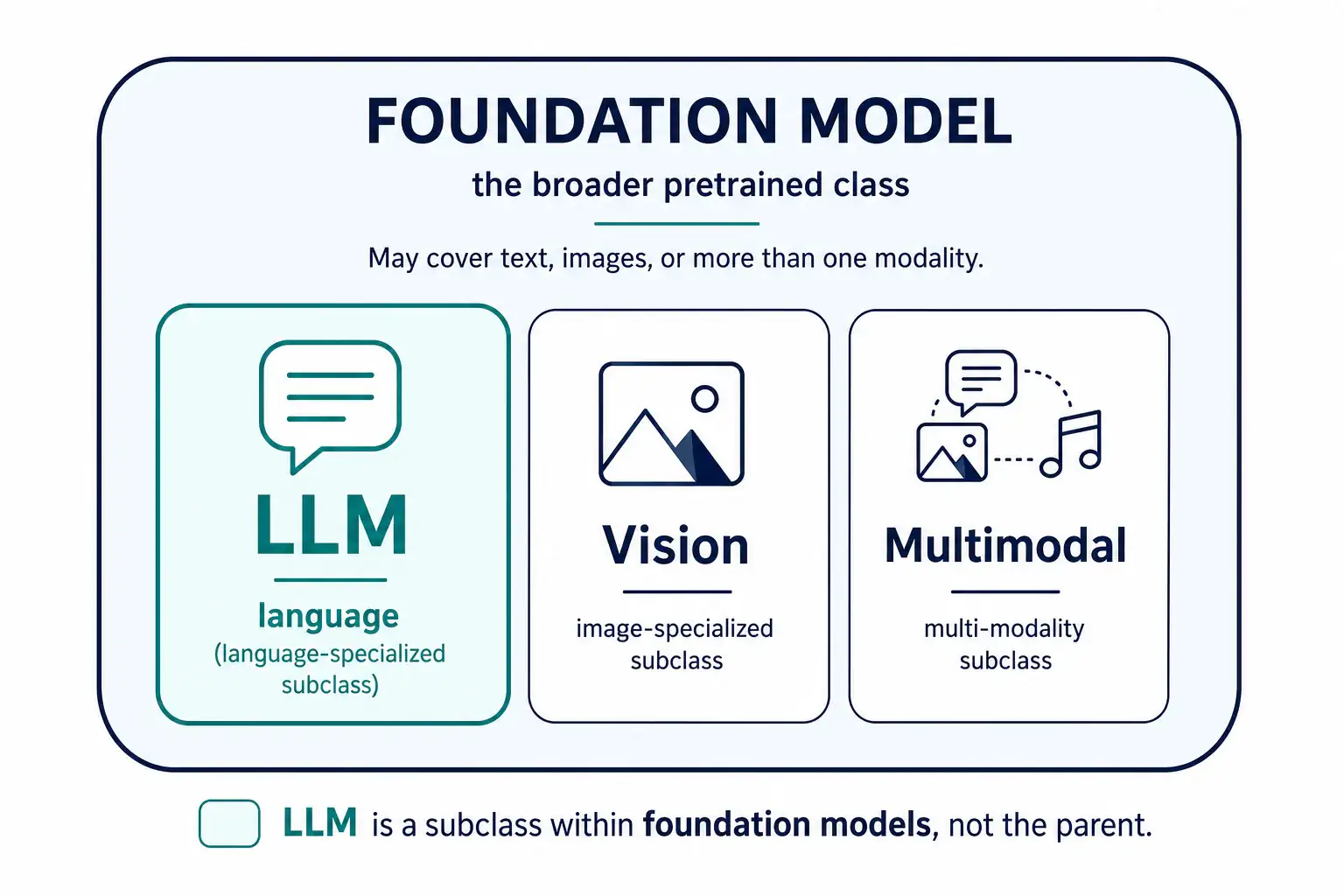
Think of a foundation model like a Swiss Army knife and an LLM like the blade that only does language. Tool B is that language blade. Tool A has to read hull diagrams too, so it needs the broader class, not a claim that LLMs sit on top.
Full Explanation
A foundation model is a broad, pre-trained model class that can be adapted to many downstream tasks and modalities; language is one specialty, but foundation models can also span vision, multimodal inputs, or other domains. A large language model (LLM) is a language-specialized subclass focused on text generation and understanding. Tool A needs draft work orders from text and answers about scanned hull diagrams—language plus visual diagrams—so a broader foundation/multimodal framing fits. Tool B only chats about written procedures, which an LLM can cover. The accurate relation is: foundation model is the broader class; LLM is the language-specialized subclass.
Saying an LLM is the parent class and foundation models generate only images reverses the relationship and invents a false image-only limit. Calling both names for a clustering algorithm confuses generative/foundation model concepts with unsupervised grouping methods. Claiming an LLM cannot process language contradicts the definition of an LLM.
Exam caveat: on AIF-C01, "foundation model" is the umbrella term; LLMs are the text-centric members of that family, not the other way around. Operational check: for Tool A, verify the chosen system can accept diagram images or OCR'd diagram text plus procedures; for Tool B, a text-only LLM endpoint may be enough—avoid buying multimodal capacity you will not use.