
A county grants office wants to tag incoming PDF narratives by research theme so reviewers can sort the pile. The files are prose, not photos and not sensor streams. Which capability should they use?
Select an answer to reveal the explanation.
Short Explanation
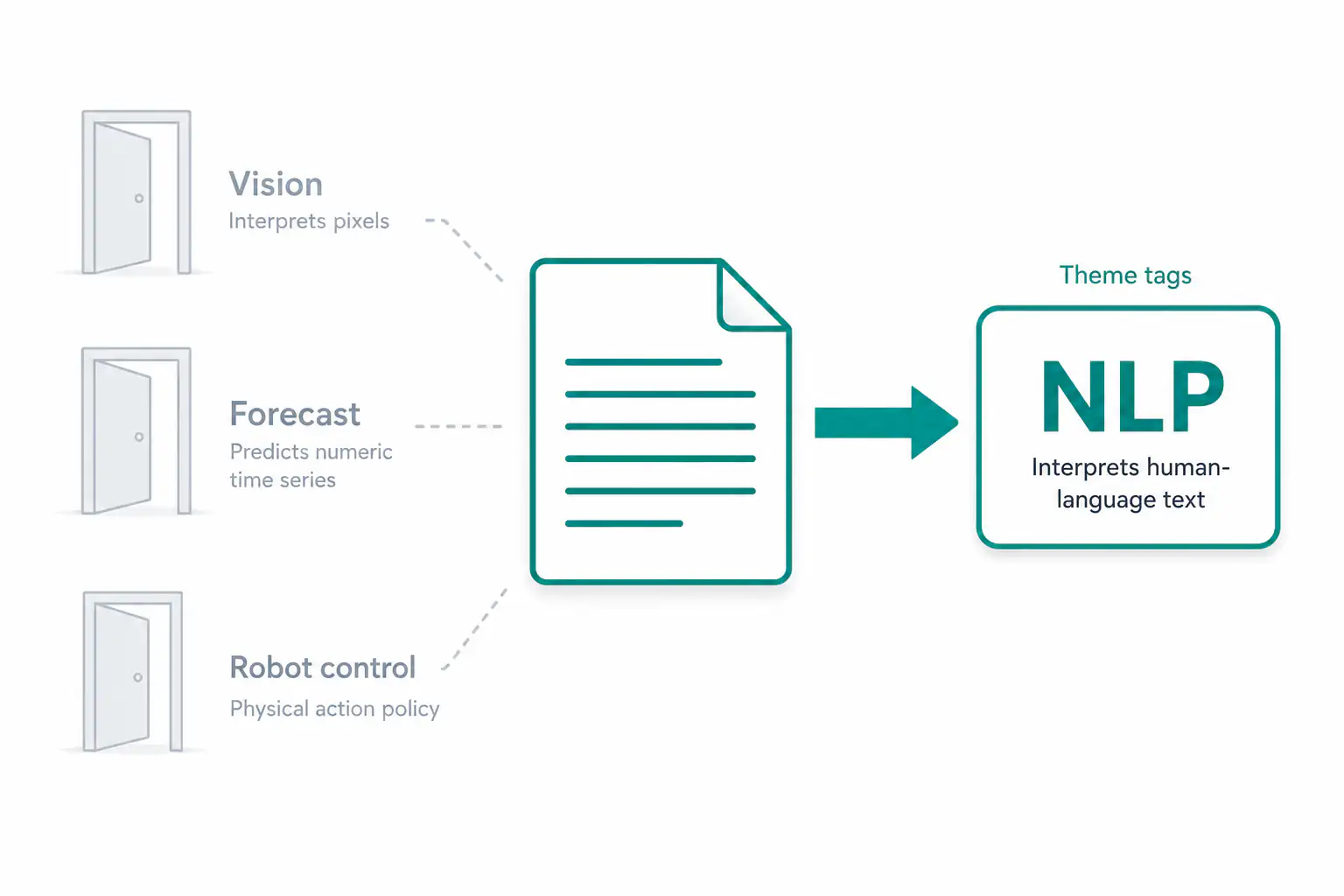
Think of it like a librarian reading the grant and slapping a theme sticker on the folder. The PDFs are prose, so natural language processing is the capability that tags the pile. Vision is for photos, forecasting is for numbers over time, and a robot arm is for moving things, not sorting sentences.
Full Explanation
Natural language processing (NLP) covers machine understanding, classification, and extraction over human language in text or speech transcripts. The county grants office needs to tag incoming PDF narratives by research theme so reviewers can sort the pile; those files are prose documents, not photos and not sensor streams, so NLP—topic classification, embeddings, or related text models—is the matching capability.
Computer vision operates on images and video pixels; it does not tag research themes in written narratives. Time-series forecasting predicts future numeric values along a timeline; theme tagging is a text-labeling job, not a seasonal numeric forecast. A robot-arm control policy concerns embodied actions and control loops in physical space, which has nothing to do with sorting PDF themes for human reviewers.
Exam caveat: PDF packaging does not change the modality—if the useful content is written language, the capability is still NLP even when the container is PDF rather than plain text or HTML. Operational check: extract text reliably (including OCR for scanned pages), define a theme taxonomy reviewers accept, measure tagging quality with precision/recall or reviewer agreement on a labeled sample, and only then auto-sort the incoming pile.