
A rail-maintenance crew wants software that looks at wayside camera frames and marks cracked ties. A vendor offers a speech-to-text agent for radio calls, a ridership forecast, a printed tie-count rule sheet, and a model that interprets pixels. Which capability matches the job?
Select an answer to reveal the explanation.
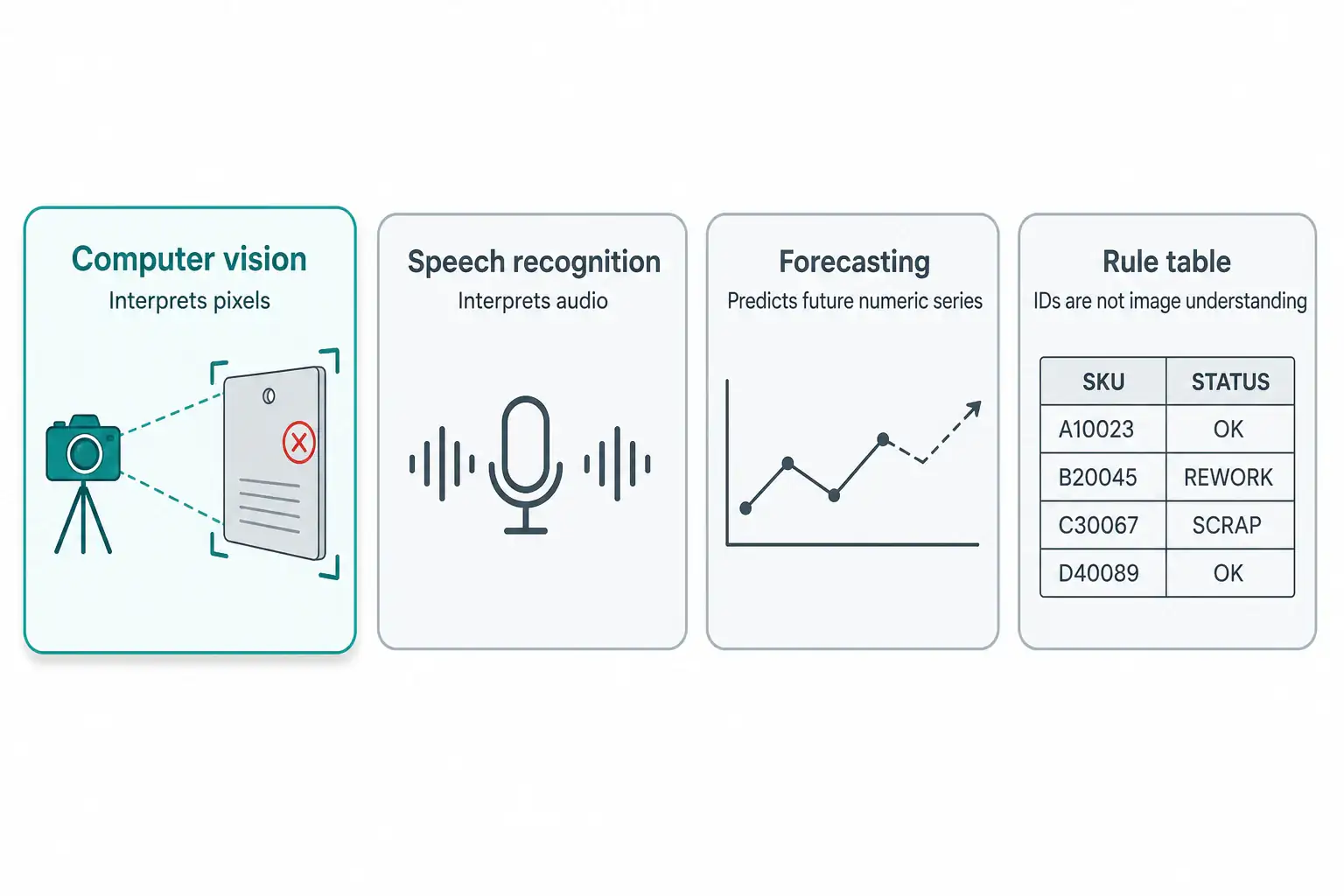
Short Explanation
Think of it like asking a camera to spot a cracked tie, not a radio to transcribe chatter. The job is pixels to a mark, and that is computer vision. Speech-to-text, ridership forecasts, and a printed count sheet are nearby tools that never look at the wood.
Full Explanation
Computer vision interprets visual pixel data to detect, classify, or localize objects and defects. The rail-maintenance crew needs software that looks at wayside camera frames and marks cracked ties; the primary signal is imagery, so the matching capability is computer vision that reasons over pixels rather than over radio transcripts or ridership charts.
Speech recognition converts audio speech to text; it may help document radio calls, but it does not inspect tie images for cracks. Time-series forecasting predicts future values in ordered numeric series such as ridership; the fact that trains run on a schedule does not turn crack detection into forecasting. A deterministic rule table on train numbers ignores visual evidence and falsely treats camera frames as non-data; frames are image data, and train-ID rules cannot see physical defects in the ties.
Exam caveat: match capability to the primary signal modality in the stem—pixels point to vision, prose to NLP, speech audio to speech recognition, and ordered metrics over time to forecasting—even when other modalities exist nearby in the story. Operational check: confirm the production input is the wayside image stream with agreed resolution and lighting, publish a labeling guide for cracked versus intact ties, and evaluate with detection or classification metrics on held-out frames rather than ridership MAPE or speech word-error rate.