
A quarry wants a rockfall-risk score. Plan A feeds four engineered numbers (slope angle, overnight rain, blast count, crack width) into a random forest. Plan B feeds raw geophone waveforms into a multi-layer network that learns its own features. Which pairing is accurate?
Select an answer to reveal the explanation.
Short Explanation
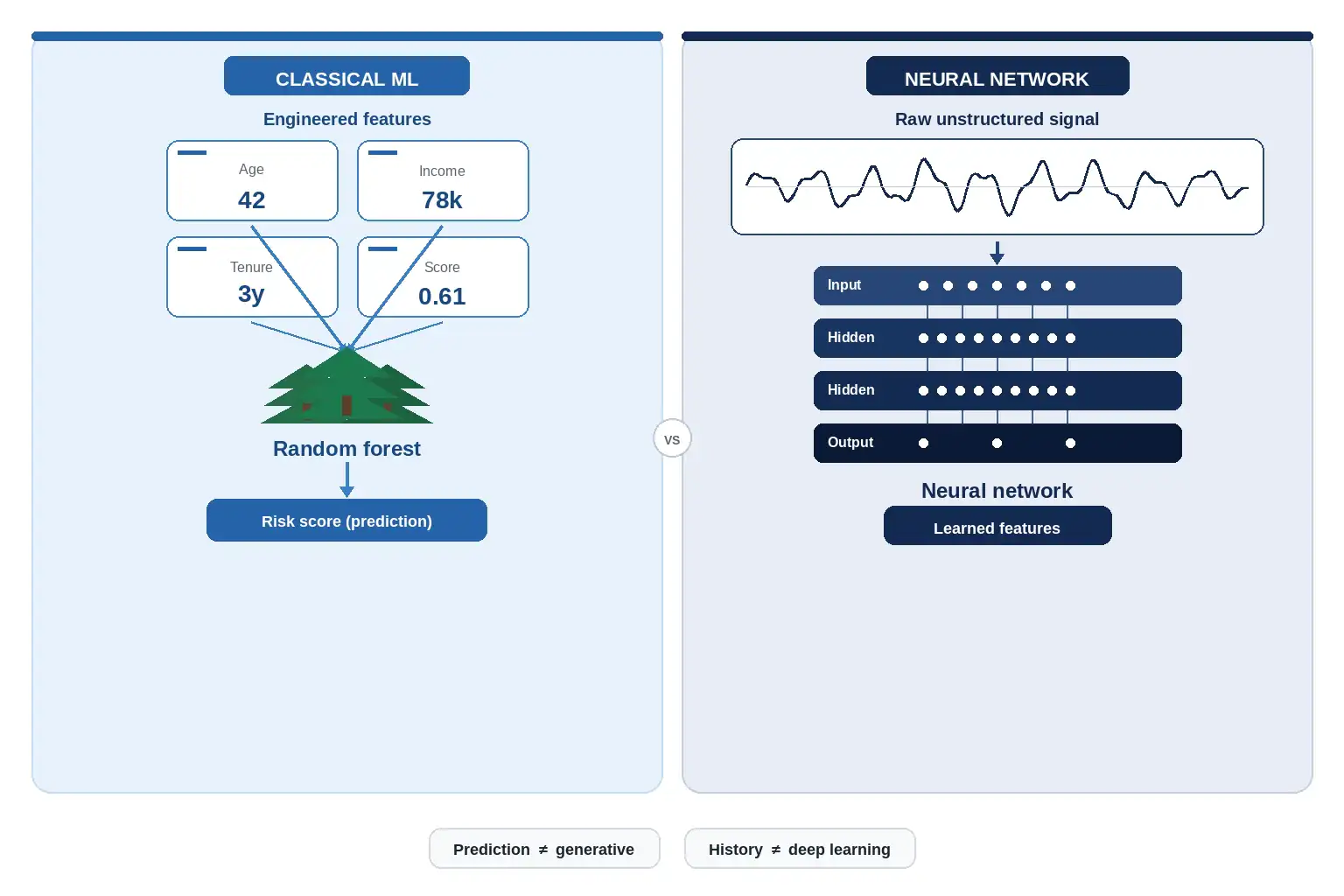
Think of Plan A like a clerk with four filled-in boxes, and Plan B like someone who listens to the raw rumble and learns what trouble sounds like. A random forest on slope, rain, blasts, and crack width is classical machine learning on engineered numbers. A multi-layer net on geophone waveforms is a neural network chewing unstructured signal, not a generative model just because it outputs a score.
Full Explanation
Classical machine learning often consumes a small set of human-engineered numeric features and algorithms such as random forests. Deep neural networks can consume raw unstructured signals and learn representations internally. Plan A matches classical ML: four engineered numbers into a random forest. Plan B matches a neural-network approach on raw unstructured geophone waveforms that learn their own features.
Calling both plans generative AI because they output a risk score confuses prediction of a risk number with generation of new content; a score is not a synthesized image or passage. Calling Plan A deep learning merely because it uses historical measurements is wrong—historical data appears in almost every ML style, and a random forest on four numbers is not a deep network. Claiming raw waveforms can only be scored by a printed checklist denies the whole point of representation learning: neural networks routinely ingest waveforms, images, and text.
Exam caveat: "outputs a number" does not make a system generative; generative systems create new samples, while discriminative models map inputs to labels or scores. Operational check: for Plan B, verify waveform preprocessing, sampling rate, and windowing; for Plan A, document how slope, rain, blasts, and crack width are measured so feature drift does not silently break the forest.