
A sawmill spends two weeks fitting a board grader on labeled photos of past cuts. After that job ends, the line scores every new board in under a second and does not update the grader from those live boards. Which statement names the two phases correctly?
Select an answer to reveal the explanation.
Short Explanation
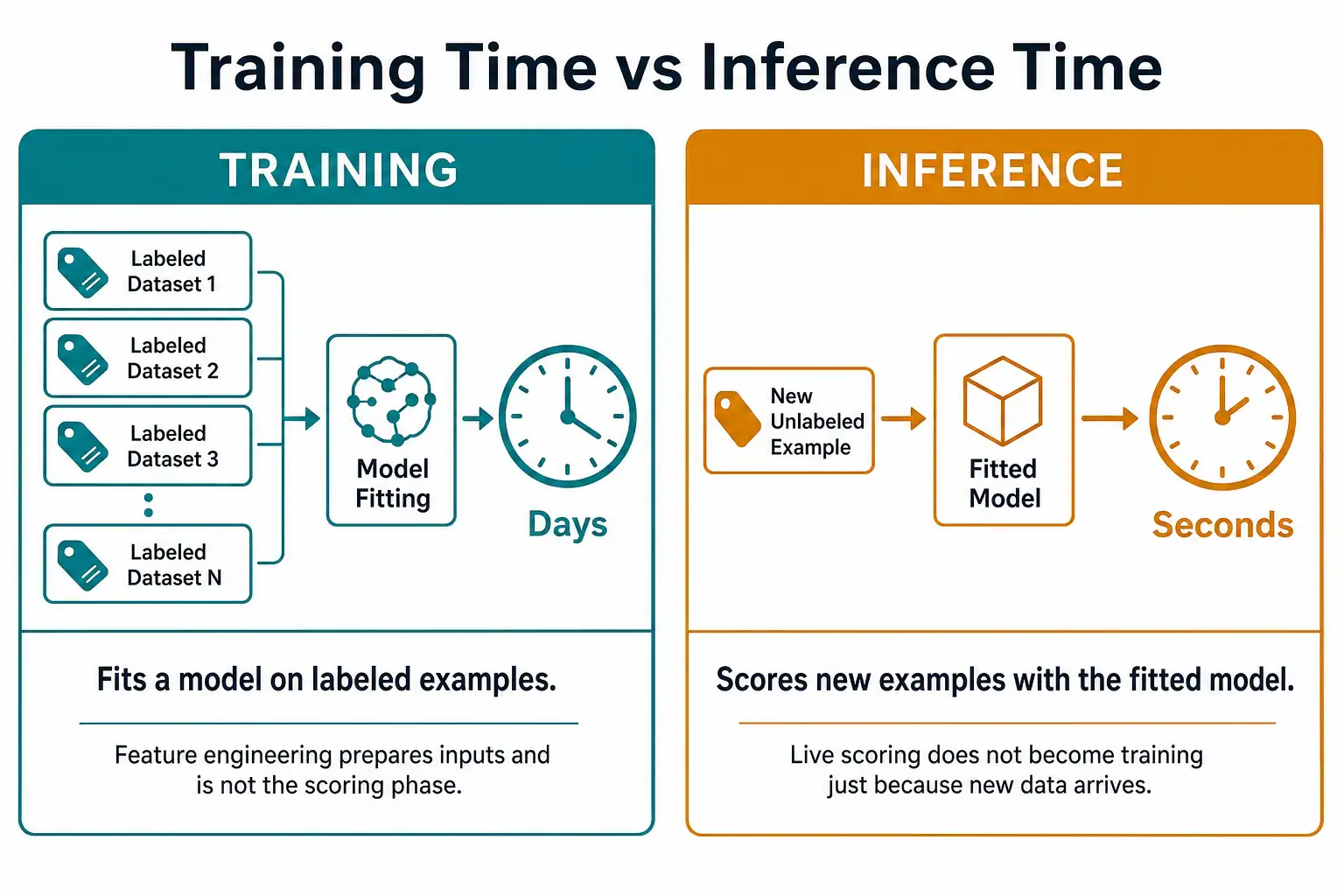
Think of it like teaching someone to grade boards, then putting them on the line. The two-week fit is school (training). The under-a-second score on a new board is the test they already know how to take (inference), and watching boards go by does not become more school unless the grader gets updated.
Full Explanation
Training is the phase that fits a model on labeled examples so parameters learn the task. Inference (scoring) is the later use of that fixed model on new examples without updating weights from those live cases. The sawmill's two-week fit on labeled past cuts is training; the under-a-second grade on each new board without updating the grader is inference.
Calling live scoring "training" because the mill still observes product mix confuses data collection with parameter updates—observation alone is not training unless the model is being refit. Claiming both phases are inference merely because photographs are involved mixes modality with lifecycle stage; photos can appear in training and in inference. Swapping the names—calling the fit inference and live scoring feature engineering—mislabels both: feature engineering prepares inputs, and the two-week job is the learning phase, not scoring.
Exam caveat: inference does not require a human waiting at a kiosk; any scoring of new data with a fitted model counts, including high-throughput line scoring. Operational check: ensure the production pipeline loads a frozen model artifact, disables online weight updates on the grader, and only schedules retraining as an explicit offline job when drift metrics justify it.