
A dairy cooperative is building a milk-spoilage predictor. They hold eight years of labeled cooling-log examples, they chose gradient boosting as the learning procedure, and after the job finishes they will ship a file that scores new cooling logs. Which object is the learned artifact they will deploy?
Select an answer to reveal the explanation.
Short Explanation
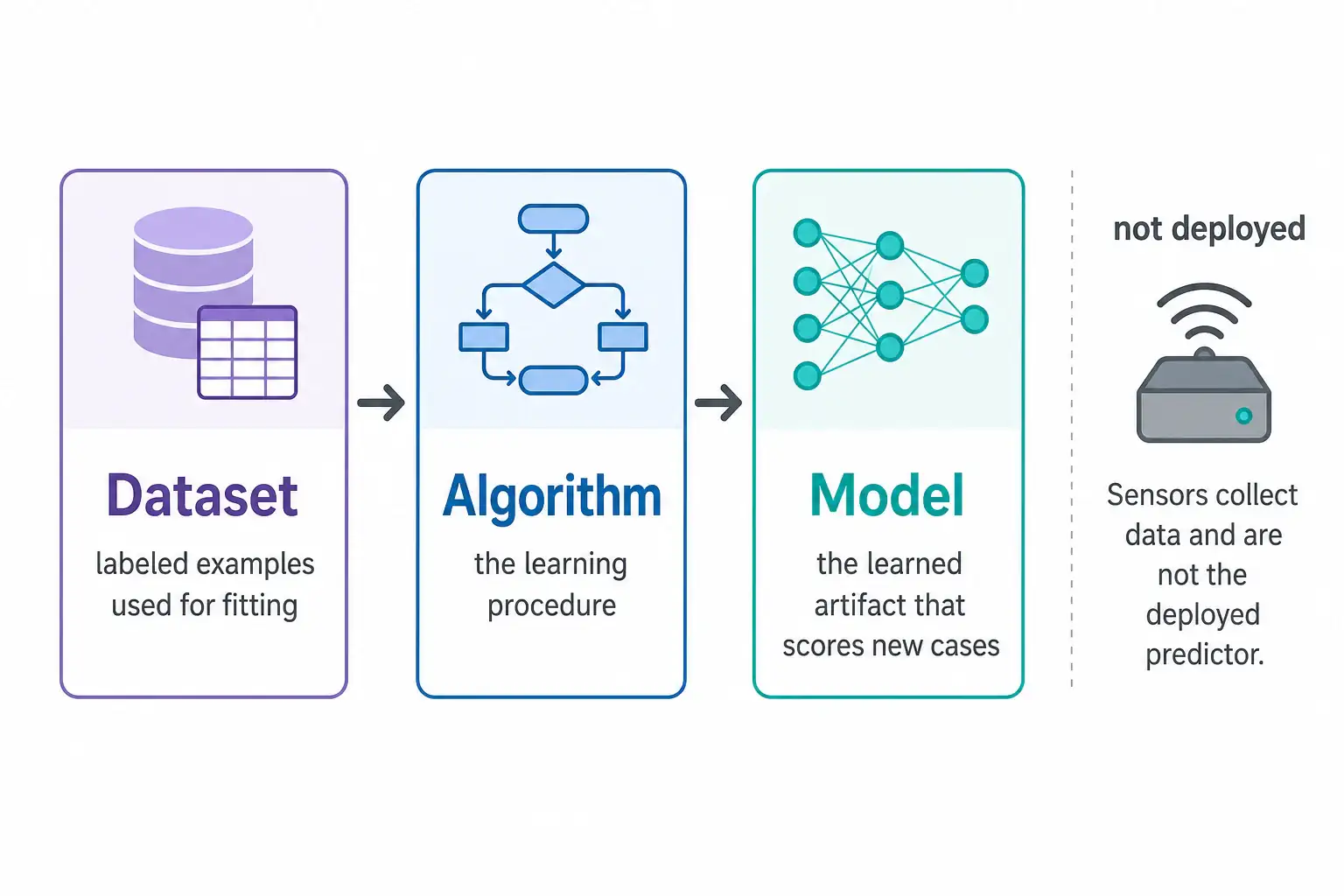
Think of it like baking. The recipe is the algorithm, the labeled cooling logs are the ingredients, and the finished cake is the model you actually serve. Sensors just measure the kitchen; they are not what you ship to score a new vat.
Full Explanation
In ML vocabulary, the algorithm is the learning procedure, the dataset is the collection of examples, and the model is the fitted artifact produced after training—the parameters or ensemble that scores new inputs. The dairy cooperative will deploy the file that scores new cooling logs; that deployable predictor is the trained model, not the recipe that created it and not the raw history used to fit it.
Gradient boosting is the algorithm (the procedure or recipe), not the finished artifact you ship to production. The eight-year labeled collection is training data consumed during fitting; you do not send the entire history to every scoring request as if the warehouse itself were the predictor. Cooling sensors are instrumentation that produce feature measurements; they observe the vat, they do not embody the learned mapping from cooling logs to spoilage risk.
Exam caveat: AIF questions frequently mix up algorithm, model, and dataset—remember the chain "algorithm trains on data to produce a model," then the model alone is what inference loads. Operational check: before go-live, version the model artifact separately from the training dataset and the boosting library version, confirm production scores the live feature vector with the saved model rather than re-running training, and smoke-test one new vat log end-to-end against the deployed file.