
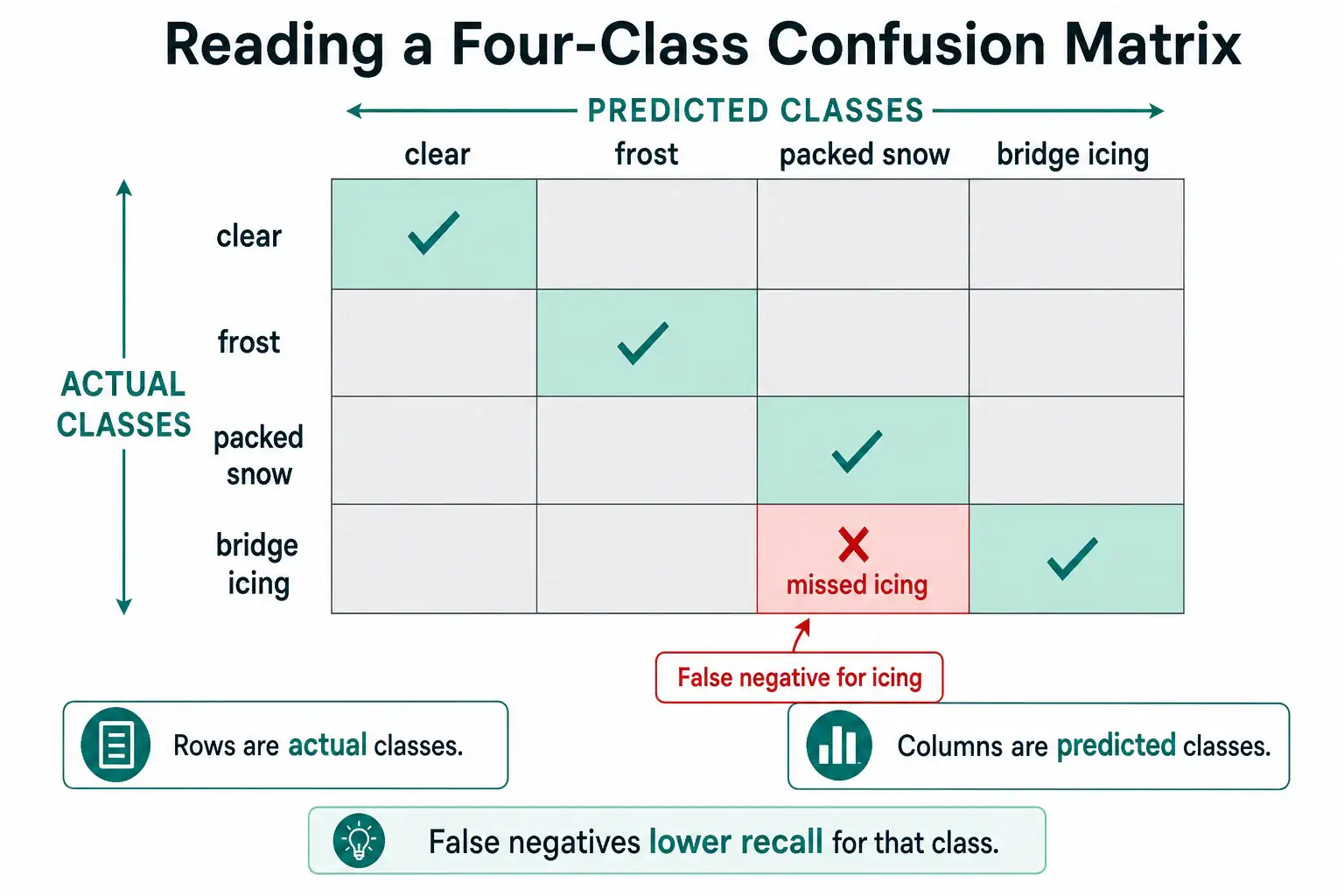
A state department of transportation trained a four-class winter-road model: clear, frost, packed snow, and bridge icing. In the confusion matrix, 22 events that were actually bridge icing were labeled packed snow. Leadership wants fewer missed icing events. Which statement is correct?
Select an answer to reveal the explanation.
Short Explanation
Think of recall like a smoke alarm that must not sleep through a fire. Those 22 real icing events called packed snow are missed icing cases — false negatives — and missed cases are exactly what drag recall down. They are not "correct packed snow" hits, and swapping in RMSE would be using a measuring tape on a four-way sorting job.
Full Explanation
In a multi-class confusion matrix, a false negative for a class is an actual instance of that class assigned to a different label. The 22 events that were truly bridge icing but predicted as packed snow are missed icing cases—false negatives for bridge icing. Recall for a class is true positives over all actual positives, so those misses directly lower recall for bridge icing. Leadership's goal of fewer missed icing events is exactly a recall improvement goal for that class.
Calling them true positives for packed snow is incorrect: a true positive for packed snow would be actual packed snow predicted as packed snow; these events were icing. Calling them false positives for icing is also wrong: a false positive for icing would be a non-icing surface predicted as icing. Replacing classification metrics with RMSE mismatches the problem type—RMSE measures continuous numeric error for regression, not multi-class road-condition labels.
Exam caveat: always anchor FN/FP/TP/TN to a named class of interest; the same cell can be an FN for icing and an FP for packed snow, but leadership asked about missed icing, so the FN/recall framing wins. Operational check: pull the icing row of the confusion matrix, compute recall, and track whether threshold or rebalancing changes reduce icing false negatives without creating unsafe false alarms that close roads without cause.