
A salmon hatchery needs one number: next month's returning-adult count. Planners will use water temperature, release year, and river flow. They have no high-or-low return labels, and they are not trying to group rivers into unnamed segments. Which technique should they use?
Select an answer to reveal the explanation.
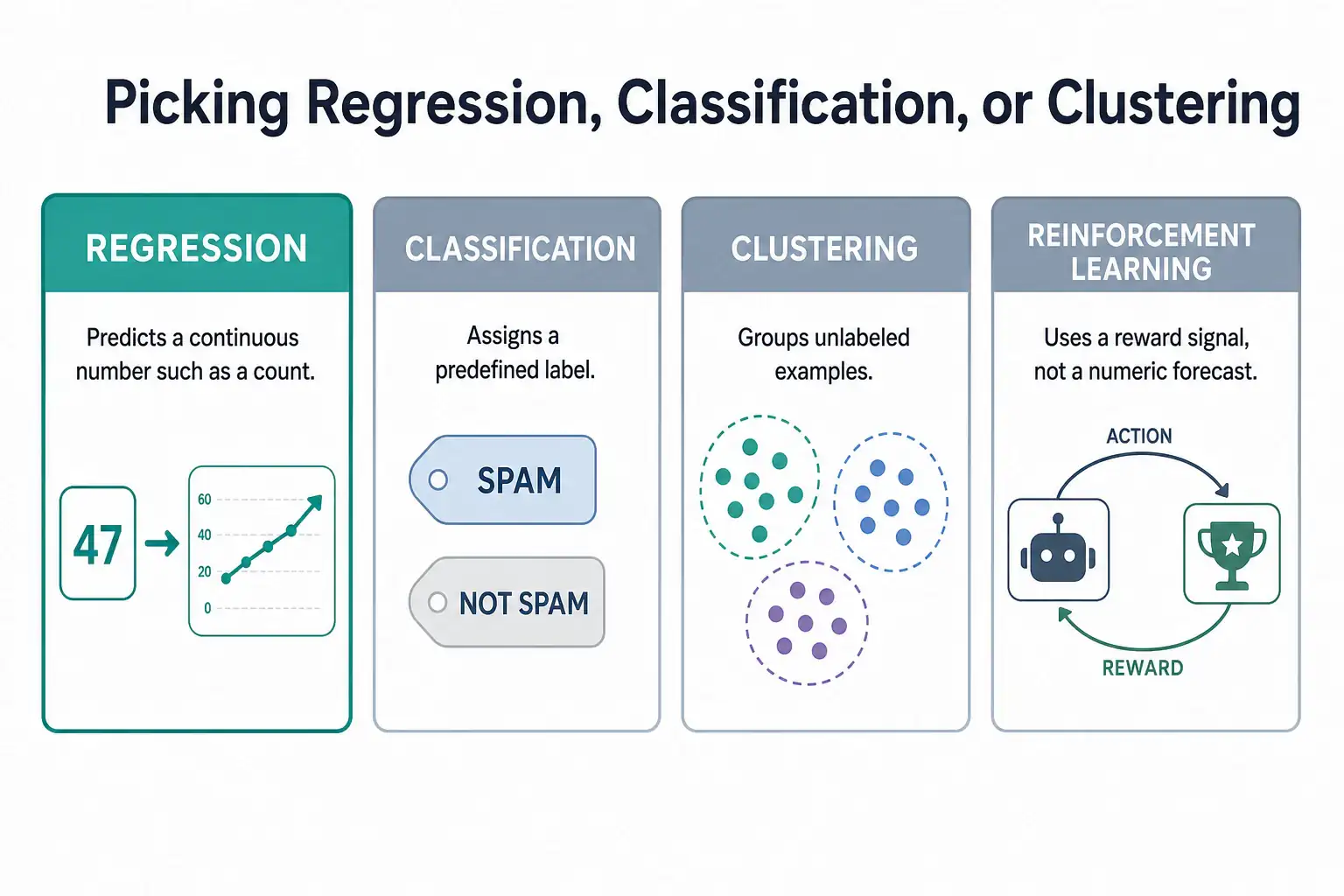
Short Explanation
Think of it like asking for the temperature, not "hot or cold" and not "which pile does this river belong in." A returning-adult count is a single number on a number line, and that is what regression is built to spit out. Classification wants named buckets, clustering wants unnamed groups, and reinforcement learning wants a score after each move — none of those is next month's headcount.
Full Explanation
Regression estimates a continuous numeric target from input features. The hatchery needs one number—next month's returning-adult count—from water temperature, release year, and river flow. That target lives on a number line, not in a named class, so a regression model is the matching technique.
Clustering would partition rivers or seasons into unlabeled groups of similar records; planners explicitly said they are not seeking unnamed segments. Binary classification would force artificial buckets such as high versus low return and would discard the precise count operations need for feed and staffing. Reinforcement learning trains an agent with trial-and-error rewards; it is not the default method for producing a single historical-style forecast from sensor and release features when no sequential control policy is being optimized.
Exam caveat: if the stem asks for "how many" or "what value" without predefined class names, think regression; if it asks "which category," think classification. Operational check: validate that labels (or targets) in the training table are raw adult counts, not hand-assigned high/low tags, and that evaluation uses numeric error metrics such as MAE or RMSE rather than accuracy on invented classes.