
A university archive approves research-loan requests with a six-rule checklist: requester affiliation, object on exhibit, insurance certificate, condition report, prior damage, and a duration cap. The checklist is stable, and a clerk can apply it in minutes. A vendor proposes a six-month machine learning project to predict approvals from five years of past decisions. Which action should the archive take?
Select an answer to reveal the explanation.
Short Explanation
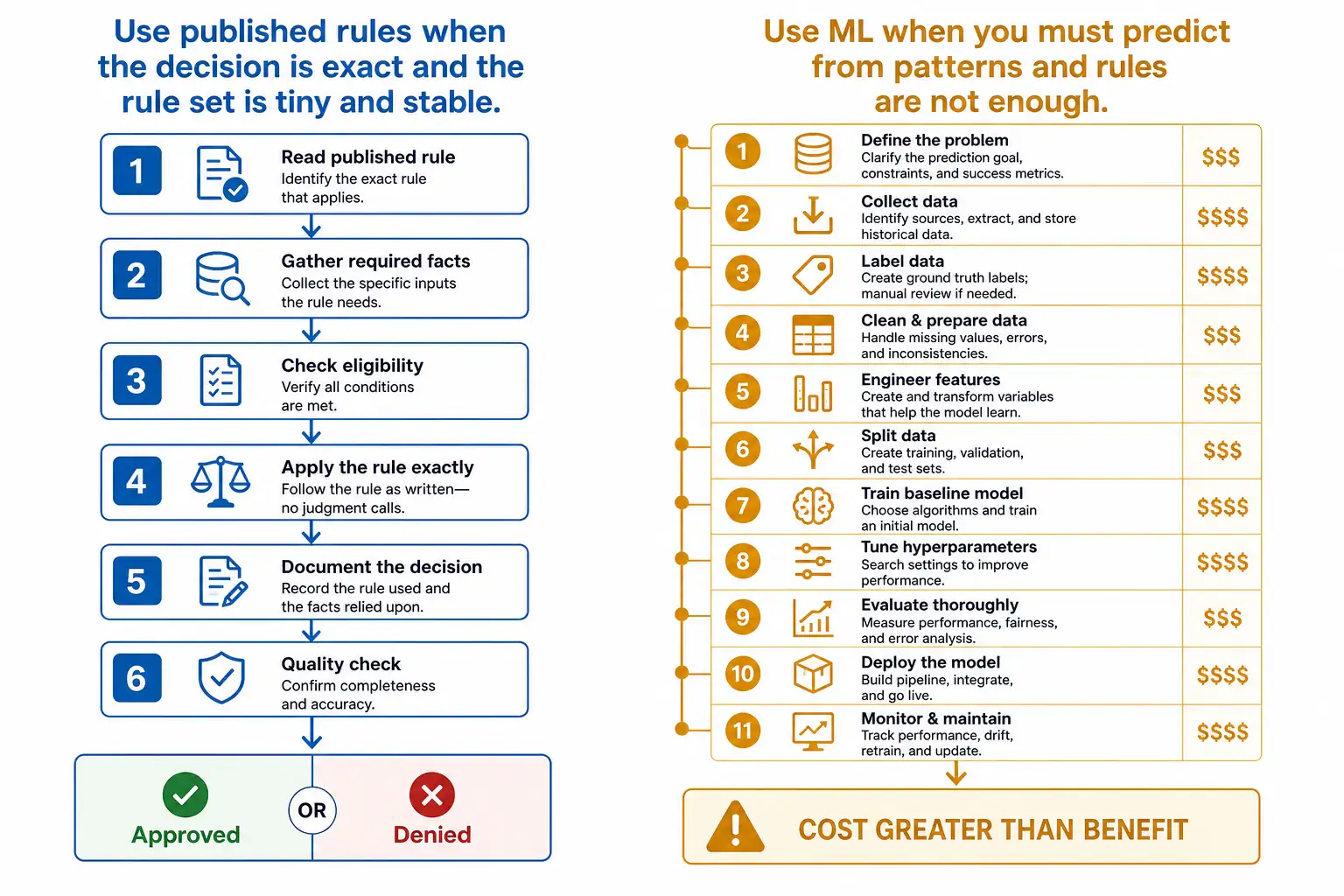
Think of it like hiring a consultant to predict whether a light switch is on, when six labeled switches already sit on the wall. The archive already has a tiny, stable checklist that gives a clean yes or no in minutes, so a six-month model is spending a fortune to guess what the rules already decide. Clustering and random try-and-see learning would just wander off the handbook.
Full Explanation
Machine learning pays off when patterns are complex, outcomes are hard to encode as rules, or labeled history reveals relationships humans cannot write down cheaply. Here the archive already has a six-rule checklist that is stable, published, and applies in minutes to produce the exact yes-or-no loan decision. A six-month predictive project would spend time and budget to approximate a decision the handbook already determines. Declining the project and keeping the checklist is the correct economic and operational choice.
Training a classifier on past approvals assumes historical decisions remain valid if handbook rules change; in reality rule rewrites would invalidate labels and force rework, while the live checklist can be updated in place. Clustering requesters and auto-approving a favored cluster ignores mandated checks such as insurance and condition reports and would create inconsistent, non-compliant loans. Reinforcement learning that tries random approvals and learns from complaints treats regulated custody as an exploration problem and risks damage, liability, and trust—none of which the archive needs when rules already decide the outcome.
Exam caveat: AIF-style questions often ask when NOT to use ML; a tiny, stable, complete rule set with a clear binary outcome is a classic "do not build a model" signal. Operational check: document the six checks, measure clerk cycle time, and only reopen an ML discussion if the handbook grows into hundreds of interacting exceptions that clerks cannot apply consistently.