
A municipal transit agency trains a traffic-signal controller that chooses a phase plan at each intersection. After every cycle the controller receives a numeric score based on leftover queue length and pedestrian wait time. Engineers have no labeled dataset of correct phase plans. Which learning approach is the agency using?
Select an answer to reveal the explanation.
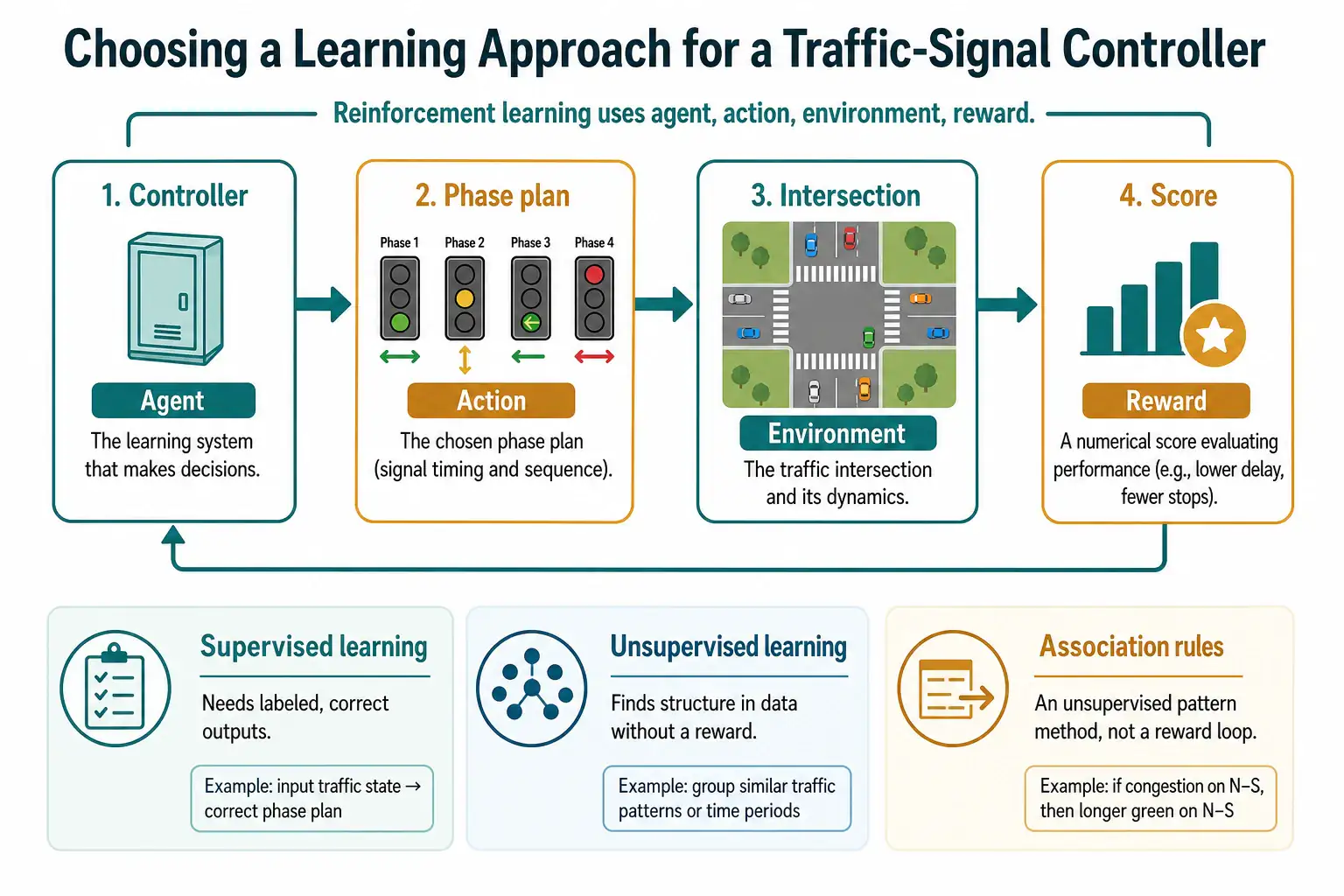
Short Explanation
Think of it like teaching a dog with treats instead of flashcards. The controller tries a phase plan, the intersection scores leftover queues and wait time, and the next choice gets a little smarter — that is a reward loop, not a labeled answer key. Supervised learning would need the "right" plans already written down, and unsupervised learning just looks for clumps in the data with no score at all.
Full Explanation
Reinforcement learning trains an agent that acts in an environment, observes outcomes, and updates its policy from a reward or penalty signal rather than from labeled correct answers. The transit controller chooses a phase plan, then receives a numeric score from leftover queues and pedestrian wait time; engineers have no dataset of "right" plans. That closed loop of action, environment feedback, and policy update is the defining pattern of reinforcement learning and matches the agency's design.
Supervised learning would require input-output pairs where each historical phase plan is tagged with the correct choice; those labels do not exist here. Unsupervised learning finds structure in unlabeled data—clusters, associations, density—without a reward that says whether a phase plan helped traffic. Association rule mining is an unsupervised technique for frequent co-occurrence patterns in transactional data; it does not choose sequential control actions under a traffic score.
Exam caveat: a numeric score after each cycle is a reward signal, not a supervised label—labels name the correct answer in advance, while rewards evaluate what happened after the agent acted. Operational check: confirm the controller never receives a ground-truth phase plan during learning and that the only training signal is the queue-and-wait score; if staff later inject labeled "correct" plans, the problem has shifted toward supervised or imitation learning and the architecture should change.