
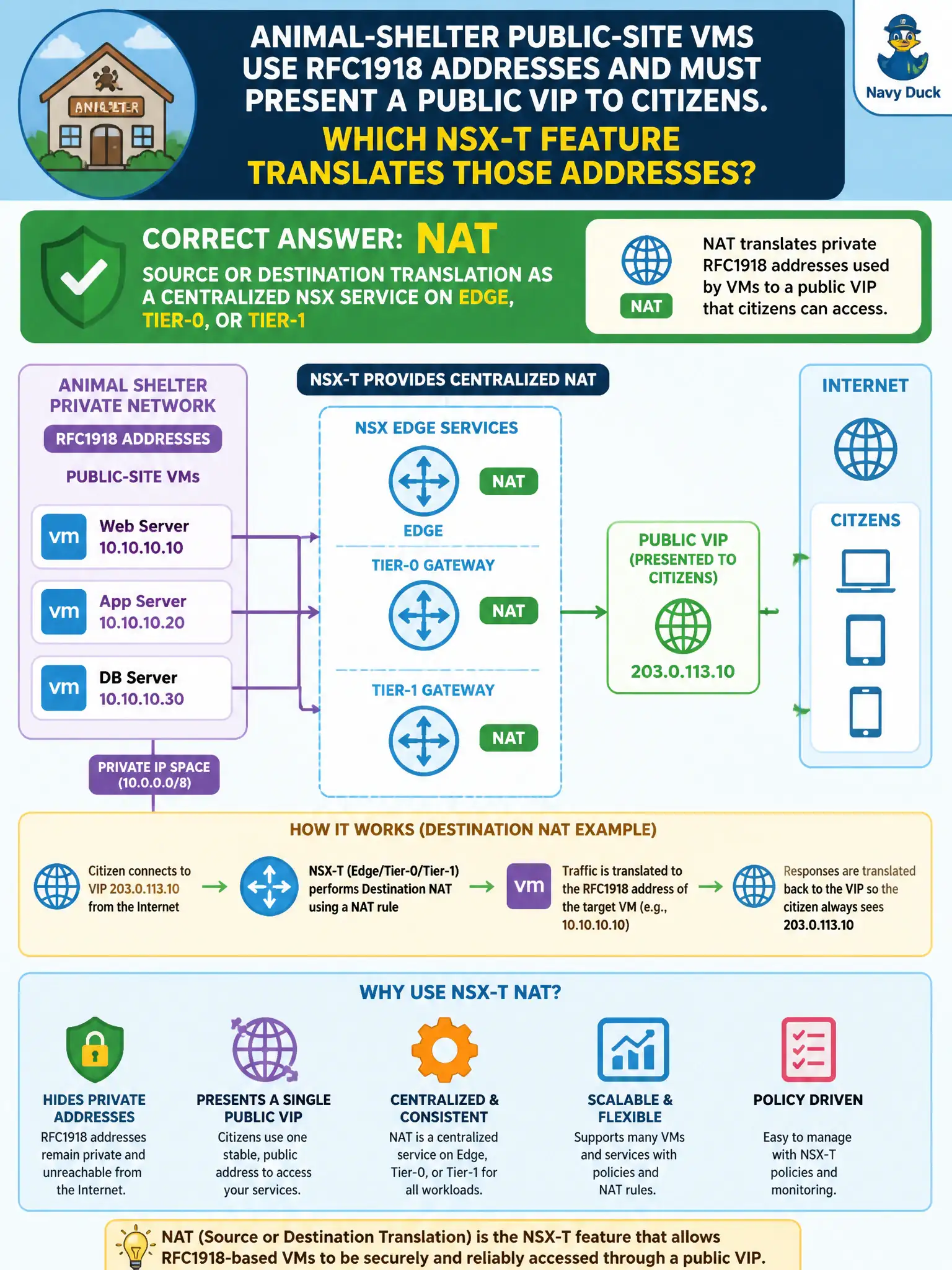
Animal-shelter public-site VMs use RFC1918 addresses and must present a public VIP to citizens. Which NSX-T feature translates those addresses?
Select an answer to reveal the explanation.
Short Explanation
Private shelter addresses need a public name tag at the door. That rewrite is NAT on an Edge or gateway, not a transport zone, a snapshot, or Horizon Client.
Full Explanation
NSX-T NAT performs source or destination translation so animal-shelter public-site VMs using RFC1918 addresses can present a public VIP to citizens. It is a centralized service typically realized on an Edge with a Tier-0 or Tier-1—the public name tag at the door for private addresses. Transport zones define span; they do not rewrite IP headers. vSphere snapshots capture VM state and do not publish a VIP. Horizon Client NAT is not the NSX-T feature for civic VIP translation. Exam caveat: NAT placement is centralized on Edge-backed gateways; do not look for NAT as a Distributed Firewall action or a transport-zone property. Operational check: configure destination or source NAT for the shelter VIP on the appropriate gateway, test citizen reachability to the VIP, confirm backend VMs remain on RFC1918, and reject transport zones, snapshots, and Horizon Client as the translator. Document the civic rationale in the change record so the next operator can restate why the correct control matches the agency outcome, why each distractor fails by concept, and which NSX Manager view confirms the result after publish. Document the civic rationale in the change record so the next operator can restate why the correct control matches the agency outcome, why each distractor fails by concept, and which NSX Manager view confirms the result after publish.