
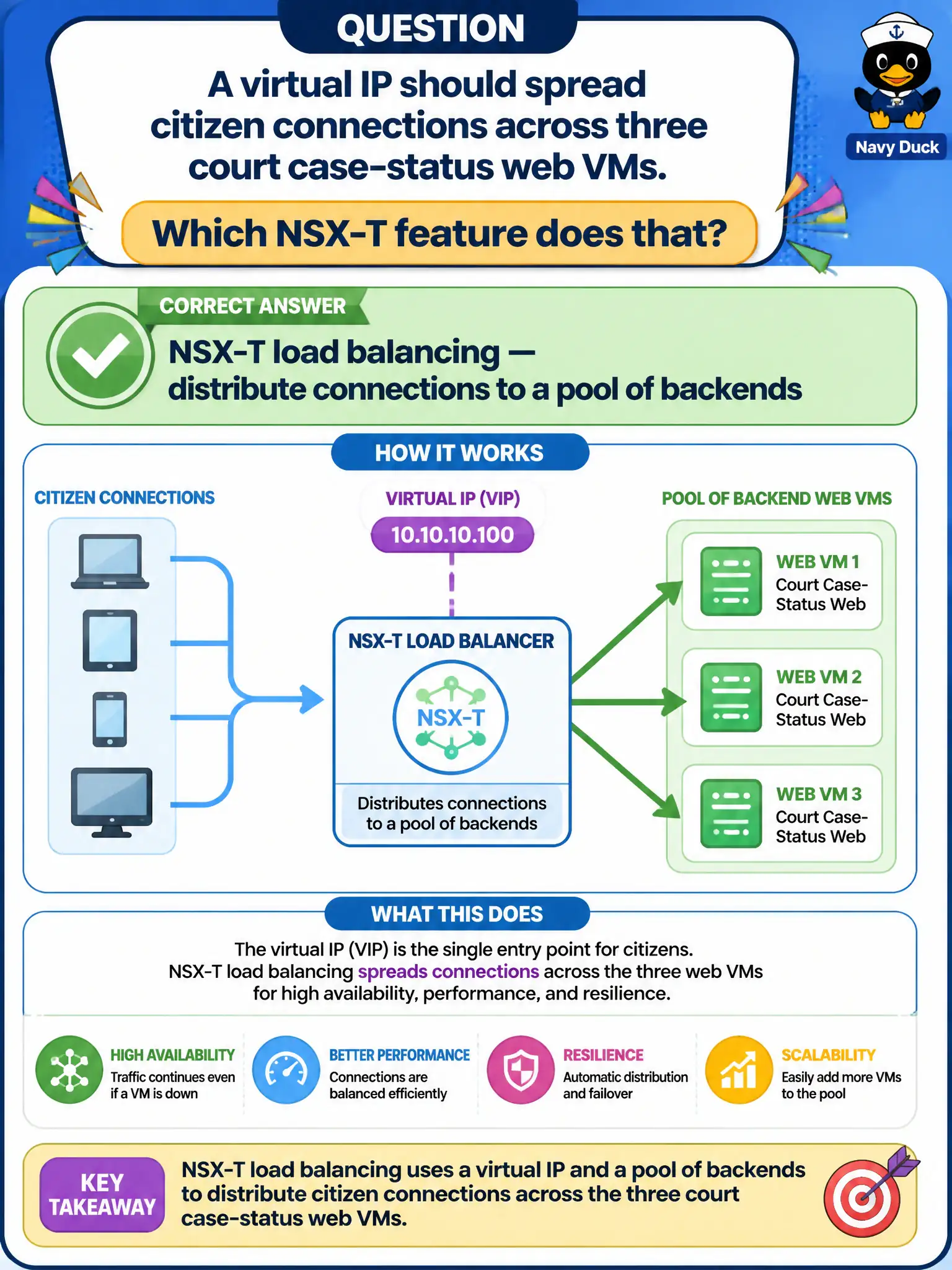
A virtual IP should spread citizen connections across three court case-status web VMs. Which NSX-T feature does that?
Select an answer to reveal the explanation.
Short Explanation
A VIP in front of three case-status servers is a load balancer, not a host-seating tool. NSX-T load balancing spreads those connections. DRS, vSAN health, and vMotion do different civic jobs.
Full Explanation
NSX-T load balancing distributes client connections that hit a virtual IP across a pool of backend virtual machines, which is how three court case-status web VMs share one citizen-facing VIP. A VIP in front of three clerks is a load balancer, not a host-seating tool. Advanced ADC use cases can also map to NSX Advanced Load Balancer, but this item names the NSX-T load-balancing feature. vSphere DRS places VMs on hosts; it does not terminate a VIP. vSAN health reports storage. vMotion migrates a running guest; it does not distribute connections. Exam caveat: do not confuse compute placement (DRS) with connection distribution (load balancing). Operational check: create a virtual server and pool under Networking Load Balancing, send test connections to the VIP, confirm distribution across the three backends, and verify DRS, vSAN health, and vMotion were not used as the VIP feature. Document the civic rationale in the change record so the next operator can restate why the correct control matches the agency outcome, why each distractor fails by concept, and which NSX Manager view confirms the result after publish. Document the civic rationale in the change record so the next operator can restate why the correct control matches the agency outcome, why each distractor fails by concept, and which NSX Manager view confirms the result after publish.