
Utility-billing needs NAT and a site-to-site VPN that are not distributed to every hypervisor. Which component's role is those centralized services?
Select an answer to reveal the explanation.
Short Explanation
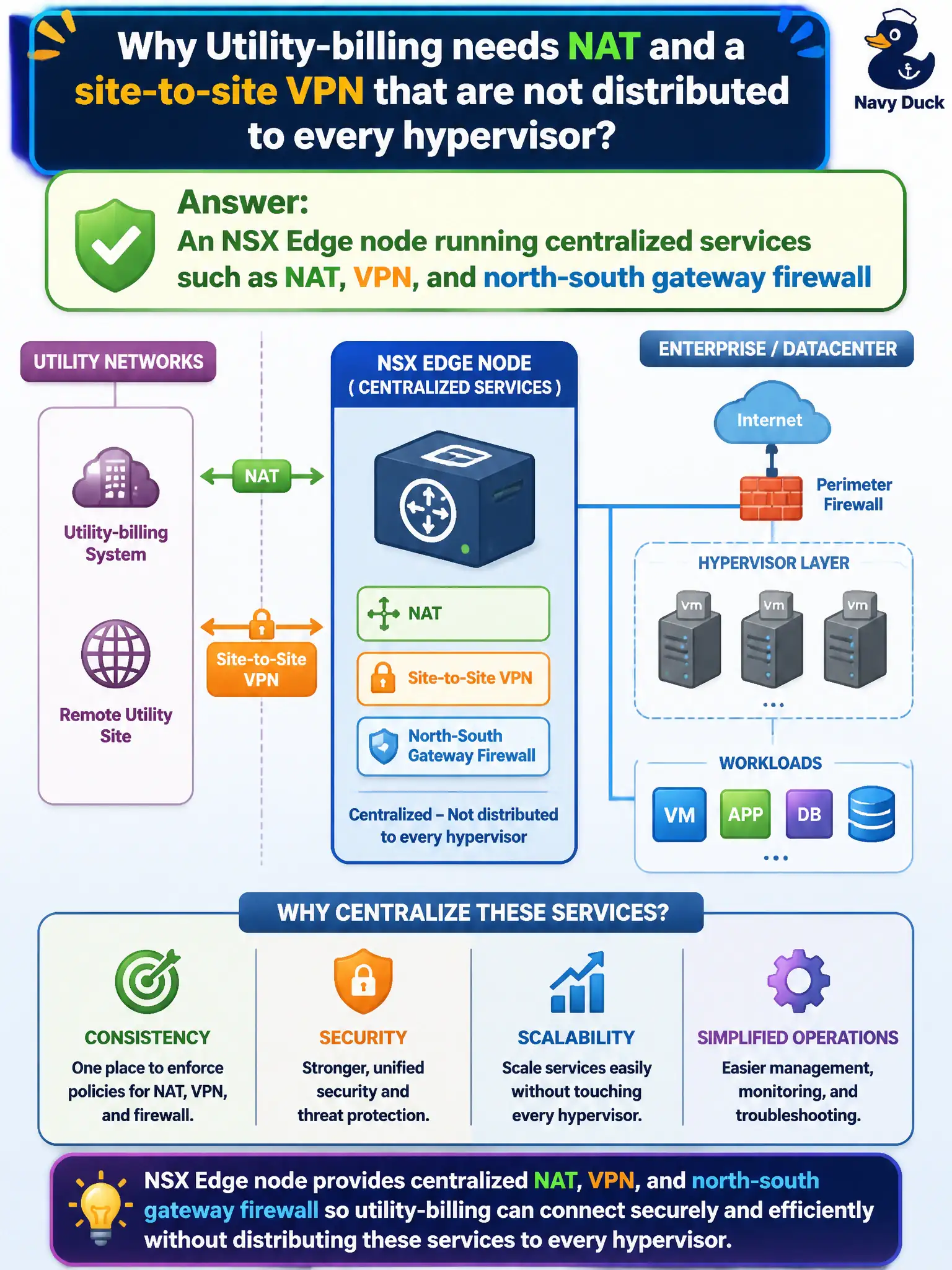
Some civic jobs stay at the edge booth: NAT, VPN, and the north-south gateway firewall. That booth is an NSX Edge, not a port group, a vSAN witness, or Instant Clone.
Full Explanation
NSX Edge nodes run centralized services that are not distributed to every hypervisor, including NAT, VPN, load balancing, and north-south gateway firewall. Utility-billing needs NAT and a site-to-site VPN that stay at the edge booth rather than installing on every ESXi host, and that booth is an NSX Edge. A standard vSphere port group is a compute-network attachment for VMs; it is not the engine for those centralized services. A vSAN witness appliance supports stretched-cluster storage quorum and does not terminate civic NAT or VPN. Horizon Instant Clone provisions desktops quickly and is out of this exam's product role for centralized NSX services. Exam caveat: associate items contrast distributed host services (such as DFW) with centralized Edge services (such as NAT and VPN)—name the Edge when the stem says the service is not distributed to every hypervisor. Operational check: confirm utility-billing NAT and VPN sessions are configured on Edge-backed Tier-0 or Tier-1 services, verify host transport nodes are not expected to terminate those sessions, and keep port groups, vSAN witnesses, and Instant Clone out of the services path. Keep the civic framing visible in runbooks so the next operator can restate why the correct control fits the agency outcome, why each distractor fails by concept, and which Manager or fabric view proves the design after change.