
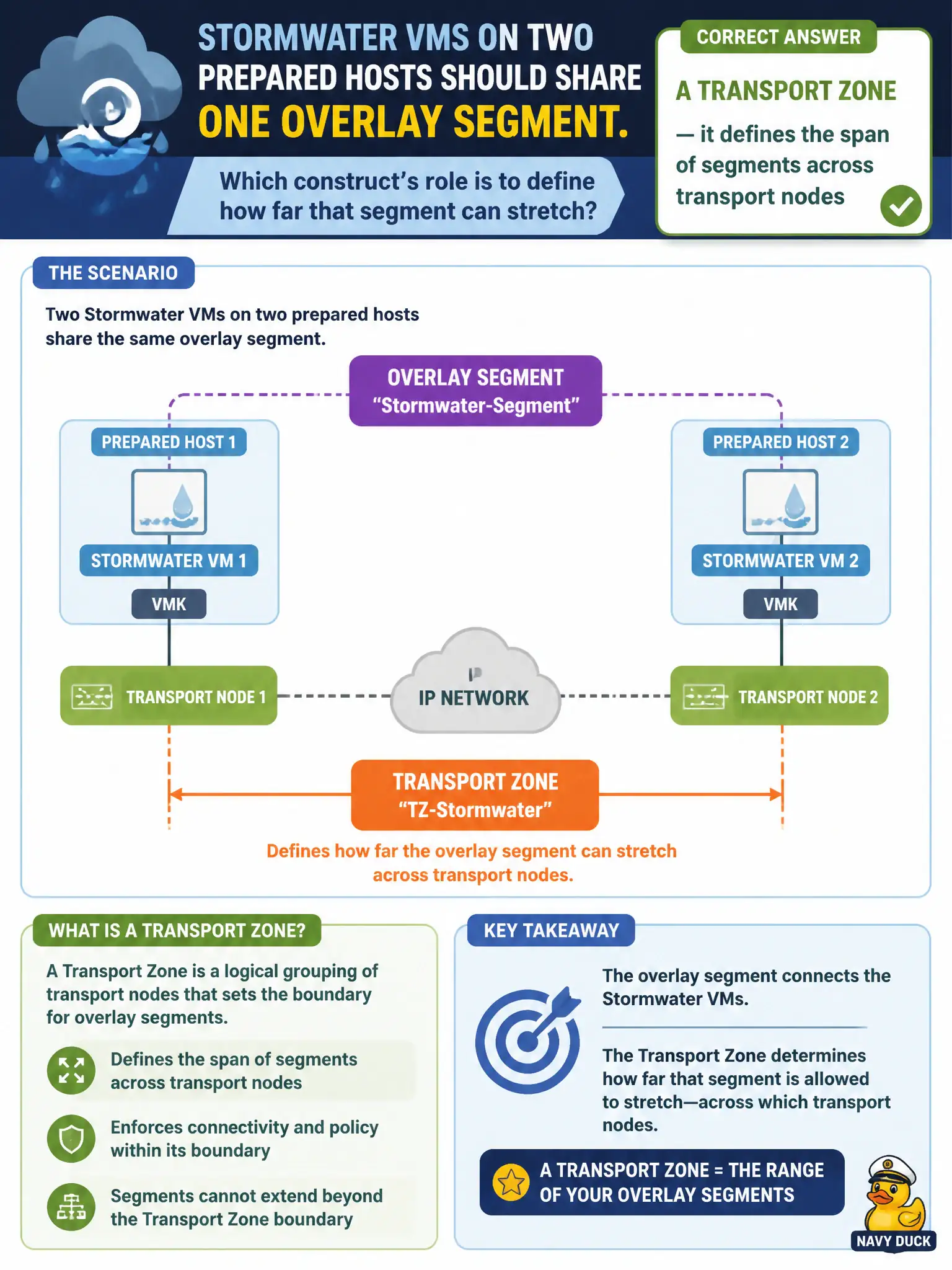
Stormwater VMs on two prepared hosts should share one overlay segment. Which construct's role is to define how far that segment can stretch?
Select an answer to reveal the explanation.
Short Explanation
A transport zone is the city-limit sign for a segment: only hosts inside that zone can carry it. Content libraries, storage policies, and desktop pools do not draw that network map.
Full Explanation
A transport zone defines the span of segments across transport nodes, which is the construct that decides how far stormwater VMs on two prepared hosts may share one overlay segment. Only hosts and Edges inside that zone can attach to the segment—like a city-limit sign for the virtual hallway. A vCenter content library stores images and templates; it does not draw NSX segment span across clusters. A vSAN storage policy governs disk placement and availability; it is not a Layer-2 boundary for overlay segments. A Horizon desktop pool is an EUC inventory object for publishing desktops and does not define how far an NSX segment stretches. Exam caveat: transport-zone type still matters—overlay zones back Geneve segments and VLAN zones back VLAN-backed segments—but the exam ask here is the span construct itself, not the encapsulation recipe. Operational check: confirm both stormwater hosts are transport nodes in the same overlay transport zone, attach test VMs to the shared segment on each host, and verify a host left outside the zone cannot attach that segment in inventory. Keep the civic framing visible in runbooks so the next operator can restate why the correct control fits the agency outcome, why each distractor fails by concept, and which Manager or fabric view proves the design after change.