
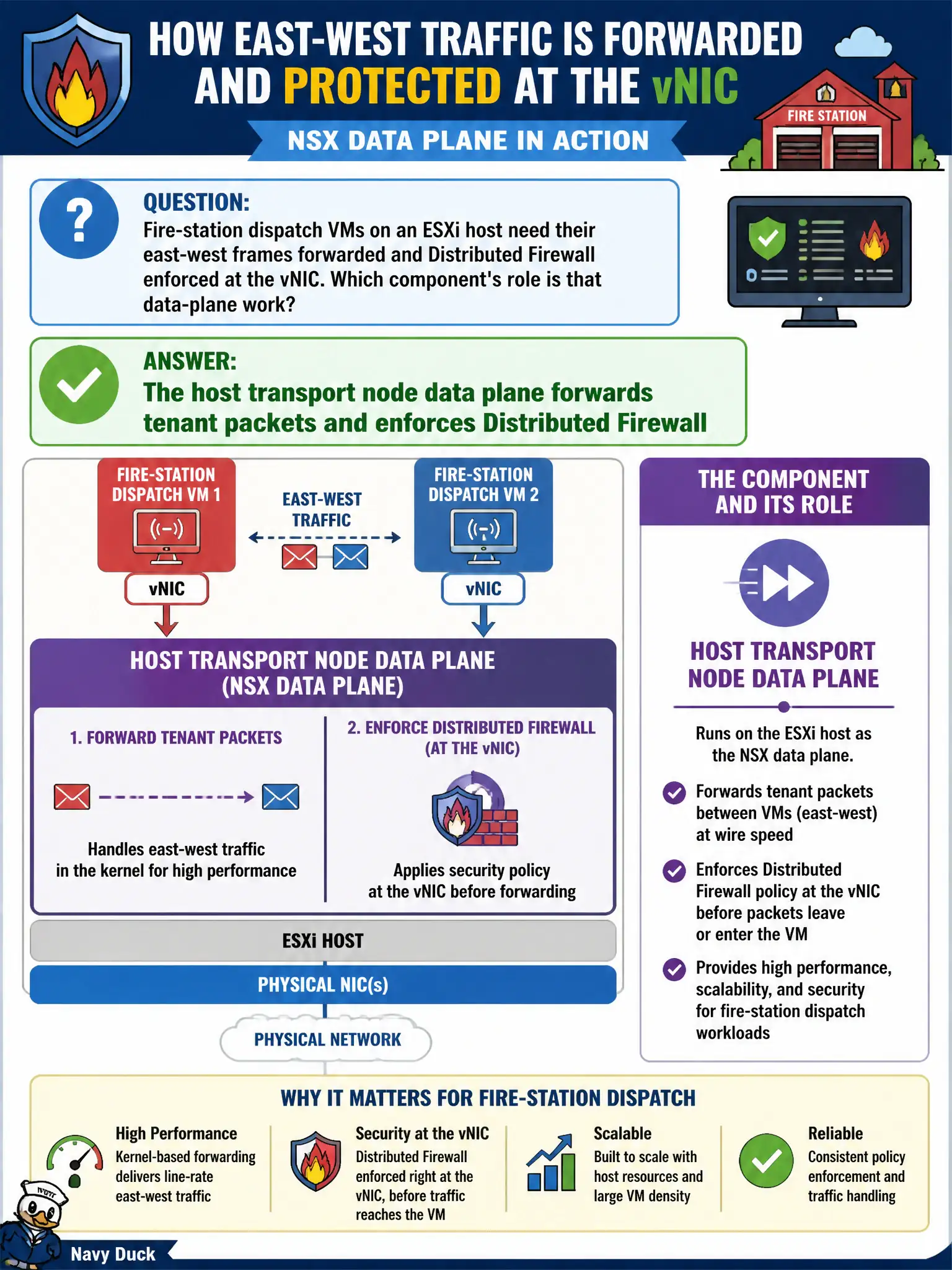
Fire-station dispatch VMs on an ESXi host need their east-west frames forwarded and Distributed Firewall enforced at the vNIC. Which component's role is that data-plane work?
Select an answer to reveal the explanation.
Short Explanation
The prepared host is the intersection cop: it forwards the dispatch VMs' packets and checks the Distributed Firewall at the vNIC. Manager writes the policy; it does not become every production switch. vCenter HA and Horizon Client are not that data plane.
Full Explanation
A host transport node's data plane forwards tenant packets and enforces distributed services such as overlay switching, distributed routing, and Distributed Firewall at the vNIC. For fire-station dispatch VMs, that prepared host is the intersection cop: it forwards frames and checks DFW locally so east-west policy stays with the workload. NSX Manager programs desired state on the management and central control planes; it does not switch every production frame on behalf of those VMs. vCenter HA restarts VMs after host failure and is not the per-vNIC firewall. Horizon Client is an EUC endpoint application and does not enforce Distributed Firewall on the hypervisor data plane. Exam caveat: distinguish management and control (Manager) from data plane (transport node)—policy is authored centrally, but east-west enforcement for these dispatch VMs is realized on the host. Operational check: generate east-west traffic between dispatch VMs, confirm DFW hits and forwarding on the host transport node, and ensure Manager CPU graphs or Horizon Client logs are not mistaken for the data-plane enforcement point. Keep the civic framing visible in runbooks so the next operator can restate why the correct control fits the agency outcome, why each distractor fails by concept, and which Manager or fabric view proves the design after change.