
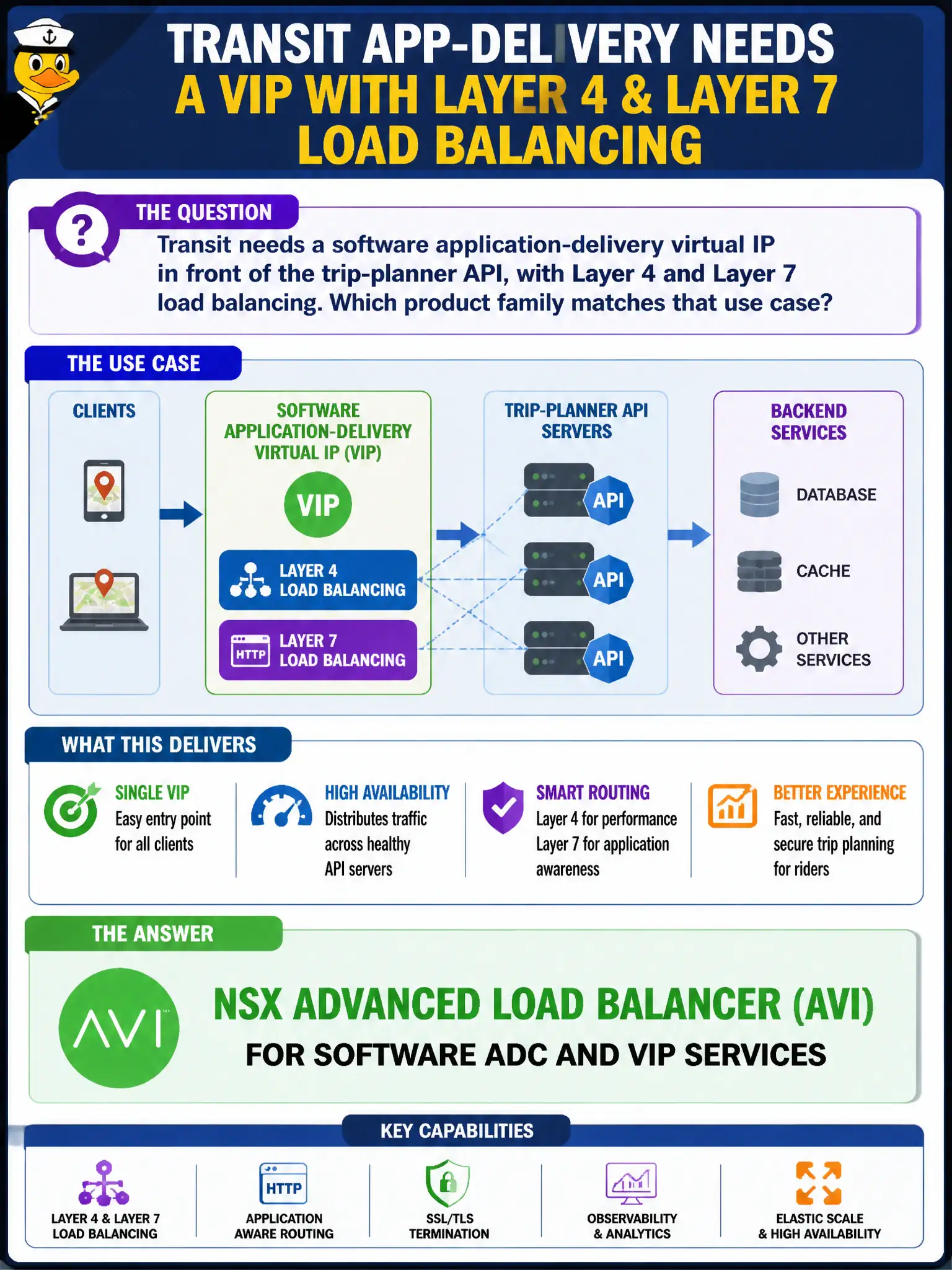
Transit needs a software application-delivery virtual IP in front of the trip-planner API, with Layer 4 and Layer 7 load balancing. Which product family matches that use case?
Select an answer to reveal the explanation.
Short Explanation
A VIP in front of the trip-planner API is an application load balancer, and the exam-guide name for the advanced ADC is NSX Advanced Load Balancer. DRS only seats VMs on hosts. vSAN stores disks, and a content library stores images.
Full Explanation
Transit needing a software application-delivery virtual IP in front of the trip-planner API, with Layer 4 and Layer 7 load balancing, matches the NSX Advanced Load Balancer (Avi) product family for software ADC and VIP services. A VIP in front of the trip-planner API is an application load balancer; the exam-guide advanced ADC name is NSX Advanced Load Balancer. vSphere Distributed Resource Scheduler only seats VMs on hosts based on CPU and memory; it does not terminate a client VIP and spray HTTP to API backends. vSAN stretched clusters provide storage resilience across sites; they are not an application ADC. vCenter content libraries store templates and ISOs; they do not load-balance API connections or perform health checks on trip-planner pools. Exam caveat: NSX also has older or native load-balancing discussions on Edges in some materials, but when the stem emphasizes software ADC VIP with L4/L7, Avi/NSX ALB is the intended product-family identification. DRS remains a different “load” word that tricks candidates. Operational check: deploy or identify an NSX ALB (Avi) virtual service VIP in front of trip-planner backends, verify L4/L7 pools and health monitors, and confirm DRS, vSAN, and content library were not used as substitutes in the transit architecture review.