
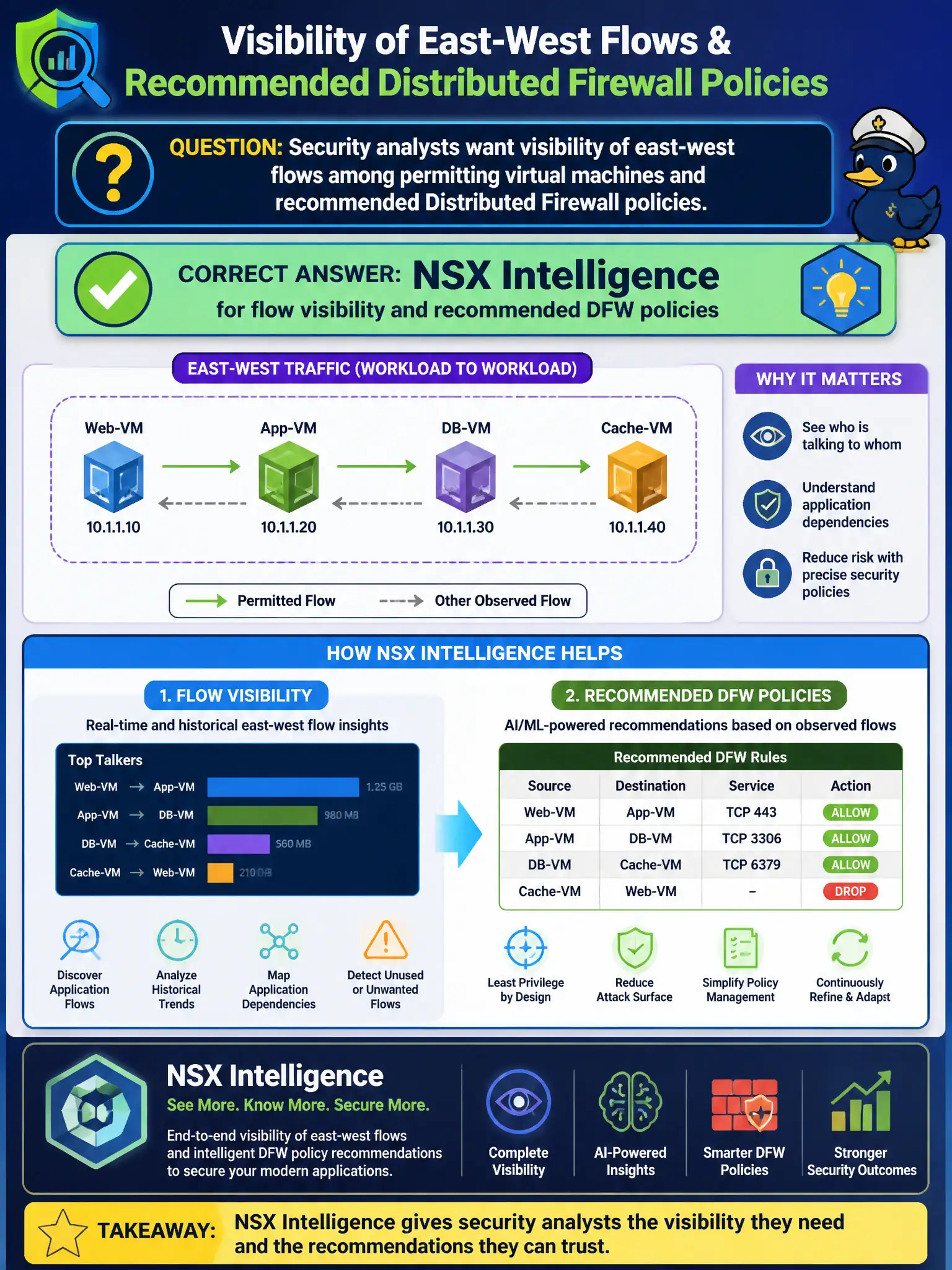
Security analysts want visibility of east-west flows among permitting virtual machines and recommended Distributed Firewall policies. Which product supports that use case?
Select an answer to reveal the explanation.
Short Explanation
Intelligence is the civic traffic camera on the overlay: it shows who talked to whom and drafts a first-pass allow list. vCenter CPU alarms and Horizon logon stats do not write Distributed Firewall. vSAN health only watches disks.
Full Explanation
Security analysts who want visibility of east-west flows among permitting virtual machines and recommended Distributed Firewall policies need NSX Intelligence for flow visibility and recommended DFW policies. Intelligence is the civic traffic camera on the overlay: it shows who talked to whom and drafts a first-pass allow list for micro-segmentation. vCenter alarms on host CPU ready time monitor compute performance contention, not east-west flow recommendations for DFW. Horizon session metrics for desktop logons measure EUC sessions, not overlay micro-segmentation policy drafts. The vSAN health service reports storage cluster health; it does not write Distributed Firewall recommendations. Exam caveat: Intelligence complements NSX-T; it does not replace the need for NSX or for human review of recommended rules before production enforcement. Associate depth is matching the visibility-and-recommended-DFW use case to Intelligence rather than to compute, EUC, or storage monitoring tools. Operational check: enable or open NSX Intelligence views for permitting segments, review recommended allow rules against known application dependencies, and promote carefully into Distributed Firewall sections—without expecting vCenter CPU alarms, Horizon logon stats, or vSAN health to produce those policies.