
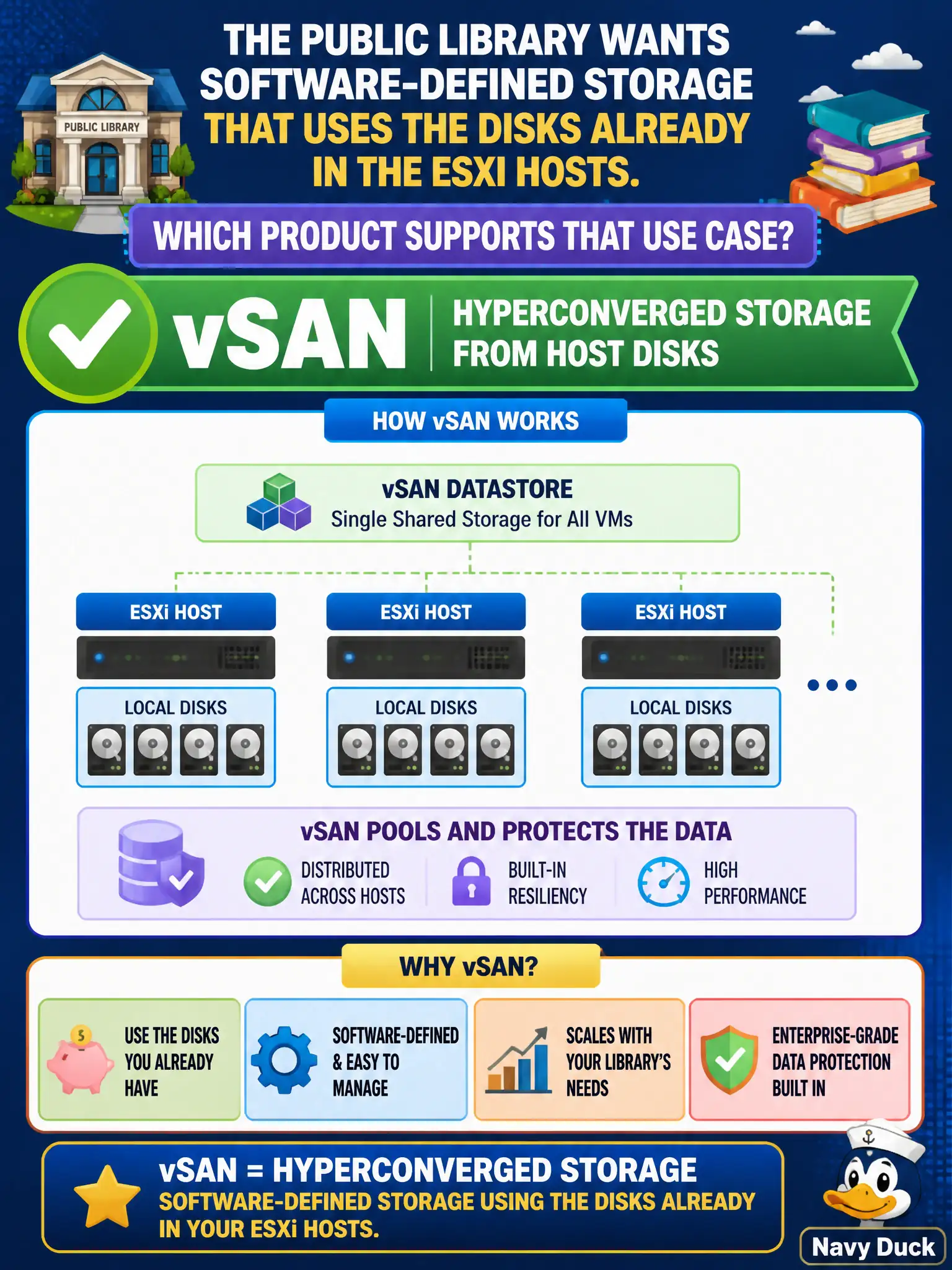
The public library wants software-defined storage that uses the disks already in the ESXi hosts. Which product supports that use case?
Select an answer to reveal the explanation.
Short Explanation
vSAN turns the disks in the library hosts into a shared datastore. NSX moves packets, Horizon clones desktops, and Avi load-balances applications. None of those is a hyperconverged storage product.
Full Explanation
The public library that wants software-defined storage using the disks already in the ESXi hosts needs vSAN—hyperconverged storage from host disks. vSAN turns those library host disks into a shared datastore for catalog and other VMs without requiring a separate traditional SAN purchase for that capacity pool. NSX-T overlay segments presented as a block datastore are a category error: segments are networks for Ethernet frames, not a SAN replacement that presents VMDKs. Horizon Instant Clone as a storage array is false—Instant Clone rapidly provisions desktop VMs from a golden image; it is not a storage array product and does not claim host disks into a datastore. NSX Advanced Load Balancer as a SAN controller is false—Avi load-balances applications at L4/L7; it does not pool host disks into a datastore. Exam caveat: vSAN requires a vSphere cluster and proper networking for storage traffic between nodes; needing network design for vSAN does not turn NSX or Avi into the storage product. Associate depth is product identification for the hyperconverged storage use case. Operational check: claim disks into vSAN disk groups on library hosts, mount the vSAN datastore, place a catalog VM’s disks there, verify vSAN health is green, and ensure the BOM does not list overlay segments or Instant Clone as the storage array line item.