
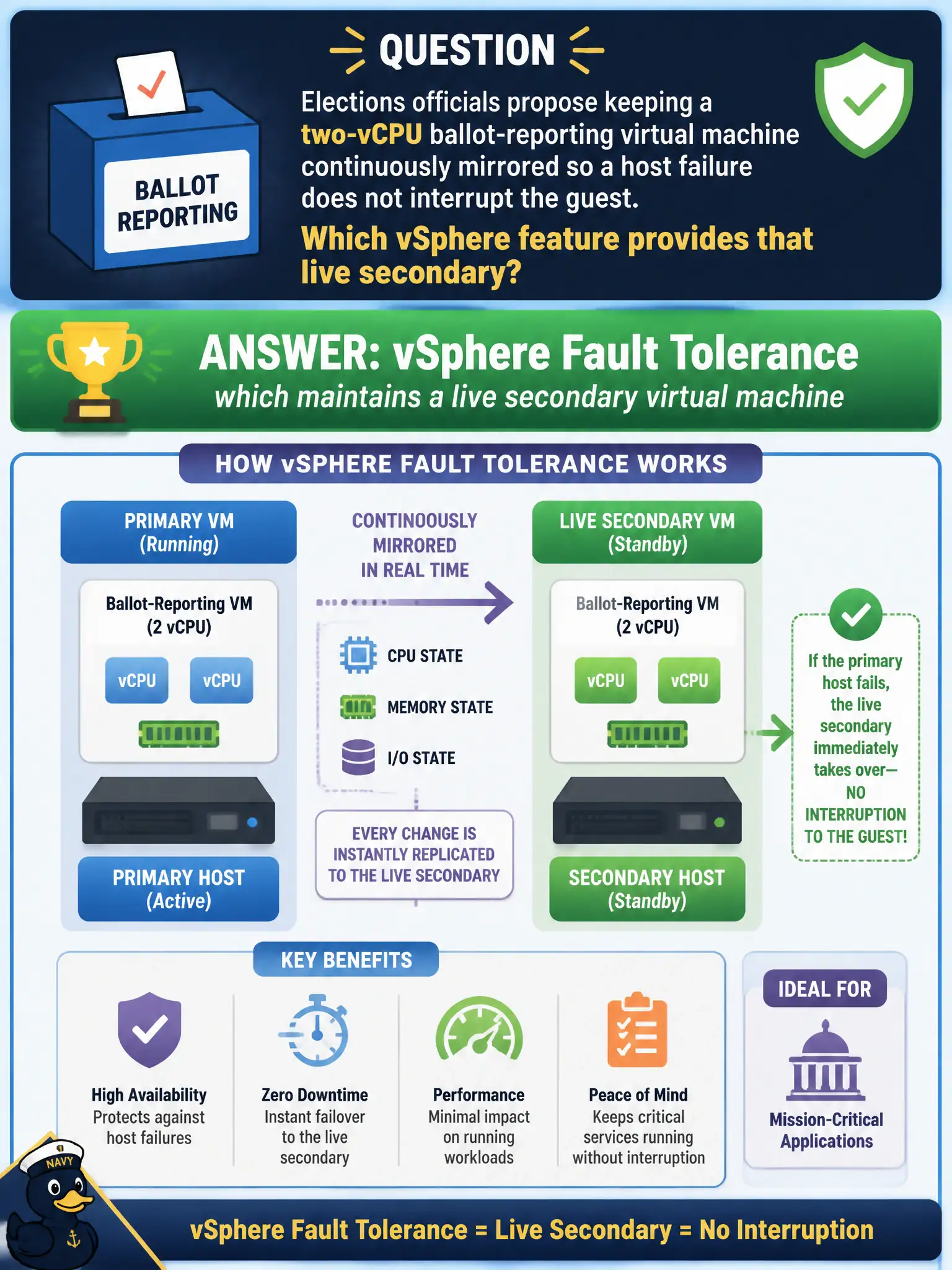
Elections officials propose keeping a two-vCPU ballot-reporting virtual machine continuously mirrored so a host failure does not interrupt the guest. Which vSphere feature provides that live secondary?
Select an answer to reveal the explanation.
Short Explanation
Fault Tolerance is a shadow copy of the ballot VM running in lockstep so a host loss does not drop the session. HA would reboot the guest after the crash. DFW only decides who may talk to whom.
Full Explanation
Elections officials who propose keeping a two-vCPU ballot-reporting virtual machine continuously mirrored so a host failure does not interrupt the guest are asking for vSphere Fault Tolerance, which maintains a live secondary virtual machine. Fault Tolerance is a shadow copy of the ballot VM running in lockstep so a host loss does not drop the reporting session on election night. NSX Distributed Firewall micro-segmentation only decides who may talk to whom; it does not mirror a running guest or preserve in-memory state across hosts. vSphere HA restart after the guest has already crashed restores service after an outage window; it is not continuous lockstep protection. An NSX Edge cluster in active/active ECMP provides resilient north-south routing paths; it does not create a live secondary of the ballot-reporting VM. Exam caveat: FT has limitations (vCPU counts and supported configurations vary by version) and higher overhead than HA; use it when zero interruption matters for a specific civic workload rather than for every VM. Operational check: enable FT on the ballot-reporting VM with a compatible secondary host, verify a secondary appears in vCenter, and contrast behavior with HA-only restart after a simulated primary host failure in a lab before election day.