
Parks-and-recreation staff describe moving a running virtual machine to a host on another IP subnet as "NSX bridging." What is the correct identification?
Select an answer to reveal the explanation.
Short Explanation
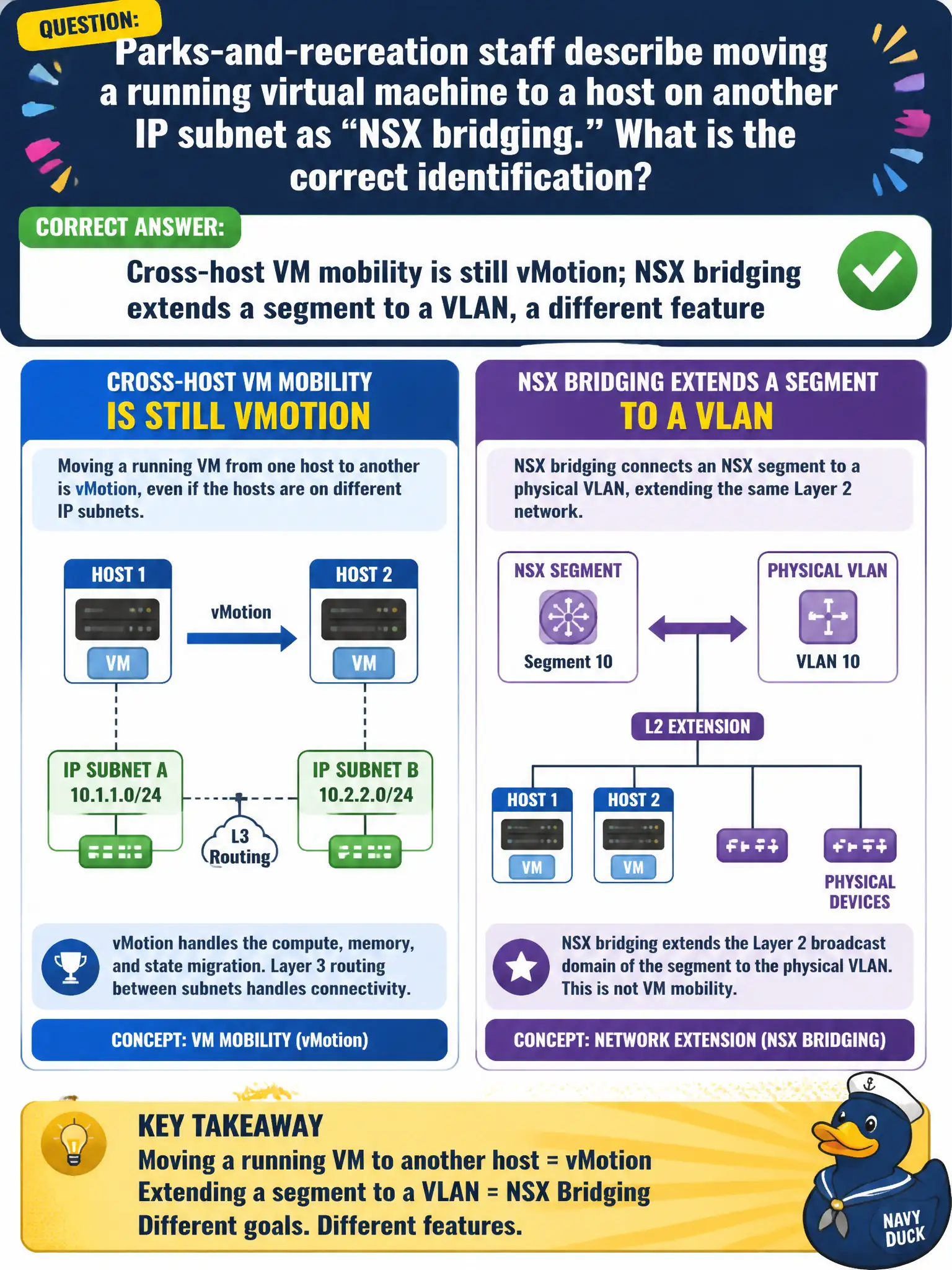
Moving the parks VM is still vMotion, even across a routed hop. Bridging is a different tool: it stitches an NSX segment to a VLAN so bare-metal and VMs share L2. Do not rename the moving van after the stitch.
Full Explanation
Parks-and-recreation staff who describe moving a running virtual machine to a host on another IP subnet as "NSX bridging" need a correction: cross-host VM mobility is still vSphere vMotion; NSX bridging extends a segment to a VLAN and is a different feature. Live migration between hosts—including when hosts sit on different IP subnets and an L3 vMotion network is in use—remains vMotion for the parks workload. Claiming NSX bridging is the vSphere feature that live-migrates VMs across Layer 3 is false; bridging stitches overlay and VLAN Layer 2 domains for endpoint connectivity, not guest migration. Geneve overlay encapsulation does not replace vMotion when the destination is on another subnet. Storage vMotion of the guest's vNIC is nonsensical—Storage vMotion moves disks, not a vNIC as a migration object. Exam caveat: municipal teams sometimes rename familiar operations with NSX vocabulary. Bridging, Geneve, and vMotion must stay conceptually separate: bridging for L2 extension to VLAN, Geneve for overlay encapsulation, vMotion for live VM mobility. Operational check: validate the L3 vMotion network between parks hosts on different management or vMotion subnets, migrate a test VM with vMotion across that boundary, confirm the guest stays up on its port group or NSX segment, and demonstrate bridging only in a lab where a VLAN-backed bare-metal endpoint must share L2 with an overlay segment—never as the migration tool.