
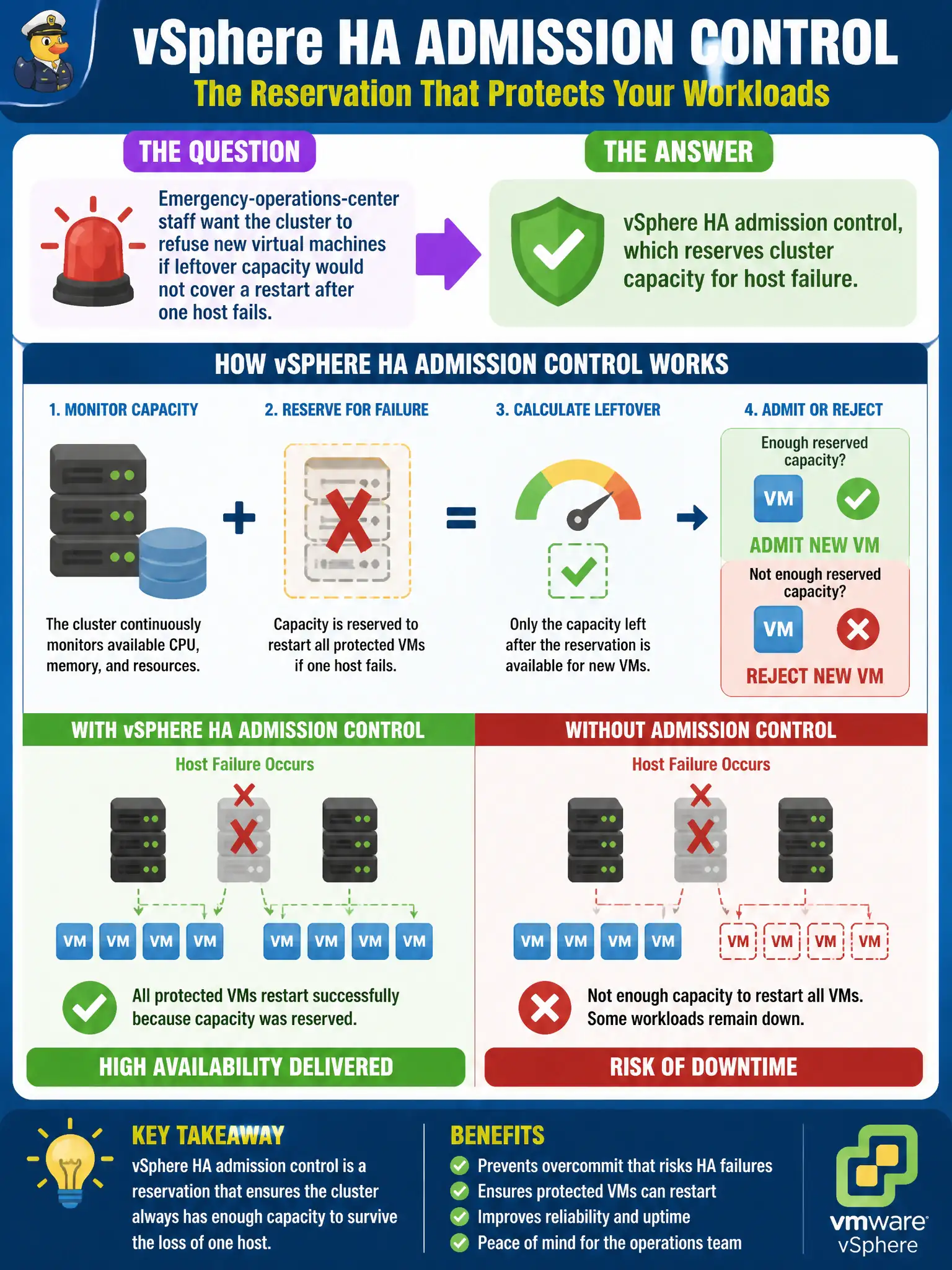
Emergency-operations-center staff want the cluster to refuse new virtual machines if leftover capacity would not cover a restart after one host fails. Which vSphere feature is that reservation?
Select an answer to reveal the explanation.
Short Explanation
Admission control is the EOC keeping an empty bunk for the night shift. If filling a new VM would steal that bunk, vSphere says no. Edge HA protects NSX services, and FT is a live twin, not a cluster-wide spare-capacity lock.
Full Explanation
Emergency-operations-center staff who want the cluster to refuse new virtual machines if leftover capacity would not cover a restart after one host fails are describing vSphere HA admission control. Admission control reserves cluster CPU and memory so remaining hosts can restart VMs after a defined host failure—keeping an empty bunk for the night shift so a new workload cannot steal the failover budget. NSX Edge active/standby high availability protects centralized NSX services on Edge nodes; it does not reserve vSphere cluster capacity for guest restart after ESXi failure. vSphere Fault Tolerance applied to every virtual machine is neither practical nor the admission-control mechanism; FT maintains live secondaries for selected VMs within limits and does not replace cluster-level capacity reservation. NSX load-balancer health monitors on the EOC VIP test application backends and remove unhealthy members; they do not gate VM power-on against host-failover capacity. Exam caveat: HA, FT, Edge HA, and load-balancer health checks are frequent distractors. "Refuse new VMs if failover capacity would be insufficient" is specifically admission control language. Operational check: on the EOC cluster, open HA settings, confirm admission control is enabled with the intended host-failure or resource policy, attempt a test power-on that should be blocked when capacity is tight (in a lab), and document Edge HA and VIP monitors as separate resiliency controls for network services and the portal, not as substitutes for admission control.