
City staff use "load balancer" and "Distributed Resource Scheduler" as if they were the same tool for the permitting portal. What is the correct distinction?
Select an answer to reveal the explanation.
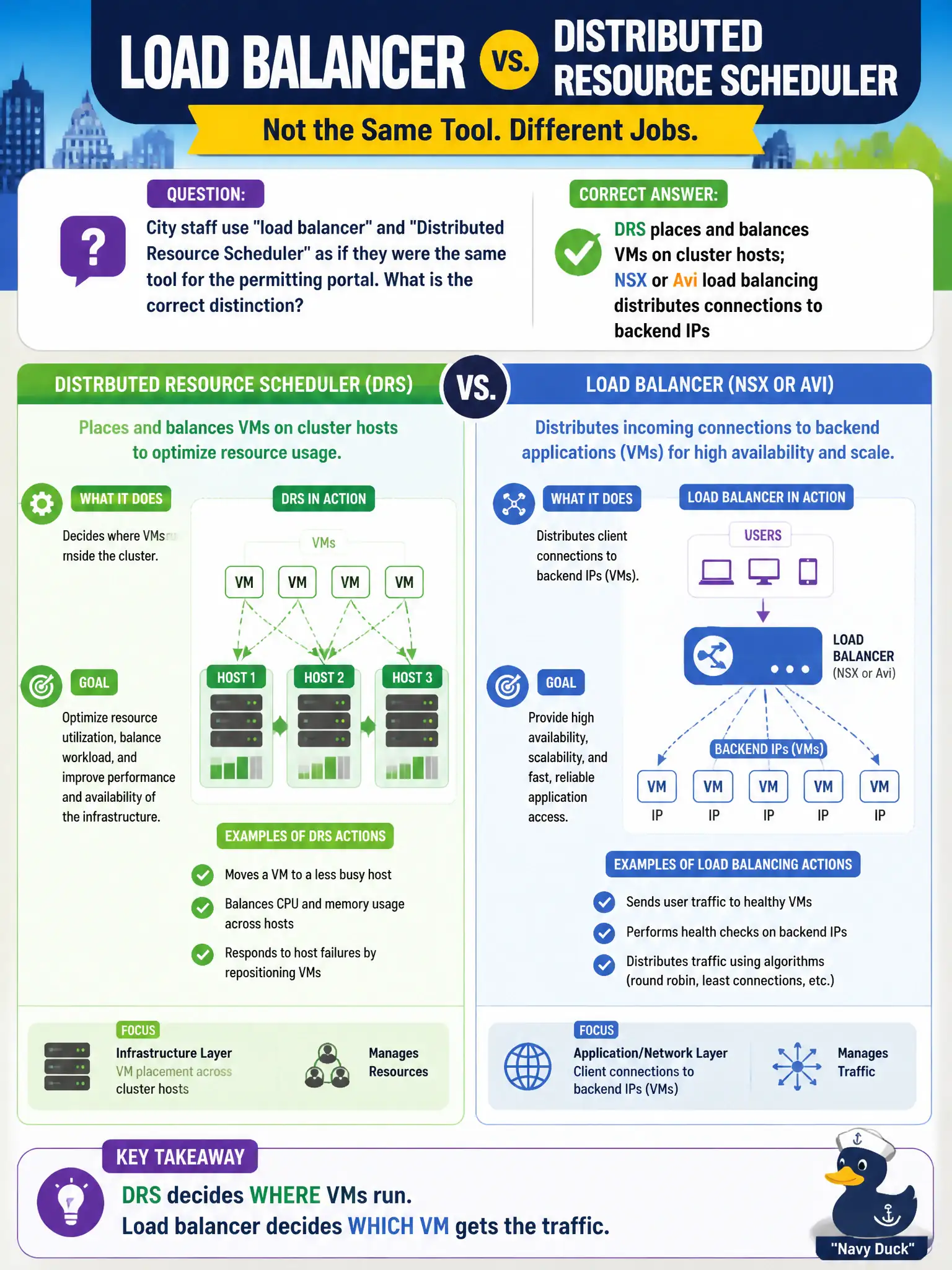
Short Explanation
DRS seats the VMs on hosts, while a load balancer seats client sessions on application IPs. Mixing those names is like calling a parking attendant a ticket window. One balances compute; the other balances connections.
Full Explanation
City staff who use “load balancer” and “Distributed Resource Scheduler” as if they were the same tool for the permitting portal need the correct distinction: DRS places and balances VMs on cluster hosts; NSX or Avi load balancing distributes connections to backend IPs. Mixing those names is like calling a parking attendant a ticket window—one balances compute placement with vMotion, the other balances client sessions to application endpoints. Claiming DRS distributes HTTP connections to backend IP addresses while NSX load balancing places VMs on hosts reverses the definitions and sends operators to the wrong console. Claiming both names describe the same vSphere object with two marketing labels is false. Claiming DRS is an NSX-T gateway firewall profile used on Tier-0 confuses compute scheduling with firewall profiles. Exam caveat: many municipal portals need both DRS (healthy host placement) and a load balancer (VIP and health monitors). Associate exams punish synonym confusion more than deep algorithm knowledge. Operational check: show staff the DRS cluster settings versus the NSX/Avi virtual service VIP; demonstrate a vMotion-based rebalance versus a connection spray to backend pool members as two different operations with two different success criteria.